Read this article in 中文 Français Deutsch Italiano Português Español
Atlas Copco enters the hybrid gen set market

01 April 2026
At the launch event in Zaragoza, Spain, Julian Buckley took the opportunity to get more information about development of the new Integrated Hybrid gen sets
 Atlas Copco plant near Zaragoza, Spain (Photo: All photos from KHL Group)
Atlas Copco has a long history producing air compressor systems for a wide variety of industries. Having had the opportunity to visit more than 100 vehicle manufacturing plants around the world on behalf of another magazine title, it became commonplace to see Atlas Copco systems delivering compressed air for tooling on the assembly line (amongst other applications).
But compressed air systems are only a part of the company portfolio. Atlas Copco has been producing generator sets for more than 30 years; the first of these had its market debut in 1994.
Moving forward to the present day, a brand new Atlas Copco gen set series was unveiled in March this year. As the name suggests, the Integrated Hybrid range features a diesel engine supplied by FPT Industrial, but also a 60 kWh lithium-ion phosphate battery pack. The reasoning behind the combined power solution is that gen set engines often operate at below peak efficiency, a situation which can be addressed by using stored energy in the battery pack.
The combined solution helps to reduce fuel consumption and related engine emissions. But there’s more. Because the engine only runs at or near peak efficiency there is a reduced volume of carbon deposits and other possible damage, which in turn means more time between engine service intervals. By getting the most from the fuel and extending servicing timeframes, the new gen sets offer a reduced cost of ownership model.
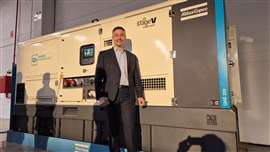 Marco Gravina with Integrated Hybrid gen set
At the launch of the new Integrated Hybrid models, Power Progress spoke with Marco Gravina, managing director of the Portable Power and Flow division of Atlas Copco responsible for developing the new gen sets, together with Sergio Salvador, Marketing and Sales director, to find out more about the new range.
Tech development
First up, the decision to use engines from FPT Industrial. “They have an extended history developing machines which use hybrid powertrains,” explains Gravina. “So they know the application type and that helped a lot with development of the new hybrid gen sets.
“There are actually two engine models, one for the 120 kVA model (QHS 120 S5) and another for the 200 kVA version (QHS 200 S5). We know these engines very well, they feature on our standard Stage 5-compliant generators. That project involved a lot of improvement work, for efficiency and quality in operation such as vibration reduction; we have a lot of confidence in their products.”
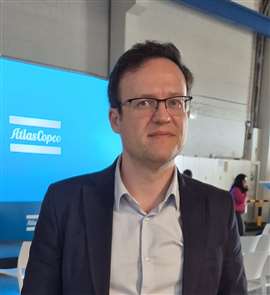 Sergio Salvador, Atlas Copco
While FPT brings market experience to the table, Atlas Copco leveraged its own internal expertise in electrification to support development of the Integrated Hybrid series. Gravina says that the company introduced its first battery electric storage system (BESS) in 2019 and knowledge gained from this exercise features across the new gen sets.
“It looks like the hybrid systems are new to us,” says Salvador. “But we have already been combining generators and battery packs. Not under the same canopy, but on a trailer or similar. These systems have been on the market for a couple of years.”
Application types
Delivering high-quality power with lower emissions is the overarching ethos of the new gen set range. This makes them suitable for series of application types, including prime power delivery, machine recharging or supplying an on-site microgrid.
One specific application type, though, is tower cranes. Compared to most other equipment, these have an easily identifiable power usage profile which combines periods of low draw with short but very high peaks.
Using an engine to deliver power over the low-draw periods is highly inefficient – at the launch event, Atlas Copco put forward that average load on a gen set in this application type is about 15% of nominal. To improve efficiency, the new hybrid generator can disengage the engine to deliver only stored energy from the battery pack.
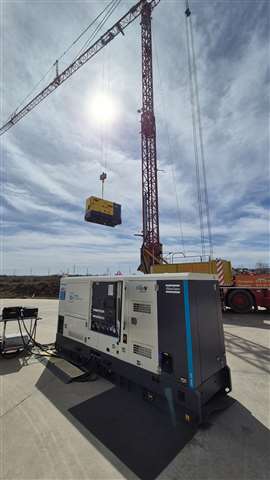 Crane demo showed how gen sets can split power delivery based on load
“Our power solutions have been used across thousands of machines, so we know the load profiles,” says Gravina. “Many of these involve cranes, so we have extensive knowledge of how they work on a construction site. From that, we selected what we consider to be the ideal elements: the engine, the battery pack and the power electronics.”
To further support this, the 60 kWh li-ion phosphate battery packs have 2C capability. This means they can effectively double their output to 120 kVA, while also supporting a higher and faster recharging rate.
“But what’s really important is being able to deliver peak power on demand,” says Gravina. “That’s in combination with almost silent power delivery from battery-only output, which can support low-noise projects or third-shift operations.”
Weight considerations
The new gen sets are heavier than equivalents using only a diesel engine, largely due to the battery pack. But Gravina says that the increase hasn’t impacted portability and standard vehicles can be used to move the units.
“The 200 kVA model is equivalent in size to others on the market. It’s a little heavier, but the size is comparable,” he points out.
Salvador: “We also had to take into account physical balancing. The engine is one side, the battery pack on the other, but the weight of a full fuel tank has also been taken into consideration. This helps to make lifting the unit a little easier.”
Internal cables have also added weight. Salvador notes that this is one of the reasons it took two years to deliver this final market-ready solution. “The connections between the engine and battery pack have been made as streamlined as possible. But all the cables, together with the operating system, are located in the central portion of the unit, which helps with balancing during a lift.”
Control system
The ECO Controller system is used to operate the gen set, including overall power output. Dependent on draw, it can take power from either the engine or battery, or combine output from both. In the case of the QHS 120 S5, the control system delivers peak 120 kVA output using engine and battery power.
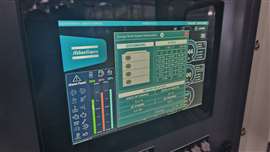 GUI interface for ECO Controller and other functions
ECO Controller has been designed for ease of use. During a demonstration of the new models, it’s put forward that only minimal operator training is required to get the gen set up and running.
The system has some noteworthy features. These include a battery state of health check to provide insight into how the battery is performing, which can improve efficiency and overall longevity. Due to the li-ion phosphate chemistry, the batteries are rated for around 6,000 charge/discharge cycles. If fully recharged twice each day, that equates to a near 10-year lifespan.
Developed internally by Atlas Copco, both the ECO Controller and the Integrated Hybrid gen sets have undergone extensive testing. Gravina: “We have carried out some simulated tests, but there has been more physical testing, both here [at our facility] and in the field. The standard company test is 1,000 hours of continuous operation, possibly more for products intended for special applications – if something is going to happen, it will be within that timeframe.”
On top of this there is the FleetLink telematics system, which can help to optimize individual and fleet performance. Including a remote access feature, the system supports both functionality and efficiency.
“[FleetLink] data is available to the customer,” reports Gravina. “It’s an analysis tool. We can produce customer reports to highlight where improvements in operation can be made, offer recommendations for fine tuning the machines.”
Assembly and more
The gen sets are all assembled at the Portable Power and Flow division headquarters, located outside Zaragoza, Spain. The chassis elements and canopies for the units are delivered by a third-party supplier which has its production base in close proximity to the assembly site.
The units are air cooled, using a system which is incorporated within the canopy. “The gen sets are mobile,” says Salvador. “Because of this, they need a reliable and portable cooling system that’s integrated into the unit. It’s designed to be robust, to manage difficult conditions. We could have added a liquid cooling system for the battery pack, but the fewer items there are, the less chance of anything going wrong.”
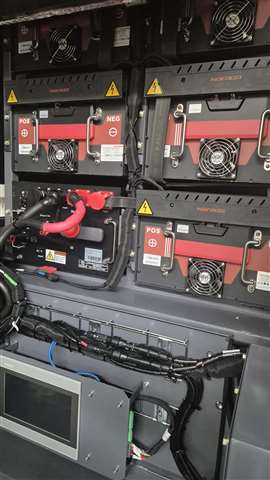 Battery packs are supplied by Zhejiang Narada Power Source
Atlas Copco has targeted making sustainable solutions, such as the Integrated Hybrid gen set range, 50% of its total revenue by the close of 2027. “In Europe, we’re already at 40% of that target,” says Gravina. “In some regions of the US we’re already over that figure.”
To support the sustainability credentials of the new gen sets, Atlas Copco put forward that if the estimated 200,000 existing 200 kVA or lower gen sets now in operation across Europe were replaced by hybrid variants, it could save around 3.2 billion liters of diesel fuel each year.
Asked whether fuel consumption is the only measure of sustainability, Gravina smiled – it was apparent he had heard the question before. “Clearly it’s not only fuel. Sustainability also relates to elimination of power supply interruption, the cost of repairs, the extended generator lifetime. All of these and more add up to overall sustainability.”
POWER SOURCING GUIDE

The trusted reference and buyer’s guide for 83 years
The original “desktop search engine,” guiding nearly 10,000 users in more than 90 countries it is the primary reference for specifications and details on all the components that go into engine systems.
Visit Now
STAY CONNECTED



Receive the information you need when you need it through our world-leading magazines, newsletters and daily briefings.
CONNECT WITH THE TEAM