Are backup generators key to support the grid?

14 August 2026
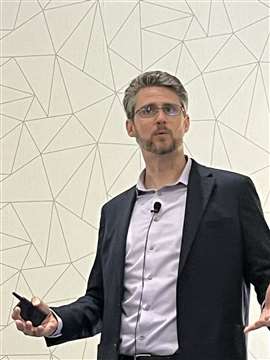 Cummins’ Michael Sanford speaking at Off-Highway & Power Generation USA 2026. (Photo: Becky Schultz)
Michael Sanford (who is now with Integra), wore many hats at Cummins – business development manager, energy policy leader, senior sales application engineer, and a myriad of others, he noted as he began his presentation at Off-Highway & Power Generation USA 2026, hosted by Emissions Analytics. These varied roles make him uniquely qualified to discuss power generation as it relates to protecting grid reliability – particularly in North America, the global hotbed of data center development.
For those who question whether the data center boom is real, Sanford points to the top four hyperscalers globally – Microsoft, Google, Amazon and Meta – who are expected to invest $432 billion in the market in 2026, a 33% shift from the previous year.
“That is an immense amount of growth in a market that was already growing rapidly,” he noted. “My counterparts that are also in the data center business, and any other business that serves the space, know that we were all predicting a boom, or were all happily riding the growth in the data center market.” But this, he said, “was truly unexpected, and continues to be.”
Then there’s the coming boom in agentic AI data centers – facilities that support autonomous AI systems designed to make decisions and take actions with minimal human supervision. “This is the next wave of growth in this space,” Sanford predicted. “We’re expecting a 14,000% increase in growth in agentic AI from now through 2030.
“I give you this context to say this is not a bubble about to burst,” he continued. “This is very real, and we do expect to see continued growth in this space.”
Fed eyes backup power
With the amount of power being drawn by these facilities vastly outweighing the growth in centralized power generation infrastructure, data center developers – eager to ensure sufficient energy is available at all times – have and are continuing to invest in behind-the-meter power solutions to supply backup power in the event of grid outages, said Sanford. But this available power has garnered some unforeseen attention.
The federal government – primarily the U.S. Department of Energy – is eyeing these “gigawatts of readily available backup generation that have remained largely untapped until now” as a means to stabilize the grid during peak power demand or supply power during a natural disaster or other extended emergency situation, Sanford pointed out.
Incentive programs are starting to be put in place to promote and encourage facilities such as data centers to deploy their backup generation assets under such scenarios, he noted, and there are even mandates in a few cases. The problem is current regulations don’t support such usage.
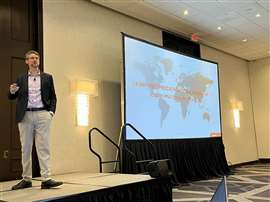 According to Cummin’s Michael Sanford, there is an enormous amount of backup generation available that could be leveraged to support the power grid. (Photo: Becky Schultz)
“We can all acknowledge that there is an enormous amount of backup generation available today in North America alone that could be leveraged [as] support,” Sanford said, but “most of these engines – and by most, I mean 99.8% of [those] installed today – are certified U.S. EPA stationary emergency, which means that they are able to operate for an unlimited period of time during an emergency; outside of that, I’m sorry.”
Emergencies are generally defined within the Code of Federal Regulation (CFR) as an unplanned failure; in other words, a loss of acceptable voltage and/or frequency from the normal power source (utility). “The problem with this is that for an emergency to be an emergency, the problem has to have already happened,” said Sanford. “You have to have lost the power before you react.”
Outside of the emergency scenario, such assets are only permitted to operate up to 100 hours per year, or up to 50 hours per year in limited non-emergency applications. “It’s not a lot of time when we’re talking about broad-scale grid instability,” said Sanford.
‘Bring your own power’ solutions
Because data center activity is scaling “so big and so fast,” utilities have struggled even to connect facilities to the grid, resulting in long lags – sometimes years – before a data center is fully connected. This has caused many data center developers to “bring their own power,” Sanford noted.
“They’re getting creative in the ways that they solve that power problem for themselves so they can continue to hit their lead time and continue to operate.”
Often, this means turning to stationary, non-emergency, Tier 4 engines, which don’t have the usage limitations associated with emergency engine variants. However, non-emergency engines present their own set of problems, one of which is they are not widely available.
“Very few engine manufacturers offer U.S. EPA stationary non-emergency certified solutions, so the portfolio and the availability is nowhere near where the emergency portfolio is,” Sanford indicated.
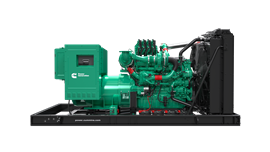 The S17 Centum gen-set achieves up to 1 MW of peak power, has a 17 L engine and is rated for EPA Tier 2. (Photo: Cummins)
Another is their susceptibility to inducement-driven shutdowns. “Those engines are self-monitoring and would have to alert the operator that there’s a problem and ultimately shut themselves down,” Sanford explained. “Many large load centers, like hospitals or data centers, don’t want to be subject to these inducement-driven shutdowns because it risks their day-to-day operation while they’re on generator set power.”
Converting a Tier 2 emergency engine for non-emergency unlimited use is not an option either. “Effectively, when that engine is… ‘born,’ it is born in one configuration and has to live out its life that way,” said Sanford, even if the engine is proven, via on-site testing, to comply with Tier 4 emissions requirements.
“The guidance we received from the EPA says… if you want to operate an engine in a stationary non-emergency application, you must purchase it from the engine manufacturer as such,” he said. “Even if it demonstrates compliance perfectly, that is still an emergency engine. Period.”
So, what’s the path forward?
Sanford pointed to three areas that he believes, with the right guidance, could encourage changes from the EPA as it relates to grid stability and on-site power generation.
First, would be to encourage the mitigation or elimination of inducement actions, specifically shutdowns, for DEF/SCR systems applicable to non-road and stationary non-emergency certified engines.
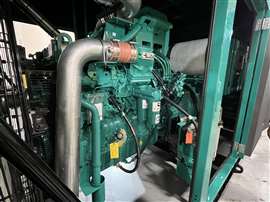 EPA does not permit Tier 2 standby engines like the Cummins S17 shown here to be converted for non-emergency use. (Photo: Becky Schultz)
“This is one of the challenges for end users who want to deploy these assets. Even if there was a broad portfolio and they were cheaper than their emergency counterparts, which they’re not, we still get hesitation from end users because they don’t want to be susceptible to these shutdowns,” said Sanford.
“We’ve already seen some action from the EPA in other spaces… We need to see that continue, to allow these engines to be more effectively used in these non-emergency applications.”
Second, would be to persuade EPA to permit in-field conversion of stationary emergency engines to a stationary non-emergency certification or listing via the upfit of emission controls and site demonstration. “This would be a big opportunity,” Sanford said, “not just for new engines entering the space, but also all of those tens of thousands of gigawatts that are out there.”
Lastly, the EPA needs to be prompted to redefine what qualifies as an emergency, which Sanford described as “fuzzy” within the CFR today.
“There are a lot of other sections within the CFR that quantify what an emergency is – how it can be declared by a governor, by a president, by a myriad of bodies, so that we can appropriately deploy these assets proactively before there’s a failure,” said Sanford, “[rather than] have to wait for that grid to have collapsed.
“This is the regulation that is encouraging large load centers to only solve the problem for themselves,” he added, “[rather than] for all of us that depend on the power for our safety, for our health and for our well-being.”
POWER SOURCING GUIDE
The trusted reference and buyer’s guide for 83 years
The original “desktop search engine,” guiding nearly 10,000 users in more than 90 countries it is the primary reference for specifications and details on all the components that go into engine systems.
Visit Now
STAY CONNECTED



Receive the information you need when you need it through our world-leading magazines, newsletters and daily briefings.
CONNECT WITH THE TEAM