Read this article in 中文 Français Deutsch Italiano Português Español
Daimler Truck to build 100 units of its latest H2 truck

26 January 2026
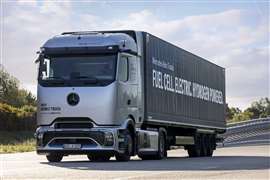 NextGenH2 will go out to customers from the end of 2026 (Photo: Daimler Truck)
Following the announcement that it would delay series production of its GenH2 hydrogen fuel cell truck until the early 2030s, Daimler Truck has now advised that it will be completing a very limited production run of 100 units of its NextGenH2 model.
The units will be sent to selected customers from the end of 2026.
While components such as the Cellcentric BZA150 hydrogen fuel cell and the liquid hydrogen fuelling tech which featured on the GenH2 truck will be carried over, new safety solutions and improved packaging will feature on this latest concept, helping to ‘improve customer value through broader compatibility with trailers’.
Two fuel cell units are used, delivering a total output of 300 kW. In tests, these average between 5.6 and 8 kg/100 km on vehicles with a gross combined weight of between 16 and 34 tonnes.
The fuel cells generate electrical energy through the reaction between the hydrogen and oxygen. Together with a buffer battery, this powers motors in the e-axle. The powertrain can deliver 340 kW in Economy Mode and up to 370 kW in Power Mode.
A 101 kWh li-ion phosphate (LFP) battery pack stores energy from the fuel cells and also from brake regeneration.
While the liquid hydrogen tech remains, the capacity of the onboard tanks has been increased to 85 kg of H2. Refuelling can be completed from either side of the vehicle as the tanks are connected. Using the sLH2 refuelling standard developed by Daimler Truck and Linde, the process takes between 10 and 15 minutes.
New components in the NextGenH2 truck have been taken from the battery-electric eActros 600. This includes the high-voltage E/E architecture, the integrated e-axle, aerodynamically optimised ProCabin, Multimedia Cockpit Interactive 2, together with the latest safety assistance systems and cybersecurity standards.
The Tech Tower, located behind the cab, has been made more compact. This has allowed the wheelbase to be shortened by 150 mm to 4,000 mm, allowing better compatibility with standard trailers. The Tech Tower also has a new boil-off management system which meets a related regs for handling hydrogen, including parking in enclosed spaces.
A new sensor system can detect hydrogen leaks, allowing overnight stays in the cab. This increases usability on multi-day assignments.
Achim Puchert, CEO Mercedes-Benz Trucks, said: “In addition to battery-electric solutions, hydrogen-based drives are crucial for the sustainable transformation of our industry.
“With the NextGenH2 Truck, we are taking the next technological step in fuel cell trucks. Together with our customers, we aim to introduce the small series with high range and near production-ready technology into daily transport operations from the end of 2026.”
POWER SOURCING GUIDE

The trusted reference and buyer’s guide for 83 years
The original “desktop search engine,” guiding nearly 10,000 users in more than 90 countries it is the primary reference for specifications and details on all the components that go into engine systems.
Visit Now
STAY CONNECTED



Receive the information you need when you need it through our world-leading magazines, newsletters and daily briefings.

CONNECT WITH THE TEAM