Read this article in 中文 Français Deutsch Italiano Português Español
Five things we learned from Caterpillar’s sustainability report

18 May 2026
Caterpillar’s 2025 sustainability report offers a useful indication of where the world’s largest construction equipment manufacturer sees the industry heading.
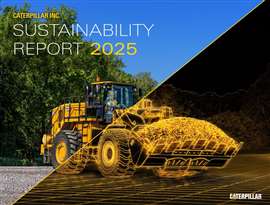 Caterpillar has released its latest sustainability report. Image: Caterpillar
The US-based OEM, which reported sales and revenues of US$67.6 billion in 2025, uses the report to set out its approach to sustainability across construction, mining, power and energy. But for construction, the most relevant sections are less about broad corporate targets and more about the practical technologies Caterpillar is developing for machines and jobsites.
The report highlights autonomy, digital tools, alternative fuels, battery-electric and hybrid equipment, rebuilds, remanufacturing and safety technology as areas of focus. It also makes clear that Caterpillar does not see the transition as a single pathway.
Five things Construction Briefing learned from the first section of the report.
1. Caterpillar sees autonomy expanding into quarrying and adjacent applications
Autonomy has long been associated with large mining trucks, but Caterpillar’s report suggests the technology is expanding into quarrying and other adjacent applications.
The report highlights Caterpillar’s work with Luck Stone on what it describes as the first deployment of autonomous systems on Cat 777, or 100-ton-class, off-highway trucks. Caterpillar said that by the end of 2025, more than two million tons of material had been safely moved as part of the project.
That is significant because quarrying sits closer to construction materials supply than traditional large-scale mining. The report says the aim is to enable more consistent and safer machine operation across industries, scaling proven autonomous haulage capabilities into new applications.
Caterpillar also references a Cat 938M small wheeled loader operating with semi-autonomous technology, with blue lights used as a visual cue to indicate when autonomy is active.
2. Cat is not betting on one power source
The report repeatedly stresses flexibility rather than a single technology route.
Caterpillar says its portfolio includes alternative fuel and fuel-flexibility capabilities, high-efficiency diesel and natural gas engines, digital and autonomous solutions, and battery-electric and hybrid equipment. It says it is expanding options for customers to use lower-carbon-intensity fuels across diesel and natural gas platforms, including biodiesel, renewable diesel, biogas, renewable natural gas, hydrogen blends, methanol and ethanol.
Battery-electric and hybrid equipment are also part of the strategy. Caterpillar says it is advancing these technologies across construction, mining and energy applications, supported by charging, energy management systems and high-density batteries.
But the report’s emphasis is clearly on customer choice. Caterpillar presents the transition as dependent on application, geography, infrastructure and fuel availability, rather than as a simple shift from diesel to electric.
3. Safety technology is becoming more active
Caterpillar’s report suggests that safety systems are becoming more interventionist, rather than simply warning operators.
Granite Construction is cited as one of the first customers to test and implement Caterpillar’s Collision Warning System with motion inhibit on next-generation Cat medium wheeled loaders. The system uses radar and cameras with people detection to alert operators to hazards and assist in preventing unintended machine movement.
The report also says Caterpillar has established “safety direct controls” as foundational to its technology portfolio. Initial factory and retrofit offerings include motion inhibit and automatic emergency braking for selected medium wheel loaders. It also highlights Cat 2D E-fence, which prevents or limits machine movement beyond set boundaries and is available on most excavators.
Caterpillar also says VisionLink was expanded in 2025 to provide deeper insight into safety metrics such as seatbelt compliance and near-miss detections, with enhanced safety metrics and event video capabilities planned in 2026.
4. Connected fleet monitoring is being linked to sustainability
The report makes a direct connection between connected equipment, maintenance, fuel consumption and emissions.
For Kiewit, which operates equipment across construction and mining projects in North America, Caterpillar says traditional maintenance programmes and onboard machine technologies were not sufficient. Kiewit adopted Caterpillar’s Fleet Monitoring Center for continuous, connected fleet condition monitoring.
Caterpillar says its condition monitoring advisors review equipment data to help prevent unplanned downtime and detect unsafe operating conditions before they affect productivity or safety. It also says the system can help reduce fuel consumption and greenhouse gas emissions by maintaining engine and aftertreatment performance, detecting oil, coolant and hydraulic issues early, and extending component and asset life.
That points to a broader theme in the report: sustainability is often framed less as a separate category and more as an outcome of efficiency, uptime, maintenance and asset management.
5. Rebuilds and remanufacturing are central to the message
One of the strongest construction equipment themes in the report is circularity.
Caterpillar says its products are “built to be rebuilt” and describes remanufacturing as a way to lower total cost of ownership, reduce greenhouse gas emissions and reduce the need for new raw materials. It says remanufacturing sales and revenues have increased 41% since 2018 and that Cat Reman received 150 million pounds of end-of-life material in the past year.
The report also says remanufacturing uses 65% to 87% less process energy and process greenhouse gas emissions compared with manufacturing new parts, based on US environmental impacts of gate-to-gate remanufacturing and remanufacturing processes for Cat engines and components.
Caterpillar gives the example of a customer’s Cat 336 excavators nearing end of life. The machines were disassembled, worn systems including engines and hydraulics were exchanged for remanufactured components, and remaining parts were rebuilt or replaced.
The report also says a Cat Certified Rebuild reduces a customer’s Scope 3 greenhouse gas emissions by a minimum of 70% compared with buying an equivalent new machine. For contractors facing high equipment costs, longer fleet cycles and pressure to reduce emissions, that may be one of the most practical messages in the report.
POWER SOURCING GUIDE

The trusted reference and buyer’s guide for 83 years
The original “desktop search engine,” guiding nearly 10,000 users in more than 90 countries it is the primary reference for specifications and details on all the components that go into engine systems.
Visit Now
STAY CONNECTED



Receive the information you need when you need it through our world-leading magazines, newsletters and daily briefings.
CONNECT WITH THE TEAM