Read this article in 中文 Français Deutsch Italiano Português Español
FPT Industrial takes modular approach to growth

26 March 2026
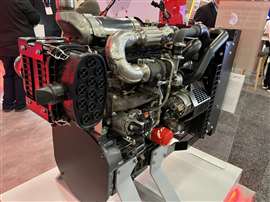 Smaller engines such as the 2.8 L F28 Tier 4 Final/Stage V engine could be “de-emissionized” to further expand the product portfolio. (Photo: Becky Schultz)
With an engine portfolio ranging from 2.4 to 20 L and rated from 30 to more than 1,000 hp, you would think FPT Industrial has solutions to meet just about every power generation demand. Close but not quite, according to Max Meegan, head of North America Sales for the company.
During a conversation at PowerGen 2026 in San Antonio, Texas, he brought up the very large and power-hungry elephant in the room: data centers.
“If I look at the market today, the area that’s booming and everyone’s talking about is data centers and having larger engines to provide those larger power needs,” he commented. “We have a very wide product portfolio today, but obviously, we are always looking at how we can expand and how we can attack different markets.”
Easing emissions transitions
Such expansion has proven pretty seamless for the company thus far, thanks to its ability to build upon its existing base engine architecture. Take its approach to differing emissions tier levels for power generation.
“When you look at the base engine, it’s almost identical from when you’re looking at a Tier 0 or unregulated engine, to a Tier 3 product, to then a Tier 4 Final/Stage V for prime power applications,” said Meegan.
As an example, he pointed to FPT’s 4.5 L emergency power gen engine. “This is our Tier 3 fully mechanical engine. Very simple architecture. The mounting points are identical between the 4.5 L and the 6.7 L. It’s just a little shorter,” he said. “If I want to go from this 4.5 L to an electronic Tier 3 or an electronic Tier 4 Final engine, this engine installation doesn’t change at all…. You just add the aftertreatment system above the engine… and now you have one installation for the entire emissions range.”
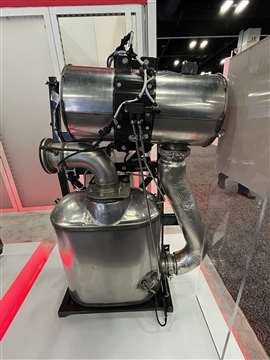 FPT Industrial’s ATS HI-eSCR2 aftertreatment system is available mounted on a frame for “plug & play” installation. (Photo: Becky Schultz)
To further simplify the shift to Tier 4 Final/Stage V, FPT Industrial’s ATS HI-eSCR2 aftertreatment system, which utilizes an SCR catalyst to convert NOX and simultaneously trap and oxidize particulate matter, is available mounted on a frame for “plug & play” installation. “We know best how to package the engine components, so why wouldn’t we offer [ATS packs] on a frame that a customer can just… bolt into their package,” said Meegan. “And they are designed to be compact.”
From there, a customer interface box allows OEMs to simply wire in their panel. “It’s turnkey for them, even with the Tier 4 Final system. We offer all the relays and the fuses and the wiring from the factory just to help expedite that development program for our customers,” said Meegan.
“We want to make it as easy as possible for the OEMs to launch an FPT-powered gen-set. We offer a large amount of scope and supply to help kick that off and reduce their development effort.”
“De-emissionized” solution
Conversely, an FPT Industrial engine can be “de-emissionized” for lesser regulated or unregulated markets or applications. Meegan pointed to the NEF 6.7 L, which comes equipped with the ATS pack to meet Tier 4 Final/Stage V regulations.
“If a customer wants to develop a prime power gen-set, they have to use that entire package. But let’s say that customer also builds emergency backup power gen-sets,” he posed. “You take that almost identical base engine, take off the aftertreatment system and now it’s a Tier 3 engine. And then we maybe change some internal components on the engine to go to unregulated, but all uniform from an installation perspective.”
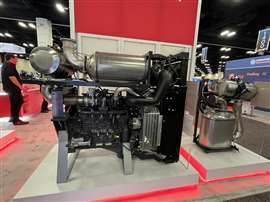 The 6.7 L N67 engine comes equipped with the modular ATS pack to meet Tier 4 Final/Stage V regulations. (Photo: Becky Schultz)
With each iteration, the base engine footprint remains largely the same. “Even from an engine mounting perspective, it’s identical,” Meegan stated. “If an OEM or a gen-set packager leaves a little bit of space, they could just add in that aftertreatment system and it’s the same exact enclosure that’s used for all those different engines across emissions tiers.”
The result is less development time and complexity to meet varying emissions requirements.
“OEMs are limited with the amount of engineering resources and capacity that they can develop,” Meegan commented. “So, we want to try to have a common platform where you can develop one engine and that opens the door for unregulated to Tier 3 to Tier 4 Final/Stage V and not have to have separate, different development programs.”
Adaptive by design
Going back to his earlier comments on higher power nodes for larger power generation such as data centers, Meegan said the company already has engines in use in other markets that could potentially be adapted for such applications.
“We try to have the same base platform or base engine architecture, whether it’s going into construction, agriculture or power generation,” he commented. “We have engines today that are being used in ag or construction equipment applications that we say, ‘Hey, why can’t we just carry this over into the power gen segment, and now we could expand our lineup.’”
The Cursor 16L, a high-power, high-torque engine currently used in ag and marine applications, is one potential prospect. FPT brought the engine to PowerGen specifically to gauge customer interest. According to Meegan, “I had customers today [saying], ‘Hey, we’d love to use this for data center projects.’
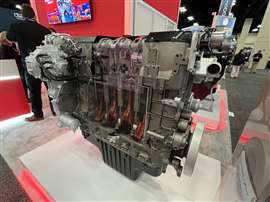 FPT Industrial brought the Cursor 16 L to PowerGen to gauge interest in adapting the engine for power generation. (Photo: Becky Schultz)
“If we see that market demand or that need, we can easily develop this and launch it for power gen applications, because it’s fairly simple to convert from industrial or agriculture to power gen… because the base architecture doesn’t change that much. A lot of it is just software development and certifying with the EPA. It’s fairly straightforward.
“But at the same time, we’re trying to evaluate how can we play on the lower end as well,” he noted. “What other things can we do to grow the business or the product offering on the low end?”
Though all alternatives are being considered, such growth could again come through adaptation. For example, by removing the diesel oxidation catalyst from the newly developed 2.8 L F28, FPT’s smallest Tier 4 Final/Stage V engine, it could be converted to a Tier 3 configuration, Meegan said. Remove a few more components and it could be fit for unregulated markets.
“These are the types of programs that we’re looking at – to develop this state-of-the-art, brand-new engine to meet the most stringent emissions requirements,” he said, “now how can we de-emissionize it to offer a wider product portfolio for those lower power ranges?”
Modularity for multi-fuel
Yet another question is how to meet demand for alternative fuel capability. FPT’s entire lineup is already certified for use with renewable diesel, but it’s too soon to say what primary fuel may come next.
To address this uncertainty, the company developed the XCursor, a modular engine design that offers multi-fuel capability. Displayed at ConExpo-Con/Agg 2026, the engine again provides the ability to adapt to evolving market demand.
“We have a base engine that’s identical, kind of along the same theme of our different emissions tiers, and then we have three different cylinder heads in front of it – one for hydrogen, one for natural gas and one for diesel. We’re developing all the technology for whether it is natural gas, methane, hydrogen, etc.,” Meegan said. “We don’t know what the next fuel source will be, but we’ll have that solution.”
OEMs seeking to broaden their own portfolios will be able to order the base XCursor engine with more than one cylinder head, say, for hydrogen and for diesel to enable a dual product offering. “We’re trying to offer that flexibility to the customer so they can choose whatever they want, and we’ll have that product portfolio there.”
The XCursor is currently in field testing using different alternative fuels. “We have it running in construction and agricultural equipment but there’s no reason we can’t carry it over to power generation and all the other segments that we play in today,” said Meegan.
“We have one of the largest product portfolios from an emissions tier and from a power node perspective, and we’re always looking to grow,” he continued. “We’re not being stagnant here. We’re still trying to look at how we could expand this already large product offering to offer more to our customers and really be a one stop shop for power gen OEMs.”
Going a different aftertreatment route
In the move from Tier 4 Interim to Tier 4 Final, a number of power gen engine suppliers sought to avoid selective catalytic reduction (SCR) with diesel exhaust fluid (DEF) as an aftertreatment solution, choosing instead to use exhaust gas recirculation (EGR) with a diesel particulate filter (DPF). Yet, that brings its own complexities.
“With EGR, you’re filtering exhaust gas back [into the engine], inherently making the combustion less efficient,” said FPT’s Max Meegan. “Then you have a DPF that captures all the particulate. Now you have to go through regen. You have to have the machine out of service. You have to replace that filter every couple thousand hours. So, you’re adding components on the engine to make it less efficient.”
FPT chose to use SCR to optimize the combustion process to produce a very small amount of particulate matter, which its ATS HI-eSCR2 system is then able to passively burn off to meet Tier 4 Final/Stage V requirements, with no active regen required.
“When you add in EGR, you produce a lot of particulate matter which requires a DPF with active regeneration,” Meegan said. “We went the opposite way. We produce almost no particulate matter but then we produce a lot of NOx. It’s easy with a DEF system to manage NOx and reduce it, so that’s how we can get away with our SCR system and not a traditional DPF like our competitors. It’s really a huge differentiator for our aftertreatment.”
POWER SOURCING GUIDE

The trusted reference and buyer’s guide for 83 years
The original “desktop search engine,” guiding nearly 10,000 users in more than 90 countries it is the primary reference for specifications and details on all the components that go into engine systems.
Visit Now
STAY CONNECTED



Receive the information you need when you need it through our world-leading magazines, newsletters and daily briefings.

CONNECT WITH THE TEAM