Going back 90 years: December 1963

14 January 2026
Bulk hauler switches to 105 diesel unit fleet
Starting with the May 1935 issue, Diesel Progress – or Power Progress as it’s known today – has covered engines and engine-powered equipment. Through those nine decades, the writers and editors of this publication have witnessed technology that was considered science fiction in the 1930s and they’ve praised (as proper non-biased journalists) the entrepreneurs and engineers that have facilitated those changes. It’s been – and continues to be — an amazing thing to watch. Throughout 2025, we celebrated those 90 years. With this department, we’re going back to some of the unique applications, forgotten firms and the companies that have been part of the industry and the publication from the beginning of both.
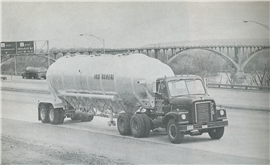 One of Indianhead Truck Line’s new International DCF-405 tandem axle tractors pulls a bulk trailer in this photo from the December 1963 issue of Diesel Progress. The article was written by Associate Editor Anthony A. Alberte.
From the December 1963 issue of Diesel Progress:
When an operator decides to convert his fleet to diesel the changeover usually comes in somewhat gradual steps-replacement of a number of units at a time. So the all-at-once conversion of the Indianhead Truck Line, Inc, is unusual. On Feb. 1, 1963, Indianhead had no diesel tractors in their operation. By May Ist, the St. Paul, Minn., bulk hauler operated nothing but diesel tractors. The diesel tractors involved in the switch consisted of 105 International model DCF-405 tandem axle units equipped with 235 hp Cummins V-8E diesel engines. These replaced 126 gasoline-powered tractors ranging in age from six down to two years.
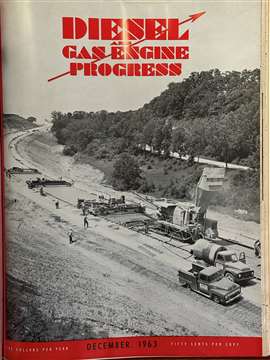 The cover of the December 1963 issue shows a Koehring 34E Tribatch paver at work for Streu Construction Co. of Two Rivers, Wis., on a state highway project. The paver was powered by a GM 6-71 diesel rated 180 hp. The cover also features one of the publication’s many names throughout its nine decades: Diesel and Gas Engine Progress.
Said Lester Wilsey, Jr., secretary general manager: “We traded all our gasoline jobs because the complete changeover was easier to sell to our force than piecemeal conversion; we found the gasoline engine maintenance, rather than improving, was falling away with age and downtime required too much spare equipment to maintain our business volume. We’re doing as much … work with the 105 tractors than we did with the 126 gasoline jobs. A good deal of this is attributed to the fact that at any given time there are fewer units in the garage awaiting maintenance. This is partly due, of course, to the fact that these are all new tractors. But over and above that is the factor of the diesel’s inherently lessened maintenance requirements.”
Wilsey estimated that 98% of Indianhead’s cargoes are bulk products, hauled in a variety of types of tank trailers. Cargo includes such commodities as cement, petroleum products, asphalt, salt, liquid or dry fertilizers, propane, and anhydrous ammonia for fertilizer. The company is a common carrier which has 20 terminals in Minnesota, North Dakota, Iowa, Wisconsin, and Illinois and serving, in addition, areas in South Dakota, Nebraska and Michigan. The company was started in 1930 with one small [Ford] Model T truck operating within a limited county area. In 1963, Indianhead rolling stock totals 302 units, including tractors, trailers and trucks, and will handle an estimated 112,500,000 ton-miles of freight.
A typical one-way haul for an Indianhead tank unit averages about 80 miles. All their hauls are generally quite short except for some chemical cargoes….
The Cummins V8E-235 diesel engine in the Indianhead tractors are eight-cylinder Vee units introduced by Cummins in 1961. The engine develops 235 hp at 2400 rpm. It has a bore and stroke of 5½x41 in. and piston displacement is 785 cu. in. This is the derated version of Cummins V8-265 truck diesel, rated 265 hp at 2600 rpm, and forms a good example of how new compact engines can offer flexibility in ratings to take fullest advantage of maximum fuel economy and engine life in a specific application.
Wiley anticipates that the tractors will average about 80,000 miles per year. In 1962, Indianhead’s fleet turned in a total of 8.5 million miles and 1963 mileage is expected to reach a total of 9 million. The V8E-235s have been averaging 5.9 mpg since they went in service.
POWER SOURCING GUIDE

The trusted reference and buyer’s guide for 83 years
The original “desktop search engine,” guiding nearly 10,000 users in more than 90 countries it is the primary reference for specifications and details on all the components that go into engine systems.
Visit Now

CONNECT WITH THE TEAM