How excavator safety is evolving

07 September 2026
In May 2006, International Construction’s then-editor Chris Sleight (now managing director of Off-Highway Research) was just back from the Intermat exhibition in France and reported on a new range of compact excavators from JCB.
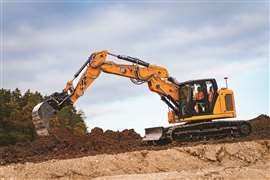 Caterpillar launched the 319 compact radius excavator at ConExpo 2026 with wide tracks for extra stability Image: Caterpillar
A fold-back door that could be clipped to the counterweight to keep it within the machine’s footprint and tracks caught his eye.
“It is a useful safety feature that should prevent the door getting caught and broken when slewing the upper structure in tight spaces,” he wrote.
It was a practical solution to a physical problem. If it seems like a fairly basic feature these days, it also illustrates just how much things have changed in two decades.
Excavator safety features have mushroomed from passive measures largely aimed at protecting the operator inside the cab, to monitoring everyone and everything within the machine’s working area. Increasingly, the excavator is expected not only to see a danger but to understand it and, potentially, intervene.
The excavator learns to ‘see’
Brian Stellbrink, excavator market professional at Caterpillar, recalls that the emphasis 20 years ago was mainly on the operator and the physical attributes of the excavator. These included seat belts, cab guarding and finding ways to allow the operator to spot hazards.
“There was a big focus on sight lines, making the cab structure stronger but with less steel and more glass for greater visibility,” he says.
Fast forward to 2026 and Todd Sutton III, EHS director at Skanska USA Civil West says sophisticated tech like camera systems (from rear-view cameras all the way up to 360-degree birds-eye view systems) are now a must-have.
“What was once considered an enhancement is now a baseline expectation because of the visibility it provides in increasingly complex and congested work environments,” he tells International Construction.
Meanwhile, Wu Yuanfeng, deputy general manager of Zoomlion Earthmoving Machinery Company and Zoomlion Mining Machinery Company, regards the combination of 360-degree vision and active anti-collision technology as the “single development with the greatest impact” on excavator safety.
Seeing a person is only one part of the problem, though. The operator still has to notice the warning and respond.
Kevin Randall, director of technical services at Balfour Beatty Asset & Technology Solutions, says earlier sonar-based vehicle collision avoidance systems could detect an object but did not necessarily prevent people being injured.
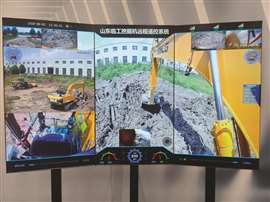 SDLG’s remote control system removes operators from hazardous environments Image: SDLG
“The advent of human-form recognition was a game-changer for me,” he says. “My frustration with the industry is that we are not taking this up. The OEMs seem to be quite slow in adopting the technology.”
Randall has seen the systems alter how people approach machinery. A worker receives an external warning that the machine has detected them, while the operator is alerted inside the cab.
“If you are a groundworker and you approach a machine and it detects you and you know you have been detected, you think: ‘Now I’m at risk. Now I’m in danger because I’m in close proximity,’” he says. “From the other perspective, the operator has now got a notification.”
More safety features
Warren Wilkinson, business stream leader for Plant & Power Solutions at Select Plant Hire, notes that the conversation around excavator safety has shifted from roll-over protective structures (ROPS), falling-object protective structures (FOPS) to safe load indicators (SLIs), rated capacity indicators (RCIs), and height and slew restrictions.
“Originally we started off with ROPS and that was to protect the operator,” he says. “Now we’re talking about plant-people interface, making the construction site safer, making the people around it safer, supporting the exclusion zones around the machine,” he says.
The nature of construction may be intensifying the need for that protection. Stellbrink points to restricted sites, tighter programmes and more contractors undertaking activities concurrently.
“The velocity on projects is increasing. There’s more contractors working together on the same job and more activities going on concurrently, which drives more of a need for safety of those outside the machine,” he says.
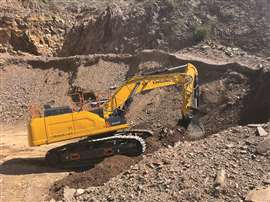 LiuGong says that the industry has shifted from cab-centred passive protection to active prevention and full-domain awareness. Image:
A spokesperson for China-based OEM LiuGong agrees that the industry has shifted from cab-centred passive protection – ROPS, FOPS, belts, alarms and hydraulic locks – to active prevention and full-domain awareness.
“For excavators built around 2006, safety design centred on protecting people when accidents occur, relying mainly on passive protection devices such as ROPS, FOPS, safety belts and safety lock levers.
“By contrast, safety in today’s LiuGong excavators has evolved into a full‑chain system featuring pre‑event early warning, in‑event intervention, and post‑event traceability.”
The spokesperson added that its new excavators have 360° panoramic vision to eliminate visual blind spots, and AI personnel detection identifies hazards in advance to stop incidents from happening.
If an incident is about to occur then an ‘in-event’ intelligent anti‑collision system delivers multi‑level warnings, ranging from audio‑visual alerts and speed limiting to emergency braking. If that has not been enough to stop an accident, post-event, continuous video recording enables accident‑scene reconstruction.
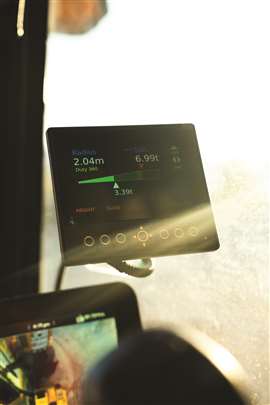 A Komatsu HB365 LC hybrid excavator with slew and height restrictions, part of Select Plant Hire’s fleet
Skanska’s Sutton identifies grade-control systems as a good way to reduce excavation errors and the likelihood of utility strikes, while digital planning can identify potential conflicts before work begins. However, he cautions against attributing changing behaviour entirely to machine technology.
“Modern systems have changed operations, but a large factor in changing operator behaviour has come from training, incident reviews and a culture of sharing lessons learned across projects,” Sutton says.
Machines taking control?
As excavator safety technology advances, a new capability for machines is emerging – the ability to override an operator if they spot a hazard.
“When you are trying to control the machine, your focus is on the thing that you are trying to control and dig with,” Randall points out.
“You are not looking in your peripheral vision or over to your side where someone might approach.”
Human detection can address that limitation but a warning still relies on the operator responding. The next stage is for the machine to restrict the movement that creates the danger.
A spokesperson for China-based SDLG identifies 360-degree environmental awareness, AI-based person detection and active braking as the most transformative developments of the past 20 years.
“Active sensing and intervention systems identify hazards in advance and proactively prevent accidents, directly addressing the most common incidents involving blind spots and swing collisions,” they note.
The manufacturer says industry statistics indicate that more than half of excavator-related fatalities and injuries involve ground personnel struck in blind spots or during slewing. It also claims active sensing and intervention can reduce such incidents by more than 80%.
Zoomlion’s Wu Yuanfeng predicts, “Over the next decade, the dominant direction in the excavator safety field will transition from ‘assisted warning’ to ‘active intervention and autonomous decision-making’, building an intelligent closed loop of ‘perception-decision-execution/intervention-learning/evolution.’”
Chinese manufacturing giant XCMG has developed its Intelligent Control Safety (ICS) system, which combines attitude sensors, visual and radar technology, and safety logic to enable real-time monitoring and functions such as rollover warnings, boom anti-fall protection, and personnel detection-based speed control and emergency locking.
“While the past two decades of safety innovation have focused on reducing accident risks, the next decade will focus on predicting and preventing risks before they occur,” says the company’s marketing manager Ziqi Li who also notes that a fusion of multiple sensors, 5G connectivity, and autonomous tech will drive the next stages of development.
Automatic intervention, however, introduces its own engineering challenge. Stopping an excavator is not necessarily as simple as cutting power, particularly if it is carrying a load or working on difficult ground.
“When I say stop a machine, I mean stop a machine in a controlled, safe manner,” Randall says. “You don’t want it to fall over because it stopped it too quickly.”
More integration demanded
There’s another challenge that is less to do with the technology, much of which already exists, and more do to with how it is being adopted. Contractors may add height and slew restrictors, human-form recognition, machine control and camera systems from several different suppliers.
“A lot of these are third-party fit systems, so you have lots of different installs once you buy a machine,” Wilkinson says.
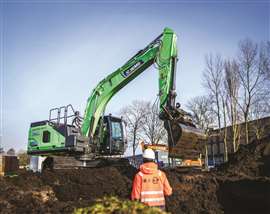 XCMG’s XE215EV electric hydraulic excavator is fitted with a high-definition camera to allow operators to keep tabs on workers around the machine
Different systems can bring separate displays into the cab, potentially creating distraction and obstructing the visibility that manufacturers have spent decades improving.
Stellbrink says Caterpillar is listening to customers on that challenge. Its person-detection camera is integrated into the standard machine display rather than requiring another monitor.
“There are some very good solutions out there but pretty soon you end up with four or five different displays.
“When we talk to contractors, they want less clutter in the cab, more integration into the machine’s monitor and into the joystick controls, and we’re acting on that as a manufacturer,” he says.
There are other obstacles. SDLG’s spokesperson says the performance of cameras and radar can deteriorate in dust, heavy rain, mud or difficult lighting, leading to false warnings or missed detections. They also acknowledge the need for advanced safety equipment to be extended to smaller excavators.
As a spokesperson for Chinese OEM Yuchai acknowledges, such systems are still relatively expensive. “The high cost of intelligent safety systems limits their widespread adoption, especially on smaller machines,” they say.
Nonetheless, Yuchai’s spokesperson also notes just how much progress has been made. They highlight how the company’s YC15-7, a major export model 20 years ago, was only equipped with “relatively basic” safety features.
“Today, excavators build on that structural foundation by integrating smart safety systems. On Yuchai Equipment’s primary export model for 2026, the U60, rearview cameras and travel alarms are standard equipment,” they note.
Balfour Beatty’s Randall argues that factory integration and standard fitment would increase production volumes and reduce costs. “If it was just integrated into the equipment architecture, cost becomes less of an issue because instead of doing 100 you are doing 10,000,” he says.
Contractors also have considerable influence. “Clients establish safety expectations, but the selection and implementation of specific equipment technologies is 99% contractor driven,” says Sutton.
Keeping out of harm’s way
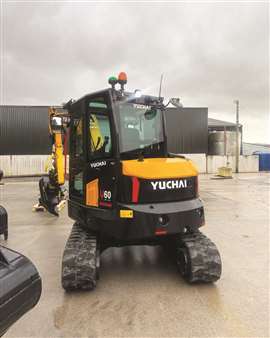 Rearview cameras and travel alarms are standard on Yuchai Equipment’s U60. Image: Yuchai
Another goal for excavator manufacturers is removing the operator from hazardous environments altogether.
Remote-control systems already allow machines to work near unstable ground, water, quarry faces and contaminated areas without placing the operator in the cab. Thomas Haas, head of product management at Liebherr-France, can envisage a time where operators are no longer put at risk in such scenarios.
“Remote operation solutions will allow machines to be operated safely in hazardous or contaminated environments, reducing risks for personnel,” he says.
“Looking further ahead, autonomous machines have the potential to remove operators from dangerous working areas altogether.”
Many OEMs have already applied remote operation and automation in mining. However, the leap from a controlled mine or demonstration area to a live construction project is a large one.
“If you can make the human-machine interface aware of its environment, you are already a step along the road to autonomy. But [mining] is quite removed from what happens today on a construction site – it is a quantum leap to prove autonomy works on a jobsite,” says Randall.
For now, the longer-term objective may not be autonomous excavators but a connected safety system. SDLG envisages excavators exchanging position and operational data with workers’ wearable devices, other machines, and site-management platforms.
This is a similar scenario to the safety future that LiuGong predicts. They contend that the sector will move from ‘single-machine safety’ to ‘group safety’ over the next decade.
“All machines on the construction site communicate in real time, sharing position, speed, and motion intent. When one excavator slews, the surrounding loaders and trucks automatically avoid it,” says a LiuGong spokesperson.
Twenty years on from JCB’s fold-back door innovation, manufacturers and contractors are attempting to create an invisible protective boundary around the machine and everyone near it.
The challenge now is deciding how much responsibility the excavator should assume, and making the systems reliable, integrated and affordable enough to work across the entire construction industry.
POWER SOURCING GUIDE

The trusted reference and buyer’s guide for 83 years
The original “desktop search engine,” guiding nearly 10,000 users in more than 90 countries it is the primary reference for specifications and details on all the components that go into engine systems.
Visit Now
STAY CONNECTED



Receive the information you need when you need it through our world-leading magazines, newsletters and daily briefings.

CONNECT WITH THE TEAM