Read this article in 中文 Français Deutsch Italiano Português Español
How JCB turned its production hydrogen engine into an 800hp racing monster

25 June 2026
 UK-based construction equipment manufacturer JCB hopes that its hydrogen-powered Hydromax car will be able to exceed 350mph (Image: JCB)
When JCB’s Hydromax car heads to Utah’s Bonneville Salt Flats later this year, it will do so powered by two hydrogen combustion engines producing 800hp each.
That represents a dramatic increase over the company’s 55kW (74hp) hydrogen engine developed for construction equipment such as JCB’s hydrogen-powered 3CX backhoe loader.
The race engine isn’t a modified version of the production unit but an entirely new engine, according to JCB.
But the UK-based construction equipment manufacturer nonetheless used the architecture and lessons learned from five years and £100 million (US$132 million) worth of hydrogen engine development to create a dedicated racing powerplant.
Speaking at RAF Wittering in the UK ahead of the June 16th test run, Mark Richards, principal engineer at JCB Excavators, explained how the company first approached hydrogen combustion for off-highway applications.
“There have been attempts at hydrogen combustion engines before,” he said. “Fundamentally it is easy to make a hydrogen engine run, but it’s difficult to make it run well – and by run well I mean getting the efficiencies you want, taking the emissions out, and also getting the performance you want.”
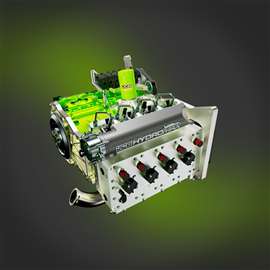 The new engine developed for Hydromax, based on the architecture of the hydrogen ICE used in JCB’s production hydrogen engine (Image: JCB)
Previous attempts to create a hydrogen combustion engine in the automotive sector by the likes of BMW and Mazda relied on converting a naturally aspirated diesel engine, with mixed results. The problem was that the high temperature combustion involved in a naturally aspirated engine resulted in high NOx emissions and relatively low efficiency.
Rather than converting an existing off-highway diesel engine, JCB developed a purpose-built hydrogen combustion engine based on turbocharging, spark ignition and low-temperature combustion.
The result is an engine that matches the performance and torque characteristics of its diesel counterpart while achieving slightly higher thermal efficiency, according to Richards. It also meets Stage V emissions requirements without diesel aftertreatment systems such as selective catalytic reduction (SCR) or a diesel oxidation catalyst (DOC).
One of the key advantages for JCB is that much of the engine’s architecture remains unchanged. The sump, bedplate, block, cylinder head, intake manifold and rocker cover are shared with the base engine design, allowing hydrogen engines to be built on the same production lines as diesel units. Richards said around 60% of the engine’s components are sourced and manufactured in the UK.
The production engine, which in 2025 received EU type approval to allow commercial sales, uses port fuel injection, with hydrogen injected into the intake manifold at around 10 bar pressure before mixing with air and entering the combustion chamber.
‘Souping up’ Hydromax’s engine
For Hydromax, however, JCB needed vastly more power.
Richards explained how the company has changed the base engine from the 55kW (74hp) production version into a new unit that develops 800hp per engine, for a combined 1,600hp on the twin-engine car.
The company raised engine speed from around 2,200rpm in its construction equipment applications to almost 4,000rpm in the high-performance prototype car. Richards said torque output had quadrupled compared with the production engine.
Achieving that performance required significant redesign.
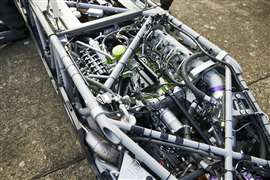 The twin hydrogen engines inside the Hydromax car during testing at RAF Wittering in June 2026 (Image: JCB)
The pushrod valvetrain used on the production engine was replaced by a double overhead cam arrangement. Richards said the change provides much greater precision over valve timing at high engine speeds and reduces system flex.
Fuel delivery also changed dramatically. While the production engine relies on port injection, the race engine uses direct injection with fuel rail pressures increased from around 10 bar to approximately 50 bar. Injecting hydrogen directly into the combustion chamber allows significantly more fuel to be delivered in the limited time available at higher engine speeds.
Meanwhile, JCB also reduced engine weight, upgraded cooling and lubrication systems and adopted a dry sump design to allow the engines to be mounted on their sides within the streamliner’s narrow bodywork.
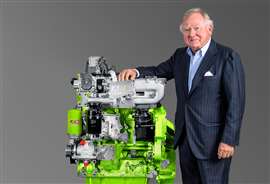 Lord Anthony Bamford with the JCB hydrogen combustion engine. (Image: JCB)
“Dry sump is common in race cars. It means the oil doesn’t slosh about during fast cornering and is always available for pick-up. On the race car, we’ve got an oil pickup pump - the scavenger pump - that is pumping that litre of oil every second around each engine, allowing us to keep the engine lubricated as it runs on its side,” Richards explained.
The arrangement lowers the vehicle’s centre of gravity while ensuring a constant oil supply under extreme operating conditions.
Another major challenge has been cooling. To overcome this, JCB has developed an ice cooling system, with air exiting the turbocharger at around 200°C cooled to less than 10°C before entering the intake manifold. The greater density of the cooler air helps to maximise power output, Richards explained. That has involved fitting the car with two tanks that can take up to 250kg of ice.
Yet despite the substantial engineering changes, some elements remain familiar. Richards noted that the crankshaft used in the race engine is the same as that found in JCB’s production diesel and hydrogen engines.
Computational fluid dynamics work originally carried out during development of the 55kW engine was also carried across to the race programme.
The next stop for the Hydromax car, which was tested at RAF Wittering in mid June, is the USA. The car is being flown across the Atlantic on a specially chartered Antonov aeroplane on 2 July prior to its participation in Bonneville Speed Week (1-7 August) on the Bonneville Salt Flats in Utah, ahead of a record attempt later in the month.
Piloting the vehicle will be Wing Commander Andy Green, who drove JCB’s Dieselmax car to a world diesel-powered land speed record of just over 350mph two decades ago, in 2006. Andy Green also holds the overall world land speed record, which he set in ThrustSSC in 1997, at 763mph.
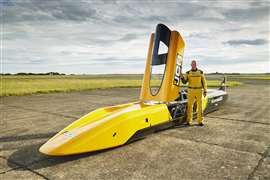 Wing Commander Andy Green will pilot the Hydromax car during its speed record attempt at Bonneville Salt Flats in August 2026 (Image: JCB)
From production engine to race engine
| Production H2 engine | Hydromax race engine | Change | |
| Power | 74 bhp | 800 bhp | 10.8x |
| Rated speed | 2,200 rpm | 3,800 rpm | 1.7x |
| Peak fuel flow | 4 kg/hr | 50 kg/hr | 12.5x |
| Weight | 500 kg | 405 kg | -95 kg |
| Coolant flow rate at max power | 240 L/min | 550 L/min | 2.3x |
| Torque | 325 lb-ft | 1,300 lb-ft | 4.0x |
POWER SOURCING GUIDE

The trusted reference and buyer’s guide for 83 years
The original “desktop search engine,” guiding nearly 10,000 users in more than 90 countries it is the primary reference for specifications and details on all the components that go into engine systems.
Visit Now
STAY CONNECTED



Receive the information you need when you need it through our world-leading magazines, newsletters and daily briefings.

CONNECT WITH THE TEAM