Read this article in 中文 Français Deutsch Italiano Português Español
Huber powers into hydro excavation

24 February 2026
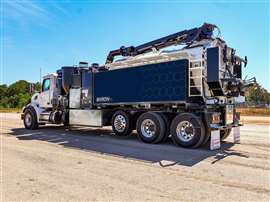 The Baron HX is mounted on a Peterbilt chassis and is typically powered by a 450-hp Cummins diesel engine. (Photo: Huber Corporation)
Huber Corp., part of the Hol-Mac family of businesses, has been manufacturing vacuum trucks for more than 40 years out of its headquarters facility in Gulfport, Miss. While the company has offered a hydro excavation accessory option, the Baron HX is its first dedicated hydro excavation unit.
Suited for applications such as daylighting, trenching, potholing and cleanup operations, Huber said the Baron HX is designed to enable faster jobsite setup, simplified operation and minimized downtime, enabling operators to work more efficiently and safely.
“It’s a very safe unit – that’s what we built it around,” said Bradley Holder, director of sales at Huber.
Powerful features
The Baron HX has a 12-cu.-yd. capacity debris tank and a 1,500-gal. fresh water capacity, with water tank shielding panels incorporated to protect against punctures. Its hydraulically driven Triplex Pump System is rated 20 gpm and 3,000 psi, which enables constant high-pressure flow with direct drive efficiency and reduced maintenance. A 700K btu Dynablast burner, running off the truck’s engine, heats the water to cut through clay and other soils.
The unit’s vacuum system utilizes a Hibon 8702 blower rated 5,300 cfm and 27-in. Hg (continuous duty cycle). “It will pull perfect vacuum nearly 27 in.,” said Holder. “Just to give you a reference, outer space is 29 in. So, it’s an extremely powerful truck.”
The company’s proprietary PureFlow 9 Cyclone air system provides nine stages of cyclonic air filtration going into the blower. Smart Idle air flow, matched with the air system, is designed to optimize engine idle for peak performance, reduced noise and enhanced efficiency.
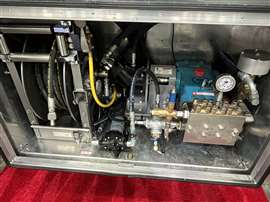 The entire hydro excavation system is run off of a single hydraulic pump. (Photo: Becky Schultz)
“Part of our air system is the silencer... It’s extremely quiet,” said Holder. “And because of the efficiency of this air flow system, you can actually run our truck at just above idle and do most of the work.”
Dig-ready design
The new hydro excavator features vertical lance storage for the telescoping boom, which includes a 24-ft. reach with 6-ft. extension, 330-degree rotation and a 47-degree pivot range for a wider operating range. This “dig-ready” design enables excavation up to 48 in. below frost level without stinger tubes.
Holder said this capability covers roughly 80% of hydro excavation jobs. “It will dig 6 ft. without having to take time to put one of the dig pipes on it, which is a big value for efficiency for the customer. You can dig quickly,” Holder said.
It also promotes safety during digging. “We include that much pipe and stinger to keep the operator from having to crawl down in the hole, which is always a safety hazard,” said Holder.
Ease of control
In-house developed CANbus programming is used throughout the Baron HX. “Our electrical engineering department has six employees now that fully own that, and then they can also remote diagnose anything that might happen to the truck,” said Holder.
This facilitated the addition of simple, intuitive controls throughout the vehicle, including one-button controls and in-cab blower engagement to ease operation.
“[Operation] is as simple as… engaging your blower, which is your vacuum, and your water pump. We have a single push button water system, where you can select your flow rates and pressure… to cut the ground with a zero-degree tip typically, or a fan nozzle, and then vacuum [the spoils] into the tank,” Holder explained.
The water pump offers 32 setting configurations for a variety of water control options while permitting shutoff at any rpm.
A multi-function remote controls boom, water pump, blower, engine speed and E-stop functions during operation. Backup controls are included on the machine for redundancy.
“The remote allows control of the boom, and the same person can hold the dig pipe and move the boom as they vacuum,” Holder said. This means a single operator can perform hydro excavation versus the traditional two workers. “So, you can save one operator with this. And the big thing is once you get out of that cab you don’t have to [return to push] anything in the cab.”
Safer tank operation
The debris tank has a hydraulically operated three-quarter rear door with twin hydraulic cylinders.
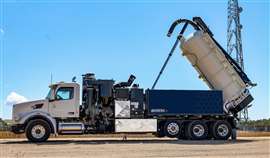 The tank has a combined 50-degree dump angle, 60-in. dump height and proprietary twin tank vibrators to facilitate spoils removal. (Photo: Huber Corporation)
“On the top of those cylinders is [an integrated] safety valve. If we were to lose a hydraulic hose, there’s a counterbalance valve as a safety feature that would stop that door from falling,” said Holder. “We also have manual tank props – four locking rods – for safety during maintenance. You have to get inside the tank to change the float ball, which [is part of] a standard maintenance interval, so that safety feature is huge.”
In addition, one-touch rear door unlock with auto-lock is designed to streamline cleanouts, reduce dump site trips and keep operators safely on the ground. “With just one push of this lever, you can open the rear door,” Holder said. “You don’t have to climb to unlock anything.”
To speed unloading of material, the tank has a combined 50-degree dump angle, 60-in. dump height and proprietary twin tank vibrators that oscillate intermittently. “When you get the tank at 50 degrees, you hit a button and [the vibrators] agitate, shake the mud and allow the tank to evacuate the load easier,” said Holder.
The tank comes equipped with a decant outlet to drain water from the tank to accommodate additional spoils. An optional sludge pump is also available.
“When you hydro excavate, because you’re jetting, you’re going to pull a lot of water into the truck and that is not what you want to haul,” Holder stated. “So, the [sludge pump] allows you to pump that water off elsewhere so you can keep digging.”
Design partners
The Baron HX, which requires a minimum of 450 hp, comes standard mounted on a Peterbilt chassis and is typically powered by a Cummins L9 diesel engine.
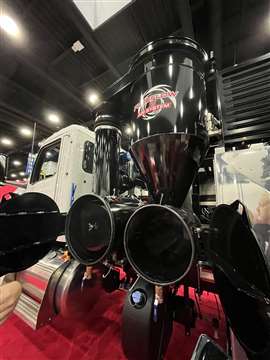 The PureFlow 9 nine-stage cyclone system to optimize engine idle for peak performance, reduced noise and improved efficiency. (Photo: Becky Schultz)
“We have a very good relationship with Peterbilt Corp. and this is their chassis. We work directly with the engineers at Peterbilt to do two things: frame layout so we don’t have to drill so many holes in that frame, and weight distribution and calculations,” Holder explained.
Huber also works directly with Allison Transmission to address the system’s unique requirements for the driveline. As Holder noted, a hydro excavation system requires high horsepower to run the pump, requiring the truck engine to turn the transfer case rather than a power take-off (PTO). But one of the main complaints of any transfer case is lack of engagement.
“We’ve built a program with Allison that [allows for] 100% engagement every time you turn the transfer case… The driveline comes out of the rear of the transmission and that turns on an Omsi transfer case; it changes the power 2:1 up to the blower,” said Holder. “We use [the program] on all our products now.”
Both the motor and hydraulic pump are run off the transfer case, he continued. “What that does is it allows the efficiency of using that engine… You don’t have a separate PTO.
“Because of the way we set up our systems, that also allows us to size our hydraulics precisely for what this [machine] does,” Holder added. “So, you have less gallons you have to put in the truck, which is less maintenance costs, etc. Hydraulically, this is all run off one single pump.”
POWER SOURCING GUIDE
The trusted reference and buyer’s guide for 83 years
The original “desktop search engine,” guiding nearly 10,000 users in more than 90 countries it is the primary reference for specifications and details on all the components that go into engine systems.
Visit Now
STAY CONNECTED



Receive the information you need when you need it through our world-leading magazines, newsletters and daily briefings.

CONNECT WITH THE TEAM