Read this article in 中文 Français Deutsch Italiano Português Español
Moog aims to electrify with lower cost and complexity

03 August 2026
Moog (“Mōg”) was founded in July 1951 by brothers Bill and Art Moog and Lou Geyer with just $3,000 they pooled together and space in the corner of a dirt floor airplane hangar to produce Moog Valve’s first product, an electrohydraulic servo valve. Over the 75 years that followed, the company grew from its humble beginnings into Moog Inc., a global leader in advanced motion control solutions employing more than 10,000 workers at 38 locations around the world.
Today, the U.S.-based company, headquartered in East Aurora, N.Y., produces a broad spectrum of solutions for aerospace, defense, industrial and medical applications – where precise control of velocity, force, acceleration and fluid flow are critical. Its products encompass all forms of actuation technology, advanced control electronics and system software.
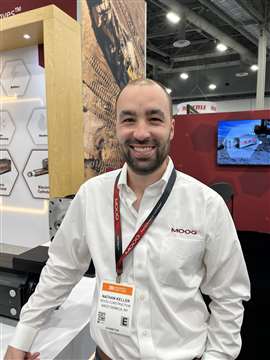 Nate Keller, business development manager, Moog Construction Group. (Photo: Becky Schultz)
Among its offerings, Moog has a complete electrification portfolio coupled with decades of experience leading the transition to electric in several different industries, said Nate Keller, business development manager, Moog Construction Group.
“Now, our sights are set on the construction industry,” he stated. “We all know it will move to electric. We’re here to help it move along.”
Overcoming the barriers
One of the challenges the construction industry faces, said Keller, is that many of the electric machines currently being built by OEMs never move beyond the concept or prototype stage.
“They’re not really scalable or production-level machines. [If you] look under the hood, there’s a lot of cables, a lot of extra boxes,” he noted. “To be able to scale them, things need to change. [You] need to make them less complex, pull costs down. You have to increase the reliability.”
Cost has been a major barrier to electrification, with batteries largely viewed as the biggest cost driver. However, there are other aspects that add both expense and complexity to an electric machine, Keller said, including all the extra cables and boxes utilized and the ways in which they are typically packaged.
To alleviate this concern, Moog has developed the Adaptive Electrification Management System (AEMS). The modular, universal system sits inside the vehicle like a compact “bookshelf” and contains a configurable controller, DC/DC converter, high-voltage distribution and single- and dual-axis inverters.
“A typical electrical architecture has a lot of different boxes, and all those boxes have to be connected together with high voltage cables, [which are] very expensive and you have points of ingress for dirt and water, which means lower reliability,” Keller pointed out. “The way we have gotten around a lot of the packaging challenges with all the external cables that you would normally need is we have created a common bus bar that runs across the top… We also have a common cooling manifold, so we eliminate all the hoses and connectors to run coolant through all the power electronics.
“By eliminating all the high voltage cables that go from box to box, and with the coolant manifold, we’re able to save upwards of 30% on cost for the high voltage cables, as well as over 80% of the coolant cables and coolant connectors.”
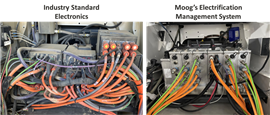 At left is an industry standard example of electrification; at right is the AEMS platform. (Source: Moog)
In addition, the patent-pending electronics system can manage multiple electric vehicle functions simultaneously with streamlined software architecture, which Moog said enhances performance and reduces power loss.
“What this system does is it helps reduce the complexity, it reduces cost and it puts reliability back in the system,” Keller stated. “At the end of the day, an end user is going to buy a machine if it makes them more money, increasing productivity, decreasing total cost of ownership (TCO). It’s the bottom line that matters. So, if OEMs can provide a machine that [does that], it will sell. So, we’re trying to help with that.”
Simple and scalable
AEMS is scalable in terms of machine size and type. OEMs are able to electrify and automate a range of machinery, from 6-ton compact track loaders to 25-ton excavators.
“It’s just a matter of how many electric motors they want to control on the machine, and then from there we can set up whatever configuration is needed,” Keller explained. “What’s really beneficial is, for example, you just need to use one inverter and one part number for all of those machines, so it scales across all those different platforms.”
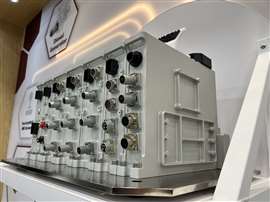 AEMS contains a configurable controller, DC/DC converter, high-voltage distribution and single- and dual-axis inverters. (Photo: Becky Schultz)
By substantially reducing both part counts and inventory complexity, AEMS enables OEMs to deploy a single electrification and software platform across equipment lines, accelerating development timelines and lowering costs, Moog asserted.
“We recently developed a machine for an OEM with AEMS, completing all system programming in under 15 minutes,” Keller said, adding, “AEMS reduces testing and configuration time by up to eight hours and supports over-the-air software updates post-production to add new features seamlessly.”
The system’s modularity enables rapid on-site module replacement, as well. “These modules are designed to slide in and out like a book in a bookcase,” said Keller.
“All you need to do is disconnect a couple of connectors and the module will slide out, slide a new one back in, put your connectors back on. It’s very easy to do,” he explained. “The controller that’s built into the AEMS solution will automatically detect what motors it’s trying to control and auto-configure that drive. The technician doesn’t have to go in and manually put in a new code or flash anything on there.
“So, all said and done, you can replace one of these modules in under 15 minutes.”
To further simplify maintenance, advanced diagnostic systems are built into the system. “It’s able to help the technicians detect what’s going wrong, what’s failed, and then they’ll be able to pinpoint where that’s located,” Keller noted.
AEMS was designed with such serviceability and reliability in mind, he said, “with the ultimate goal of reducing cost for the OEM and increasing the uptime for the end user.”
Partnership with OEMs
Announced in early February 2026 and shown for the first time at ConExpo-Con/Agg in March, AEMS is production ready and is currently in use powering prototypes such as the Bobcat Rogue X3 fully electric and autonomous loader, also shown at ConExpo.
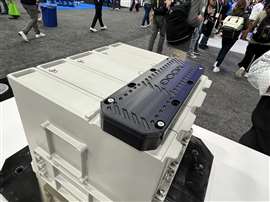 A common bus bar on top of the system eliminates the high voltage cables that typically go from box to box. (Photo: Becky Schultz)
Previous versions of the system were integrated into Bobcat’s T7X all-electric compact track loader, S7X all-electric skid-steer loader, Rogue X1 and Rogue X2, as well as the Case 580 EV electric backhoe loader. Moog said additional OEMs are actively evaluating AEMS for various machine platforms.
The company can support smaller volumes for prototypes and aftermarket integration, Keller said, but the main target is high-volume new machine applications. “If you can get that higher volume production, then you can have a lower cost for the OEMs, but also for the more specialty machines and integrators,” Keller commented.
“We really like to work with the OEM partner from the beginning, as they are trying to determine what the architecture should look like on the machine,” he continued. “As a collaborative partnership, we work to determine what’s the best architecture, what’s most cost effective… We’ll work very closely with them and then determine what that architecture or setup [should be].”
Overall, Moog believes it has a unique solution that can help OEMs electrify their equipment more quickly and potentially speed acceptance of those products among end users.
“If an OEM wants to sell a machine, it needs to be at a price point that the end user will accept, as well as making sure that the machine is going to be reliable,” said Keller. “Our solution is a patent-pending solution – there isn’t anything out there like it. If you want to increase the reliability of your electrification system and lower the cost of your total system, AEMS will help you do that.”
Electrification through actuation
Moog offers other solutions to facilitate the transition to electrification in construction, including electromechanical actuators in a wide range of sizes – from those expansive enough for airplane simulators down to micro-sized variants used in the defense industry.
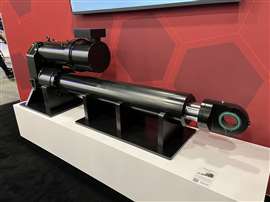 A Moog electric linear cylinder on display at ConExpo-Con/Agg 2026. (Photo: Becky Schultz)
For construction equipment, these actuators are most likely to be used in applications requiring heavy automation or where there is zero leak tolerance, said Moog’s Nate Keller. For example, they can be found on the Bobcat T7X all-electric compact track loader as well as its Rogue X3 electric, autonomous loader.
But there is a size limit when it comes to practical implementation. “When it comes to the larger equipment, or machines that normally have a lot of hydraulic cylinders, it can become cost prohibitive,” Keller noted.
Adding electromechanical actuators to the boom of a large excavator, for example, can substantially increase the weight on the front end, necessitating more counterweight on the rear to maintain the center of gravity, he pointed out.
“[The actuators are] also quite expensive once you get up to that size. So, we don’t see hydraulics going away. This industry is safe, especially the bigger machines,” Keller stated.
Conversely, to retain their current price point, the smallest compact machines are unlikely to see electric actuators anytime soon.
“We really don’t see, in the near term, electromechanical actuators outside of the 6- to 10-ton range,” said Keller. “There’s really a sweet spot between that 6 to 10 tons.”
Although he believes the construction industry isn’t quite ready for the technology on a broad scale yet, Keller expects the market will eventually become more and more automated and autonomous. That’s where such actuators will play an increasingly larger role.
“There’s not a strong market for them now, but in the coming years, in a decade or so,” he estimated. “The reason for that is they have all the feedback that is needed built in; whereas a hydraulic cylinder, if you want to have the automated capabilities, you have to add a lot more sensors.”
With electromechanical actuation, you know exactly what position the actuator is in, how much force is being applied, the temperatures, etc., at all times, Keller pointed out.
“If you have force and position known, you can do any automation.... If an OEM is designing a system and they put these in now, they already have the full autonomy capability when the market is ready.”
POWER SOURCING GUIDE
The trusted reference and buyer’s guide for 83 years
The original “desktop search engine,” guiding nearly 10,000 users in more than 90 countries it is the primary reference for specifications and details on all the components that go into engine systems.
Visit Now
STAY CONNECTED



Receive the information you need when you need it through our world-leading magazines, newsletters and daily briefings.

CONNECT WITH THE TEAM