Read this article in 中文 Français Deutsch Italiano Português Español
New marine tech directions for Rolls-Royce

10 September 2026
Julian Buckley meets Tobias Kohl at the SMM show in Hamburg to get more on development of new marine power tech at Rolls-Royce
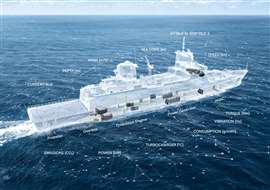 A wide variety of factors can influence vessel efficiency (All photos supplied by Rolls-Royce unless otherwise noted)
“From an efficiency perspective, diesel engine technology is very much at the edge of its potential,” says Tobias Kohl, Rolls-Royce Power’s vice president of Marine Application Engineering. “You can improve injection systems, turbocharging, combustion chamber dynamics, but in the end it’s technology which is already very much optimized.
“But we can benefit from that tech when looking at other fuels which can be used in an internal combustion engine.”
Kohl’s comment came in response to this question: as no ‘alternative’ fuel has the power density of diesel, should the next step be to improve engine efficiency to where methanol, ethanol, ammonia or hydrogen deliver an equivalent per-kilo power output to diesel?
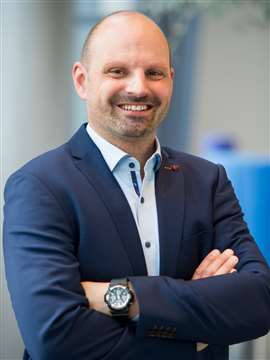 Tobias Kohl, Rolls-Royce Power
This, Kohl says, is primarily a question of engine load and speed. “No matter the fuel, if you operate an engine in its sweet spot, you will always achieve the best efficiency. But to really get the most from that engine, we believe you need intelligent load management that uses batteries – we call that combination ‘diesel engine plus’.
By way of explanation, Kohl puts forward the example of a gen set onboard a vessel. Used to deliver auxiliary power, the generator’s engine almost never works at optimal speed, usually falling well below that point. Adding a battery pack means the gen set will only come online when necessary, running at the best load and speed. That energy is then stored in the battery packs for later delivery.
He says there are other advantages. The battery pack can cancel out power delivery fluctuations and, while the vessel is docked, it can cut operating costs by only using grid power during cheaper periods – a form of peak shaving.
Emissions aftertreatment
Operating an internal combustion engine using an alternative fuel in combination with a battery pack can help to build overall efficiency. But considering the improvements of emissions aftertreatment systems, could it be that these new fuels are prematurely displacing diesel?
“The biggest challenge for emissions aftertreatment systems in marine applications has been the perceived lack of benefit for the owner. On a yacht, they see a system which increases the engine footprint. They see additional weight. And there are additional costs, such as the AdBlue urea fluid. With all this, the vessel is still not going any faster, it’s not any quieter.”
In response, Kohl says that Rolls-Royce has developed third-generation emissions aftertreatment systems which are smaller, lighter and more efficient than ever. “We have optimized the system and the improvements are significant. We think that this will make the systems more acceptable to ship builders and owners.”
This raises the point of whether the goal of Rolls-Royce in developing these systems is to improve the efficiency of the engine or the vessel.
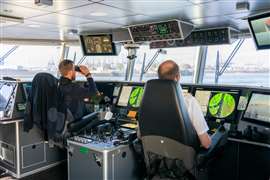 Bridge on the Halunder Jet ferry, which uses four mtu 4000 diesel engines and water jet thrusters
“Both,” replies Kohl. “As I said, the engines have been optimized by incorporating the latest technologies. We’ve been working on that for more than 100 years,” he adds with a smile. “So to gain further advantages we have to think holistically about the whole power installation and how that system interacts with the vessel.”
With regards to poor execution, he recounts how a yacht had been fitted with a generator simply to heat the onboard swimming pool. “Now we can use the CHP [combined heat and power] system to do exactly the same thing. I don’t like the term ‘waste’, but that’s essentially what we’d use now for the same purpose.”
Rightsizing delivers benefits
New fuels clearly offer a benefit in terms of reduced emissions, but rightsizing of engines – selecting the model that matches the required output, instead of simply the largest on offer – is set to play a considerable role in improved vessel efficiency.
“If a ship or yacht comes in for a refit, you can look at the data, see how the engine has been operating, where and how it has been running. From that information it’s possible to determine whether a smaller engine model would work in that application.”
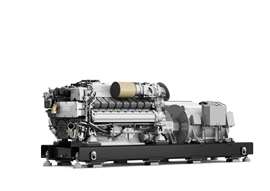 The Rolls-Royce mtu Series 2000 DS gen set engine can be used for marine auxiliary power
Kohl says there a series of key ‘levers’ when it comes to driving efficiency. Low-carbon fuels has a key role to play, while new technologies also play a part. A third element is how the vessel is operated.
“We have to look at what nature is giving us when considering efficiency,” he explains. “Tides and wind conditions impact how the boat is operated and how the engine is working. We have the mtu NautIQ Foresight system which helps ship captains monitor vessel performance and make decisions that can deliver performance efficiencies.”
This goes hand-in-hand with hull design, through to design of the propellers. Kohl says that a well-designed propeller can deliver gains of between 10 and 15% - a massive improvement which ultimately drives down operating costs.
Technology pipeline
In August this year, construction of the world’s largest battery-powered vessel was completed in Tasmania. Fitted with a 40 MWh, 275-tonne battery storage system, the China Zorrilla is a passenger and vehicle ferry that will complete crossings on the Rio de la Plata river between Argentina and Uruguay.
Kohl believes that while this is an extreme example of the technology, electrically-powered ferries have a strong use case.
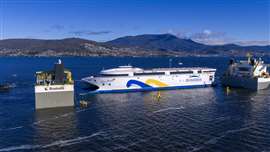 China Zorrilla ferry is loaded on the Black Marlin semi-submersible heavy lift vessel (Photo: Incat)
“When a vessel, such as a ferry, has a predictable route and there’s the capacity for recharging, that’s an ideal application for electric power and I see the technology continuing to develop over the coming years. At Rolls-Royce, we already have cases where the onboard generators are there only as a backup to the battery system, much like a range extender in a car.”
Looking specifically at the case of the China Zorrilla, Kohl says that he likes that someone is taking the risk, extending current technology to its absolute limits. But he’s doubtful that this will have any dramatic impact on development of large ferries. The opposite is true for smaller ferries; he points to battery-powered vessels already operating in Scandinavia as a more pragmatic use of the technology.
As for future marine tech at Rolls-Royce, Kohl had this to say: “We will continue developing combustion engines. We strongly believe that for longer distances, unpredictable routes and to address infrastructure challenges, this is the only way.
“But along with that, I’d like to add that we see methanol as having great potential. So we will keep developing IC solutions, just in a way that supports alternative fuels.”
POWER SOURCING GUIDE

The trusted reference and buyer’s guide for 83 years
The original “desktop search engine,” guiding nearly 10,000 users in more than 90 countries it is the primary reference for specifications and details on all the components that go into engine systems.
Visit Now
STAY CONNECTED



Receive the information you need when you need it through our world-leading magazines, newsletters and daily briefings.

CONNECT WITH THE TEAM