Read this article in 中文 Français Deutsch Italiano Português Español
Partners begin testing of Nexa 95 renewable gasoline

15 July 2026
Nexa 95 is a drop-in replacement for fossil gasoline which can cut emissions by up to 70%
Repsol, Toyota, BMW and Bosch have launched real-world pilot testing of Repsol’s 100% renewable gasoline.
The six-month pilot that kicked off in July will see about 20 vehicles supplied by the OEMs using Repsol’s Nexa 95 100% renewable gasoline product.
Use of the fuel will be tracked using the Digital Fuel Twin system supplied by Bosch.
The pilot has three key objectives:
- Testing of the distribution network for the renewable gasoline; Repsol is currently the only provider of the fuel in Spain
- Readiness of digital tracking and certification technologies which certify/verify renewable fuel usage across the fuel lifecycle
- Demonstration that existing vehicle fleets can use 100% renewable fuels using existing infrastructure.
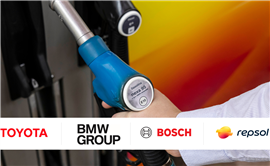 Partner companies involved in the Nexa 95 100% renewable gasoline project (Photo: Repsol)
The Digital Fuel Twin system will collect and validate refuelling data from multiple sources, including vehicle data, fuel stations and fuel card transactions.
Nexa 95 100% renewable gasoline is a drop-in solution that can immediately reduce the carbon output of vehicles using gasoline internal combustion engines.
“At Repsol, we believe every emissions-reduction solution has a role to play in decarbonizing transport. This project underscores how renewable fuels can expand consumer choice, offering another way to reduce carbon footprints using existing vehicles and infrastructure,” said Estíbaliz Pombo, deputy director of Energy Products at Repsol.
“As the only company currently supplying 100% renewable gasoline at public service stations in Spain, Repsol is proud to contribute its expertise and infrastructure alongside Toyota, BMW, and Bosch. The project’s real-world data will demonstrate the value of a technology-neutral approach to Europe’s mobility transition.”
Fuel production
Supplied details covering the test did not include specifics about production of the Nexa 95 100% renewable gasoline product, but there is more information on the Repsol site.
Nexa 95 is produced by converting renewable waste and biomass-derived feedstocks into hydrocarbons that are chemically equivalent to those found in fossil gasoline.
These sources can include: used cooking oil, agricultural and forestry residues, organic waste and other sustainable biomass and other certified renewable organic materials. According to related material, no virgin foodstuff is used in production.
The feedstocks undergo an ‘advanced refining process’ which includes hydrotreatment and catalytic upgrading to remove oxygen and transform the biological molecules into paraffins, isoparaffins and other hydrocarbon components that resemble those found in standard petrol. The hydrocarbons are then blended into finished 95 RON gasoline.
This differs from biodiesel or ethanol as the final product is immediately compatible with existing fuel systems.
 Repsol’s Tarragona facility - in 2025 it was announced that 800 million euros would fund the new Tarragona Ecoplanta (Photo: Repsol)
Nexa 95 is produced at the Repsol plant in Tarragona, Spain. This is reported to be the first facility to manufacture 100% renewable gasoline on an industrial scale. The precise chemical pathway used to produce Nexa 95, developed in part by Honeywell, has not been disclosed.
The fuel can be moved through existing distribution pipelines and tanker trucks and dispensed at standard filling stations.
Product distribution
According to related material, the Nexa 95 product can reduce net well-to-wheel CO2 emissions by about 70% compared with standard fossil gasoline. The CO2 reductions are gained from CO2 contained in the feedstocks; vehicles using the product will still produce tailpipe CO2 emissions.
The calculations are similar to those used to measure well-to-wheel emissions when using hydrotreated vegetable oil (HVO) as a drop-in replacement for diesel fuel.
Nexa 95 can be combined with fossil gasoline due to the similarity in hydrocarbons. But there would be implications for measurement of CO2 reductions.
Mixing with standard gasoline would make certification of the CO2 reductions difficult. But it is likely that without dedicated distribution and dispensing systems there will be some cross-contamination.
As such, to be marketed as ‘100% renewable gasoline’ Repsol would have to maintain chain-of-custody documentation. Issues related to contamination will need to be measured and documented by the Digital Fuel Twin system from Bosch.
In a commercial customer-facing setting, it could be possible for a gasoline retailer to certify a percentage of the renewable gasoline product by using a volumetric displacement system. A similar process is employed by Gasrec, a distributor of biomethane for heavy goods vehicles.
In that system, based on the volume of ‘green’ fuel added to the network, the dispensed product can be certified as green, even if not 100% pure at point of delivery.
POWER SOURCING GUIDE

The trusted reference and buyer’s guide for 83 years
The original “desktop search engine,” guiding nearly 10,000 users in more than 90 countries it is the primary reference for specifications and details on all the components that go into engine systems.
Visit Now
STAY CONNECTED



Receive the information you need when you need it through our world-leading magazines, newsletters and daily briefings.

CONNECT WITH THE TEAM