Read this article in 中文 Français Deutsch Italiano Português Español
Remanufacturing: Engines for the long run

24 November 2026
Caterpillar reman facility in Indiana handles 7 L and below
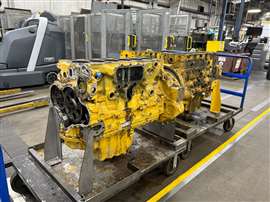 Each core is carefully inspected before the reman process begins in Franklin. (Photo: Chad Elmore)
Every week, multiple truck loads of used diesel engines arrive at Caterpillar’s remanufacturing facility in Franklin, Ind. The team then determines which cores are accepted into inventory – it’s one stage in a journey that begins at Cat dealerships around the country. Once inside the facility in Franklin, each engine goes through additional steps, each patterned after the processes that created the powerplant in the first place – but with several important differences. Unlike manufacturing a new engine, once inside the facility in Franklin, each engine goes through a series of steps central to the remanufacturing process.
Remanufacturing combines two challenges: building an engine that performs like-new and recovering any components that can be used again.
“I’ve always enjoyed remanufacturing, because it added a different additional level of challenge,” said Bryan Roberts, operations manager, Caterpillar Remanufacturing Franklin. “We have to do the same thing an OE facility would in putting these engines together, but we also have to figure out a way to get the core back to us, take it apart, clean it and reuse it. We really have two things that have to work together to be able to produce a reliable, remanufactured engine.”
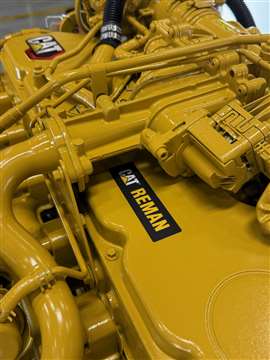 Caterpillar remanufacturers engines of around 7 L displacement or below in Franklin, Ind. (Photo: Chad Elmore)
At the facility south of Indianapolis, the company handles engines of around 7 L displacement or below; other Caterpillar remanufacturing facilities handle the larger powerplants.
The process
In Franklin, engines are disassembled, cleaned, inspected and then rebuilt using components reused when they meet strict criteria and replaced when they do not. The condition of the returned cores can vary. Some of the parts may pass inspection; others need machining or are unsuitable for reuse.
“With reman, we might have a day where we have 30% fallout on the cranks, while the next day could be 60% or zero,” said Roberts. “There is a lot of complexity in a reman program, but it reduces industrial waste and it helps our customers. It’s a pretty difficult process to develop, but one that we’ve got working well.”
Careful inspection of every part is central to the operation due to the variability of the cores that get sent in, and each tells a story of how well – or how poorly – the equipment and the engine itself were maintained. The facility uses standard work instructions to assess components, while quality controls track each engine through production.
As engines begin their journey down the assembly line, the facility uses a manufacturing execution system (MES) software which prevents an engine block from moving to the next station until each step is complete. The standards are not lowered when an engine is remanufactured.
“The software does not allow anything to move from one location to the next unless it’s gone through all the quality checks which are based on the serial number of the specific engine and its specifications,” said Shane Miller, factory manager, Caterpillar Remanufacturing Franklin. “The assembly process is treated like an OE facility would, especially as far as the level of criteria that we’re holding our assemblies to.”
The result
When assembly is complete, testing is another important checkpoint. Every engine goes through a dynamometer test, with the total run time and requirements depending on the model.
“It is very important that every engine that goes out performs like a new engine would,” said Jeremy Eldridge, senior process engineer, Caterpillar Remanufacturing Franklin. “For our final quality check, when I put that engine in the dyno, I’m running it through the exact same test that the engine will run through the OE facility. It’s not just a simple spin test. It runs through a rigorous test that’s got some tight parameters that will show if the reman engine’s not built right. If it’s not, it’s not going out the door. Every single engine goes through the dyno test.”
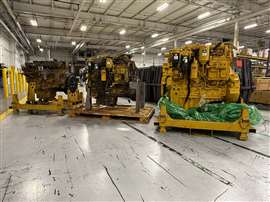 A before and after shot of the work that goes into each Caterpillar engine in Franklin, Ind. (Photo: Chad Elmore)
The reman process also relies on collaboration beyond Franklin and can involve Caterpillar’s product development teams around the world. Remanufacturing teams work with new-product engineering to share information about design changes and recurring issues. That feedback loop helps improve future products and make them easier to maintain and remanufacture.
Rather than compete with Caterpillar’s new engine business, the company believes remanufacturing is a complement to it. Remanufactured components and engines provide customers with additional aftermarket solutions to address their key challenges. When new supply is constrained, a remanufactured engine can provide customers with another option. When new supply is constrained, a remanufactured engine can provide customers with another option.
The facility’s work goes beyond returning a diesel engine to like-new condition. Its aim is to recover what can be used, restore components to specification and verify the finished product before it ships.
“We’re not trying to get a functional unit that gets you up and going for a duration of time, we’re going to give you a solution that’s going to provide you a cost-effective option to keep you running just like a new engine,” said Roberts.
POWER SOURCING GUIDE

The trusted reference and buyer’s guide for 83 years
The original “desktop search engine,” guiding nearly 10,000 users in more than 90 countries it is the primary reference for specifications and details on all the components that go into engine systems.
Visit Now


CONNECT WITH THE TEAM