Read this article in 中文 Français Deutsch Italiano Português Español
Rolls-Royce tech delivers high-quality power

20 March 2026
Rolls-Royce Power Systems’ Michael Stipa walks us through the world of prime and standby power for data centers and other superusers
 mtu 20V4000 diesel gen set (Photo: Rolls-Royce Power Systems)
Not unlike some regions around the world, there is a conflict in the power generation market. On one side, some national grids are unable to deliver the power needed by a growing number of superusers, such as new data centers. With grid connections unavailable, these facilities are turning to decentralized solutions capable of delivering the necessary power.
But on the other side of the same coin, there is an overarching need to reduce emissions across the energy generation sector. Yet how can this be achieved when diesel power still dominates the backup power market?
There are few people better placed to address this issue than Michael Stipa, senior vice president for Business Development and Product Management, Stationary Energy Solutions, at Rolls-Royce Power Systems. In addition to being responsible for strategy development for stationary power, he also looks at customer needs and market trends to determine the future direction of the company’s product roadmap.
 Michael Stipa, Rolls-Royce Power Systems
Prior to joining Rolls-Royce, Stipa was involved with a series of national energy providers across Europe, with a focus on renewable energy - there is a clear capacity here to gain insight on how best to manage power delivery for both large and small customers.
Stipa acknowledges that diesel is still the prevailing choice for standby power and he says that this is unlikely to change over the short- to mid-term. “The predominant reason diesel remains the leader in the standby power market is energy density,” he explains. “The units have a remarkably small, compact footprint, but energy density is the key. In each liter of diesel there’s about 10 kWh of energy.
“If the customer needs backup power for 72 or 96 hours, then you need to store the energy to support that and diesel has the energy density to make that easier, less expensive. There are battery energy storage systems (BESSs), but these are good for about four to six hours of energy delivery. But installing BESSs to support 96 hours of backup power – that might never be used. That’s just not economically feasible as a purely standby installation.”
Diesel issues
But diesel fuel comes with its own issues, not least of which is fuel degradation due to oxidation and microbial contamination of the fuel when stored over an extended period. Stipa says that this problem can be reduced by using B0 fuel which, unlike B7, has no biodiesel (FAME) content. He also notes that additives and fuel polishing systems can remove contamination present in stored fuel. But ultimately, the diesel will need replacing, which can be done on a fixed schedule or based on sample testing.
“Originally, the engines would be tested on a monthly basis, but with our manufacturer-certified extended test run interval, operators can extend their test runs to once every three months. That immediately cuts two-thirds of the emissions output.” Michael Stipa, Rolls-Royce Power Systems
HVO, or hydrotreated vegetable oil, is generally less prone to microbial degradation and can be stored for a far longer period. But the manufacturer must give approval for use of HVO and, while supplies are increasing in Europe and the US, the sustainable fuel is not always readily available.
E-diesel, or synthetic diesel, produced using green hydrogen and CO2, offers similar potential for emissions reductions. But it is expensive and again, not easily sourced, but production is increasing. The largest e-diesel production facility in Europe opened in Frankfurt in 2025.
Testing times
Besides fuel choice, there are various levels of aftertreatment system that can help address NOx and particulate emissions. But Stipa says that one area which does not get sufficient attention is reducing the testing program of the gen set.
“The engine in a decentralized power generation system needs to be tested to ensure it is ready to use. If you didn’t use your car for two or three years I doubt it would start. The data center operator has to be sure the engines are ready when needed.
“Originally, the engines would be tested on a monthly basis, but with our manufacturer-certified extended test run interval, operators can extend their test runs to once every three months. That immediately cuts two-thirds of the emissions output.”
Continuing, he says that Rolls-Royce is looking to extend the test cycle even further, while also looking at load levels and the necessary engine speed to ensure successful testing and validate system readiness.
Stipa: “We’re currently looking at limited testing and running the engine at idle speeds for shorter durations, only occasionally taking that up to operating speed. That will use less fuel and also help reduce related emissions.”
Of course, having zero combustion would be the cleanest way to test an engine. But Stipa says that while cold testing can validate a limited number of parameters, engine oil needs to be flowing to ensure there’s no engine damage, while auxiliary components also need validation, which can only be done with a hot test.
Improvements in engine tech can also help reduce emissions, according to Stipa. Increasing fuel injection pressures to create a air/fuel mix that has better fuel droplet dispersal supports the use of less fuel per compression ignition cycle, cutting particulate emissions.
Alternative solutions
Going back to the power requirements of data centers, the first-choice source for prime power delivery is the grid. But in cases where the grid does not have sufficient power to deliver a connection, decentralized prime power is required to bridge this gap.
This is a case of power security, says Stipa: “National grids are not keeping up with the growth in the data center market. But even if there is a connection for prime power, energy delivery can be erratic.
“This creates a security of supply issue, where the grid might not deliver power for the full 8,760 hours each year. Even if they offer a connection, there is possibly still some concern that draw will outpace supply. This is where gas engines come into play, delivering bridge power until a secure grid connection is established.”
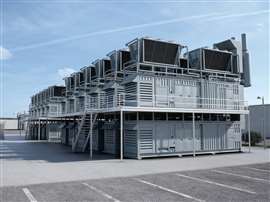 mtu gaseous fuel modular engine power plant (MEPP) (Photo: Rolls-Royce Power Systems)
Gaseous-fuel engines produce significantly less emissions than diesel. And although they do not have the same capability as diesel in being able to ramp up to full load in less than 15 seconds, significant enhancements are in development. According to Stipa, modern gas engines can achieve full load in between 90 and 120 seconds. And Rolls-Royce is now developing a fast-start solution which could be capable of achieving the same in just 45 seconds.
That gap in time before full load is achieved can be filled by power delivered by a UPS, or uninterrupted power supply. This acts like a BESS, but has inverters and other tech that allow almost immediate delivery of maximum energy. But unlike a BESS, the UPS will be drained in minutes rather than hours.
Kinetic energy
There is, though, a dynamic UPS system. This consists of a flywheel that stores kinetic energy taken from the prime power source. In the event of a power outage the grid will disconnect – and the flywheel immediately delivers power as it is mechanically connected via a synchronous alternator. This happens without interruption, voltage dip or frequency deviation.
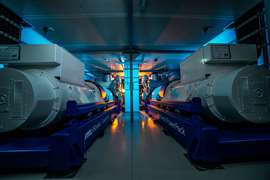 mtu kinetic power pack at Vetter Pharma (Photo: Rolls-Royce Power Systems)
The kinetic storage system is usually housed in a dedicated location or within the building structure, but there are also versions which reside in a modular container.
It might seem that a supercapacitor would be a better fit for this application. But Stipa explains that inherent features of the technology mean these lack some critical capabilities.
To start, the kinetic flywheel energy storage method is just that – kinetic. So it is essentially a mass-loaded wheel that retains mechanical energy. On the other hand, a supercapacitor holds electrical energy and, while it has a very high power density (in terms of MW), the energy density (measured in MWh) is still comparatively low.
“This is why we use the kinetic energy storage system,” says Stipa. “The supercapacitor holds energy as electricity, so no conversion is necessary. That can help with rapid power delivery. But when you need delivery measured in megawatt hours, the supercapacitor cannot compete with the kinetic energy solution.”
To sum up, Stipa notes that if you want to have a lot of energy over a very short time period, that’s a supercapacitor. For a lot of energy over a longer timeframe, that’s the kinetic rotating mass solution. For an even longer timeframe, measured in hours and days, the solution remains diesel.
“The kinetic system can even replace the UPS and BESS as part of a standby power delivery system,” says Stipa. “It’s considerably less expensive and the power it delivers is very high quality. This is very important for some industries, such as semiconductor production, as any deviation in electrical current quality can ruin a batch of very expensive chips.”
Small modular reactors
 Concept image of an SMR installation (Photo: Rolls-Royce Power Systems)
Another decentralized energy source being investigated by Rolls-Royce are SMRs, or small modular reactors.
Developed in the UK, the technology draws on more than 50 years of related experience from within Rolls-Royce covering nuclear reactor design, regulatory engagement, manufacturing and installation.
Each SMR can deliver 470 MW of low-carbon energy, which is equivalent to about 150 onshore wind turbines. That energy could power 1 million homes – or potentially serve as the prime power source for a data center installation.
In 2024, Rolls-Royce SMR moved into the final stages of UK regulatory assessment, 18 months ahead of any other SMR design. In 2025, Rolls-Royce SMR was named as the selected technology in the Great British Nuclear SMR competition.
POWER SOURCING GUIDE

The trusted reference and buyer’s guide for 83 years
The original “desktop search engine,” guiding nearly 10,000 users in more than 90 countries it is the primary reference for specifications and details on all the components that go into engine systems.
Visit Now


CONNECT WITH THE TEAM