Read this article in 中文 Français Deutsch Italiano Português Español
Solid state battery production at ProLogium

06 March 2026
At the groundbreaking ceremony for the ProLogium plant in northern France, Julian Buckley spoke with Catherine Sung about manufacturing processes and the future potential of solid state battery cells
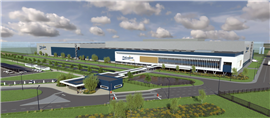 Rendering of future ProLogium plant in Dunkirk (Photo: ProLogium)
Lithium-ion batteries in all their various chemical combinations have become ubiquitous around the world. From handheld devices to cars and trucks, if it has a battery it’s probably using a lithium-based formula.
These batteries have undergone some dramatic improvements, but issues remain. Extremes of cold and heat can impact performance and safety, while maximum energy density is capped at around 250 watt hours (Wh) per kilogram. As such, a battery-electric passenger vehicle needs to carry about 500 kg of li-ion cells and supporting hardware.
Lithium-ion batteries are so-called due to the liquid lithium salts used as an electrolyte – this is the medium used to pass charged/discharged ions back and forth between the anode and cathode. To prevent free electrons from making the same journey, each cell has a separator. If this barrier degrades or is punctured, it can create conditions for a thermal runaway event.
As the name suggests, solid state batteries replace the liquid electrolyte with a solid medium. Made from ceramic, glass or plastic, this acts as its own separator between the two electrodes. Because this layer is so strong it’s possible to replace the graphite anode of a li-ion cell with one made of lithium (or other high-performance material), which can deliver a higher energy density (+/-400 Wh/kg).
The solid electrolyte can also manage much higher temperatures, which means solid state batteries can be recharged at significantly higher rates – which translates to a shorter recharge time. Also, the capability of the cell to store energy degrades more slowly, meaning they can manage many more charge/discharge cycles than a li-ion equivalent.
But there’s a catch – while offering clear benefits over li-ion cells, solid state batteries are expensive and difficult to manufacture at scale. This is because the layers that make up the solid electrolyte expand and contract as they heat and cool, taking the layers out of alignment to where it impacts performance.
Key announcement
So, with all that in mind, the winner of the solid state battery race will be the first to perfect volume manufacturing of the layered solid electrolyte to where it can withstand temperature changes without the core deforming.
In September 2025 at the IAA Mobility event in Munich, Germany, Vincent Yang, founder and CEO of ProLogium Technology, announced that after two decades of R&D, the company was ready to present its Gen4 superfluidized all-inorganic solid state lithium ceramic battery.
“This is not just a laboratory concept, but a verified, mass-producible system,” said Yang, who continued: “Its core innovations [are] our patented SF-Ceramion electrolyte, 100% silicon anode and 100% ceramic separator, which together define a new standard for next-generation batteries.”
Site selection
Up until Yang’s announcement covering the Gen4 batteries, ProLogium had been continuing research and production of battery cells at its plant in Taiwan. But supported by new investment streams, it was time to take the company’s latest technology into new markets.
 Guests at the ProLogium groundbreaking included senior French government ministers (Photo: Power Progress)
It was a wet and windy day in February this year that French government ministers and other guests came together to witness the groundbreaking ceremony for the new ProLogium gigafactory solid state battery cell manufacturing plant. Located near Dunkirk in northern France, the company is targeting an output of 4 GWh from 2028.
Catherine Sung, ProLogium’s head of Global Strategy and France Operations, offered more details about the site selection.
“The new plant had to be in Europe, as we had significant investors in the project who want the gigafactory in closer proximity to their own locations. When we started we had about 90 sites under consideration. From those we shortlisted five potential locations, including Dunkirk.”
Key to the final selection of Dunkirk was the availability of sufficient power and also power generated using clean technology. This will help to further reduce the carbon footprint of the battery OEM.
 ProLogium site in Dunkirk, France is adjacent to port terminal (Photo: ProLogium)
“Of course, Dunkirk port is right on our doorstep,” continued Sung – the container operations were clearly visible from the ProLogium site. “We can use that link to bring in materials and export finished cells, which will help to streamline our logistics.” She added that customers will be located across Europe, Asia and the United States.
Production plans
Mass production of an earlier generation of ProLogium battery cells started in 2013 in Taiwan. At that point, the cells were largely for consumer electronics and other fields; this included medical applications, as the superior safety level of the battery cells make them suitable for use in close proximity to the patient.
“From this point, we started to improve our production technology,” says Sung. “We switched from producing cells using a sheet-by-sheet basis to a roll-to-roll method. We introduced the first version of this in 2017.”
“This is not just a laboratory concept, but a verified, mass-producible system” Vincent Yang, ProLogium
Sung explains that the roll-to-roll method plays into the physical nature of the solid electrolyte used in solid state batteries, which while solid has some minor flexibility. “This flexibility of the electrolyte material supports roll-to-roll production and in turn, it is this which is critical to mass production,” she says.
Another element supporting volume cell production is the Logithium technology developed by ProLogium. The system’s core function is described as a ‘unique frame adhesive separation structure that improves battery yield and prevents shorting’. But the system can also help with alignment of the electrolyte layers and correct connection of the anode and cathode.
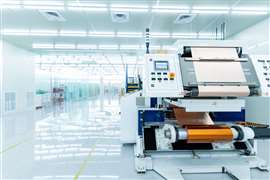 Roll-to-roll system at ProLogium plant in Taoke, Taiwan (Photo: ProLogium)
The individual battery cells are connected using a bipolar method that links the anode of one cell with the cathode of another. The design minimizes inactive material, while increasing energy density and conductivity to ultimately deliver a higher voltage. Challenges include management of interface resistance and ensuring mechanical stability.
“With conventional batteries, the wiring is all external,” explains Sung. “With the bipolar method there is minimal wiring. Really, you only need to touch the cells together. This is why the Logithium system is the foundation of our technology. It is what allows the bipolar layout.”
A further part of the solution is the separator; as noted by Yang in his IAA presentation, instead of plastic the cells produced by ProLogium use a ceramic material. This barrier has superior mechanical strength and, combined with excellent thermal stability, there is virtually zero chance of a short circuit.
Unlike other cells which use a solid sulphide-based electrolyte, ProLogium’s solid state battery does not need external pressure to support production or operation. Instead, the lamination process depends on temperature to get the necessary adhesion. This creates the interface between the electrolyte base and what Sung describes as “the active material.” Asked what that is, she declines to say as this is proprietary to ProLogium.
While not needing pressure, the electrolyte does require a dry room for assembly of the core. This is because if moisture is present during the layering process it can impact final product quality. So, as Sung notes, some considerable investment has gone into creating both a dry room and suitable assembly equipment.
Flexibility through automation
Having introduced roll-to-roll production in 2017, in 2024 the ProLogium plant in Taiwan reached the gigawatt annual production output mark. It is this technology which Sung explains will be duplicated at the Dunkirk site.
“We’re going to explore opportunities across a series of markets” Catherine Sung, ProLogium
“The plant will be almost 100% automated,” she says. “We will load and unload the rolls manually, but almost every other operation will be completed using some level of automation.”
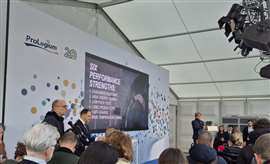 Vincent Yang speaking at groundbreaking ceremony for new ProLogium plant (Photo: Power Progress)
The automation also helps with production flexibility. ProLogium will be manufacturing solid state cells of various sizes based on customer requirements, so the capability to adjust automated processes to deliver those cells is fundamental to the business model.
“We’re going to explore opportunities across a series of markets,” she adds. “We’ll be working with electric vehicle OEMs, but also companies producing battery-electric storage systems, aerospace applications and possibly robotics as well.”
In planning the Dunkirk production line, Sung says that there will be opportunities to further combine operations and processes based on technology and capability. This, together with other factors, will help ProLogium achieve its first goal of producing 4 GW of battery storage, which Sung says is between 40,000 and 50,000 individual cells of varying capacities.
POWER SOURCING GUIDE

The trusted reference and buyer’s guide for 83 years
The original “desktop search engine,” guiding nearly 10,000 users in more than 90 countries it is the primary reference for specifications and details on all the components that go into engine systems.
Visit Now


CONNECT WITH THE TEAM