Read this article in 中文 Français Deutsch Italiano Português Español
Toyota Motor joins Cellcentric partners to develop H2 fuel cell

31 March 2026
Daimler Truck, the Volvo Group, Cellcentric and Toyota Motor have signed a non-binding agreement to cooperate in development of the Cellcentric fuel cell system.
This will make Toyota the third equal partner in the Cellcentric project.
The goal of the partners will be to develop, produce and commercialize fuel cell systems for heavy-duty vehicles and other related applications.
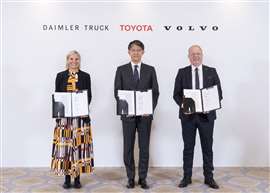 (Left to right) Karin Rådström, president and CEO of Daimler Truck, Koji Sato, president of Toyota Motor Corporation, Martin Lundstedt, president and CEO of Volvo Group (Photo: Toyota Motor)
Toyota and Cellcentric will jointly manage development and production of the fuel cell unit cells – the core component of fuel cell systems – linking architecture and control elements to create competitive products based on tech from both companies.
Through collaboration with industry associations and partners across the entire hydrogen value chain, the partners are also aiming to actively support the development of hydrogen supply and infrastructure in the early stages.
Karin Rådström, President & CEO, Daimler Truck, said: “We are proud that Toyota plans to join Cellcentric as a shareholder. This will enable us to strengthen development and further scale hydrogen technology, which we believe complements battery-electric drives in decarbonising transport.”
Koji, Sato, President and CEO, Toyota, said: “Cellcentric, which possess deep expertise in commercial fields, together with Toyota’s over 30 years of fuel-cell development in the passenger car sector, can combine their strengths to deliver one of the world-leading fuel cell systems for heavy commercial vehicles. Toyota will continue to contribute to realising a hydrogen society alongside like-minded partners.”
In early 2025, Toyota announced that it had completed development of its third-gen hydrogen fuel cell technology. Click here for full article.
According to details released by Toyota at the time, the new third-gen fuel cell system was designed to meet the ‘particular needs’ of the commercial sector. Specifically, the system is said to have twice the anticipated lifetime of the previous version, making it equivalent to a conventional diesel engine.
Complementing that, the new system offers 1.2 times the fuel efficiency of the gen two model, which should help to reduce operating costs.
Perhaps most importantly, Toyota has been able to achieve significant cost reductions across the cell design and manufacturing processes, which should help to make FC-powered vehicles less expensive to end customers.
POWER SOURCING GUIDE

The trusted reference and buyer’s guide for 83 years
The original “desktop search engine,” guiding nearly 10,000 users in more than 90 countries it is the primary reference for specifications and details on all the components that go into engine systems.
Visit Now
STAY CONNECTED



Receive the information you need when you need it through our world-leading magazines, newsletters and daily briefings.
CONNECT WITH THE TEAM