Read this article in 中文 Français Deutsch Italiano Português Español
Trendlines: CE markets are growing, but don’t call it a boom

17 November 2026
 Source: Off-Highway Research
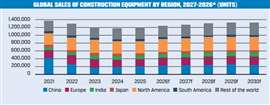
The global construction equipment market is growing again after three years of decline, but this is not shaping up as a classic industry upswing, according to Off-Highway Research. Worldwide sales rose 2% in 2025 and are forecast to increase another 3% in 2026. Even so, conflicts, geopolitical uncertainty, inflation, economic weakness, trade barriers, high interest rates and market saturation are expected to keep annual growth subdued through the rest of the decade.
Sales reached a record in 2021 as pandemic-era stimulus and low interest rates supported investment. The global total then declined from 2022 through 2024. China drove much of the initial fall after stimulus ended abruptly and the real estate market collapsed.
Elsewhere, markets remained strong longer, but rising interest rates, inflation and sharply higher equipment, material and labor costs eventually brought the cycle to an end.
By 2024, the global decline had slowed to 2% from 7% in 2023. Developed markets – including Europe, Japan and North America – were all down, while emerging economies provided most of the positive momentum. China began a gradual recovery, India benefited from purchases ahead of new emissions regulations and sales improved in South America and other emerging markets.
North America shows resilience
For U.S. stakeholders, the most important message is that North America absorbed the tariff shock better than many expected. Regional sales fell just 1% in 2025. At midyear, the combination of new tariffs, persistent inflation and higher-than-ideal interest rates had suggested a decline of 5% to 10% was possible.
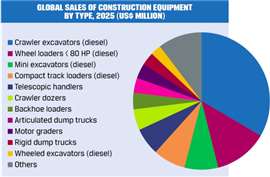
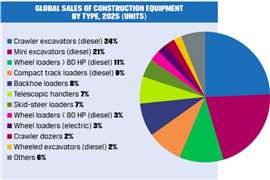
The headline number nevertheless masks a sharp divide between products. Mini excavators and telehandlers weakened, while a surge in compact track loader sales – and, to a lesser extent, stronger crawler excavator demand – offset much of the decline.
That split also reflected sourcing. Some of the steepest drops occurred in equipment categories that are predominantly imported, including articulated dump trucks, mini excavators and telehandlers, where tariffs added pressure to prices. Compact track loaders, by contrast, are largely manufactured in the United States and were the market’s standout performer.
 Source: Off-Highway Research
Growth has returned in 2026, with North American sales expected to rise 3%. The heavy end of the market should perform best, supported by infrastructure programs and a pipeline of data center and energy projects. The outlook is less dynamic for compact equipment. Housing construction remains flat as inflation and interest rates continue to weigh on mortgage affordability and household budgets.
That combination points to opportunity, but not across every product line. Suppliers exposed to large earthmoving equipment and U.S.-based production are better positioned than import-dependent businesses serving residential construction.
A global recovery with regional fault lines
China’s recovery accelerated in 2025, when sales rose 12%, although the market remained 55% below its 2020 peak. Electrification is now the clearest growth driver. Sales of diesel-powered equipment rose only 3%, while electric equipment sales jumped 115%. Electric machines reached 14% of the market, compared with 7% in 2024 and just 0.3% in 2021.
The underlying Chinese market remains difficult. Real estate is distressed, provincial governments have limited infrastructure funding and intense competition is pushing manufacturers to expand abroad.
Europe, meanwhile, appears to be rebounding after its 2024 hard landing. Sales were essentially flat in 2025 but are expected to rise 6% in 2026. The surprisingly robust improvement may partly reflect fleet owners replacing aging machines after delaying purchases during the downturn.
India should also return to growth after a 5% decline in 2025, which followed heavy buying ahead of new emissions standards. Sales are forecast to rise 6% in 2026 and move close to the 2024 record.
 Source: Off-Highway Research
Japan faces a slower recovery. Its normally stable market plunged 12% in 2025 as weaker construction investment, low consumer confidence, labor shortages and soaring material costs combined with relatively young equipment fleets. Used equipment disposal has become another obstacle because Southeast Asian markets are increasingly supplied with low-cost new Chinese machines. A return to more typical market conditions may take two to three years.
South America is comparatively stable. Sales increased 1% in 2025 as rebounds in Argentina and mining-led growth in Chile and Peru offset a 4% decline in Brazil. Sales are expected to remain broadly flat in 2026 before single-digit declines in 2027 and 2028.
The broader group of emerging markets outside the major named regions helped drive global growth in 2025, supported by Chinese manufacturers’ aggressive export strategies and resilient commodity markets. After several years of high sales, however, these markets are becoming saturated, and demand is forecast to fall 3% in 2026.
Growth but with a lower ceiling
Global sales are projected to continue growing at a modest pace through 2030.
 Chris Sleight is the managing director of Off-Highway Research, a market research and forecasting business specializing in analysis of the global construction and agricultural equipment markets. Formed in 1981 as part of The Economist Intelligence Unit (EIU), it is now the largest consultancy of its kind in the world, with offices in Chile, China, Germany, Japan, India, the U.K. and the U.S. OHR is part of the KHL Group. www.offhighwayresearch.com
Several constraints explain the lower ceiling. Global economic growth remains weak, inflation is persistent, trade barriers are disrupting established supply chains and geopolitical conflicts continue to undermine confidence.
Market saturation is another concern. Chinese manufacturers helped prevent a deeper downturn by supplying lower-cost machines to emerging economies, but the number of markets with genuine unmet demand is shrinking.
For North American businesses, the result is a market that rewards selectivity rather than broad optimism. Infrastructure, energy and data centers should support heavier equipment, while tariffs may continue to favor domestically produced machines over imported categories. Residentially exposed compact equipment remains more vulnerable.
The global market is expanding again – but the winners will be determined less by the overall growth rate than by product mix, manufacturing footprint and exposure to the right end markets.
POWER SOURCING GUIDE

The trusted reference and buyer’s guide for 83 years
The original “desktop search engine,” guiding nearly 10,000 users in more than 90 countries it is the primary reference for specifications and details on all the components that go into engine systems.
Visit Now


CONNECT WITH THE TEAM