Read this article in 中文 Français Deutsch Italiano Português Español
Volvo CE: ‘Electric is still the mission’

10 August 2026
At the welcome dinner for Volvo Construction Equipment (Volvo CE) a video was played of Melker Jernberg, President of Volvo CE, in a tuxedo doing various stunts involving cars and helicopters, interspersed with a live band on stage belting out songs from the James Bond movies.
 A video showed (a mostly AI) Jernberg performing action stunts worthy of James Bond. Image: KHL
While a lot of AI had obviously been used to complete the footage, during a sit-down interview the next day, Jernberg was keen to stress that some of the footage was him, that he did do some jumping and running around for the film – just not off a helicopter.
The video isn’t the kind of thing that every president of a multi-billion-dollar company would do, but that’s part of Jernberg’s brand – he’s the leader that seems approachable and affable, who takes business but not himself too seriously.
All the same, International Construction was interested to know how he would respond to someone who suggested Volvo CE had introduced electric equipment too quickly?
“I would say that they are right. We did the first two, the L25 and ECR 25 at Bauma 2019. At that point in time, we even debated, can we even have them in the booth? Should we place them in a corner? I said that they should be in the centre. If we convince ourselves that this is good, then it still takes time before you can deliver. And when you start to deliver, you also need a lot of other competence when it comes to software and electrification,” he says.
Live and let charge
He concedes that adoption of electric equipment has been slower than he would have liked but he remains convinced that the ‘S curve’ – a graph showing a natural cycle of slow initial growth, rapid acceleration and eventual stabilisation – will come.
“My view is that you can say that you are a quick follower and you just wait before you do it. I think that’s a risk. But if you invest early in the S curve, then you will, to your question, invest too early. But since you don’t know when this will happen, it’s just the insurance premium. And it’s not only us, because the whole industry of batteries, electric motors, inverters and chargers, are developing.”
Jernberg also makes the point that if Volvo CE hadn’t started when they did, with their first electric products delivered to customers in 2020, then their electric products would not currently be so developed.
“The products that we do now are much better. We are on the third generation now with the compact. If this never happened, then I will regret it. Since I am a strong believer that it will happen, I don’t regret it, but we are pre-investing, and we adjust. It’s not like we had a plan 2019 and we just blindly follow that.
“I’m proud that we are capable, enabled and profit generating, so we can do it. I think it’s important for everyone. Others have other strategies. But this is ours and I believe in it. Then I’m really hoping that the S curve will come quickly.”
The world is not enough
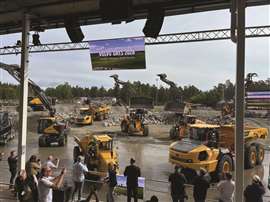 The OEM hosted the world’s press at its recent Volvo days event. Image: KHL
Volvo CE’s ambitions are global and at the ConExpo event in Las Vegas, US, it unveiled a US$1.2 billion strategic investment across North America, which included a US$261 million global crawler excavator expansion in Shippensburg, Pennsylvania.
At the press event Jernberg mentioned that the OEM is now increasingly focused on three areas – construction, mining, and quarry and aggregate – and that all these sectors are strong in North America.
“I think there are great possibilities primarily in construction, mining and quarry and aggregates and a lot of good things when it comes to products and services there. If you take the pure products, then of course the biggest part of our market and maybe the fastest growing is excavators. Our heritage is more coming from the loading and hauling.
“Excavator market shares are of course important for us product wise – that goes for all markets. In North America we have great opportunities. US is big, both in geography and on different product [markets].
“Compact is what it is, we are not that strong there yet, but both on the hauling and excavating, we absolutely have room to improve. I think we now have all the pieces in place to compete. North America is a tough market, but it’s important.”
Staying on the topic of international ambitions, Volvo CE officially ended its long-standing joint venture with SDLG on September 1, 2025. The end of the JV will affect the Swedish OEM’s strategy – and sales in China – but Jernberg was upbeat when discussing it.
“We had it for 18 years with a lot of good development together, both in China and outside China,” he says, adding that the end of the JV was like a “happy divorce.” He also makes the point that a high number of units sold does not always equate to a high profit.
Looking to the future, he says that the company is continuing to perform well in China and pointed to their factory in Shanghai, which is now producing excavators, electric wheeled loaders and compact machines.
As well as the ending of the JV, another change for the company came recently when it announced the closure of the Rokbak business, which produced articulated haulers. Jernberg says Volvo CE “fought quite hard” and tried several approaches, including rebranding the articulated haulers as Rokbak, but was ultimately unable to find a business model that worked.
Regarding the factory in Scotland, he says, “The future for Motherwell is hopefully great, because we have an extremely good competence base in Motherwell when it comes to hauling. They are a very important part of our technology teams and the competence for hauling, both rigid and articulated, and that will continue to help.”
Construction is forever
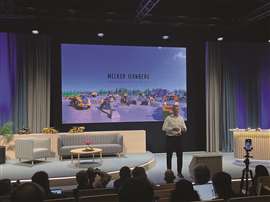 Melker Jernberg, President of Volvo CE. Image: KHL
The three segments that Jernberg identified as key focus areas – construction, mining, and quarry and aggregates – are estimated to grow between 5-6% annually. Jernberg, of course, wants Volvo CE to “grow a little bit faster than the market” in these areas, which would put the OEM in a very strong financial position.
Jernberg talks about business being fun – but only if you are winning – and that being in a healthy fiscal position means that they are in control of their destiny.
Part of this is undoubtedly linked to the ability to continue to develop and produce electric machines in anticipation of that S curve kicking in.
Jernberg talks about the TCO (total cost of ownership) benefits of electric equipment, but bristles slightly when it is suggested that this is becoming the focus, rather than sustainability – clearly the two go hand-in-hand.
“No, I don’t think it’s important that the message shifts,” he says firmly. “We cannot control how the world is moving, what’s on the headlines and spend energy on whether we have a problem or not with the planet? That is just sad that we don’t seem to be agreeing that we need to solve it.
“We focus on where we can make a difference. We can make a very small difference to influence the world by saying that they should be talking more about sustainability questions, but we can make a heavy difference in bringing products and services that helps the customer with lower TCO.
“It’s better to focus on that because that is the real shift. And that will, of course, support the sustainability question.”
The interview draws to a close and although Jernberg cannot pinpoint his favourite James Bond film, he does talk enthusiastically about the cars, specifically the Aston Martin and the Lotus Esprit that was also – handily, as it turned out – able to operate underwater.
Perhaps the best comparison with James Bond is the brief the secret agent gets from headquarters, so he knows the mission, prepares properly and is ready for when the big moment arrives.
That is how Jernberg talks about electric equipment. Volvo CE may have moved early, but he believes it moved early for a reason – and that being ready ahead of time will always beat arriving too late.
POWER SOURCING GUIDE
The trusted reference and buyer’s guide for 83 years
The original “desktop search engine,” guiding nearly 10,000 users in more than 90 countries it is the primary reference for specifications and details on all the components that go into engine systems.
Visit Now
STAY CONNECTED



Receive the information you need when you need it through our world-leading magazines, newsletters and daily briefings.
CONNECT WITH THE TEAM