

Read this article in 中文 Français Deutsch Italiano Português Español
MIT researchers develop vortex generators to cut ship emissions

08 December 2025
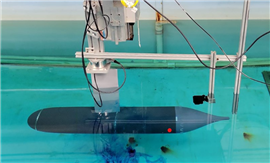 Vortex generator test rig at MIT (Photo: MIT)
Researchers at the Massachusetts Institute of Technology (MIT) have demonstrated that wedge-shaped vortex generators attached to a ship hull can reduce drag in the water by up to 7.5%.
This can cut fuel costs and overall emissions, the latter helping to meet the International Maritime Organization (IMO) goals of reducing carbon intensity of international shipping by up to 40% by 2030, compared to 2008 levels.
The related paper, ‘Net Drag Reduction in High Block Coefficient Ships and Vehicles Using Vortex Generators’, was presented at the Society of Naval Architects and Marine Engineers 2025 Maritime Convention in Norfolk, Virginia.
The researchers — José del Águila Ferrandis, Jack Kimmeth and Michael Triantafyllou of MIT Sea Grant and the Department of Mechanical Engineering, along with Alfonso Parra Rubio and Neil Gershenfeld of the Center for Bits and Atoms — determined the optimized vortex generator shape and size using a combination of computational fluid dynamics (CFD) and experimental methods guided by AI optimization methods.
The team first established parametric trends through extensive CFD analysis, and then tested multiple hulls through rapid prototyping to validate the results experimentally.
Scale models of an axisymmetric hull with a bare tail, a tail with delta wing vortex generators and a tail with wedge vortex generators were produced and tested. The team identified wedge-like vortex generators as the key shape that could achieve the best level of drag reduction.
Using flow visualization the researchers could see that drag was reduced by delaying turbulent flow separation, helping water flow more smoothly along the ship’s hull, shrinking the wake behind the vessel. This also allows the propeller and rudder to work more efficiently in a uniform flow.
“We document for the first time experimentally a reduction in fuel required by ships using vortex generators, relatively small structures in the shape of a wedge attached at a specific point of the ship’s hull,” explained Michael Triantafyllou, professor of Mechanical Engineering and director of MIT Sea Grant.
Vortex generators are already used on the leading edge of aircraft wings to improve lift and delay stalling. This study is the first to show that the vortex generators can be applied for drag reduction in commercial ships.
The modular adaptability of the wedge vortex generators would allow integration into a broad range of hull types, including bulk carriers and tankers, and the devices can synergize with, or even replace, existing technologies like pre-swirl stators (fixed fins mounted in front of propellers), improving overall system performance.
Researchers estimate that installing the vortex generators on a 300-meter Newcastlemax bulk carrier operating at 14.5 knots on a trans-Pacific route would result in ‘significantly reduced emissions’ and approximately $750,000 in annual fuel savings.
POWER SOURCING GUIDE

The trusted reference and buyer’s guide for 83 years
The original “desktop search engine,” guiding nearly 10,000 users in more than 90 countries it is the primary reference for specifications and details on all the components that go into engine systems.
Visit Now
STAY CONNECTED




Receive the information you need when you need it through our world-leading magazines, newsletters and daily briefings.


CONNECT WITH THE TEAM