Read this article in 中文 Français Deutsch Italiano Português Español
Detroit unveils 2027 Gen 6 engines

19 February 2026
At an event hosted for media both virtually and on site at its manufacturing operations in Redford, Mich, Detroit – the powertrain brand of Daimler Truck North America and a leading manufacturer of heavy-duty truck engines and commercial vehicle components – unveiled its next-generation (Gen 6) heavy-duty engine portfolio. The new DD13, DD15 and DD16 engines are fully compliant with U.S. Environmental Protection Agency’s (EPA) 2027 emissions standards.
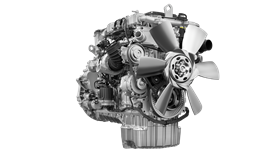 The Gen 6 engine family now includes new torque ratings up to 1,900 lb.-ft. (Photo: Daimler Truck North America)
Yet, Steve Collins, director, Detroit Field Sales Engineering, emphasized that the new engines – which will be available for all heavy-duty Freightliner and Western Star trucks – are not just a launch centered around the emissions change.
“This isn’t just a regulatory engine,” he said. “There are real efficiencies there for customers to grab and benefit from, as well.”
Three new ratings
The Gen 6 engines will carry over the same engine ratings currently found with the Gen 5 platform plus offer three new ones.
The DD13 will come in a 505-hp rating at 1,625 rpm and 1,750 lb.-ft. of torque at 975 rpm. “That really fills an important gap and will play an important role for our continued push into the vocational space,” said Collins. “There are quite a few vocational customers that are looking for that 500-hp type of engine rating that maybe aren’t quite ready to take that jump all the way up to 1,850 (lb.-ft. of torque).”
In addition, the DD15 will be available in two new efficiency ratings specifically for line-haul applications – 425 and 455 hp at 1,500 rpm paired with 1,900 lb.-ft. of torque at 1,000 rpm. “That’s the most torque that we’ve ever produced out of the DD15,” Collins stated, adding that it will allow even faster down speeding and “super-fast” reaction ratios. “That allows us to run the engine slower, work it harder and utilize that increased torque so that drivers never notice the difference in terms of performance.”
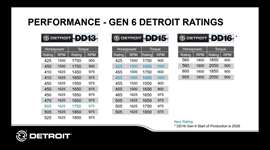 The Gen 6 engines will carry over the same engine ratings found with the Gen 5 platform plus offer three new ones. (Source: Daimler Truck North America)
All the engines, regardless of displacement, will utilize the asymmetric turbocharger first launched in 2014 but now optimized with a ball bearing design previously reserved for efficiency ratings. “It can actually spool up more quickly, which results in a better throttle response for customers,” said Collins. “When you combine that with a simple waste gate [actuator] that we’re also adding to the turbo, that waste gate can even more precisely control the air flow.”
The wastegate actuator also improves braking performance and gradeability with greater power for high altitude conditions.
EPA’27 compliance
For compliance with stringent NOx requirements included in EPA’s 2027 standards, Gen 6 engines will incorporate the same primary aftertreatment system (ATS) as Gen 5 variants with the addition of a compact pre-selective catalytic reduction (pre-SCR) system positioned upstream of the ATS.
As Collins explained, one of the most challenging parts of EPA’27 is cold starts and idle situations where it may take additional time to heat up the primary ATS. “Keeping that in mind, we developed this pre-SCR catalyst – getting it closer to the heat and being able to heat up that SCR catalyst more quickly to convert NOx efficiently above the main box while that box is still coming up to temperature.
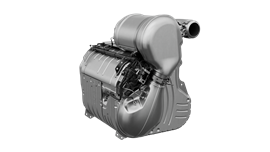 The aftertreatment system includes a pre-SCR system positioned ahead of the primary aftertreatment unit. (Photo: Daimler Truck North America)
“[The pre-SCR system] introduces DEF (diesel exhaust fluid) ahead of the primary ATS. It allows us to take advantage of the exhaust at its hottest part,” he continued. “That’s why it’s placed on top of the [main] box and strategically placed as close as possible to the engine exhaust outlet.”
Despite the addition of the pre-SCR system, Collins assured there is no additional space claim on the vehicle. Rather, it sits within previously unused space on select truck models (49X and 114SD), resulting in no packaging or blockage concerns and clear back-of-cab access for upfitting for vocational customers and truck equipment manufacturers.
For even greater efficiency, the thermal control valve used in the Gen 5 DD13 for vocational applications – which in many cases either reduced or eliminated the need for parked regens – is being carried over to all Gen 6 engines.
“So that no matter what your application, you have the absolute best in terms of thermal management to make sure that we are treating that exhaust temperature correctly to maintain correct operating temperatures of the aftertreatment system,” said Collins.
Optimized efficiency
Other Gen 6 updates are intended to deliver enhanced efficiency to help offset the impacts from these emissions-related changes.
“What that really means is improving air flow and combustion as well as reducing friction and pressure, all so that more power generated from the engine actually reaches the wheel ends,” said Collins, “which is the whole purpose of the engine – reducing those parasitic losses along the way.”
For example, a redesigned and simplified fuel system now utilizes an oil-lubricated high-pressure fuel pump in place of the previous fuel-lubricated pump, providing an efficiency boost over previous generations and enabling higher pressure on the common rail (up to 2,500 bar). “That pressure on the rail allows the use of simple, non-amplified injectors, [which] over their lifetime provide a more consistent and efficient performance,” Collins said.
The addition of an asymmetric intake port increases swirl to more effectively atomize fuel and, combined with the new fuel injectors, improves fuel and air mixing for a more complete combustion, Detroit noted. In addition, the use of Miller timing on the camshaft reduces the work of compression, increases the compression ratio and contributes to overall engine efficiency.
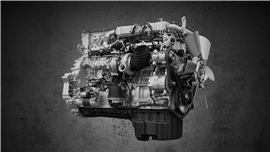 All Gen 6 engines, regardless of displacement, will utilize an updated asymmetric turbocharger with wastegate actuator. (Photo: Daimler Truck North America)
“Miller camshaft timing allows us to keep that intake valve open a little bit longer at the very beginning of that compression stroke, which reduces the overall amount of work required for compression,” Collins said. “And we’re able to do that all while achieving even higher compression ratios because we’re using a smaller piston bowl in the process.”
On the oil side, a new electronically controlled, variable displacement oil pump regulates flow, allowing the oil pump to match the varying requirements of the vehicle, whether it’s used in a line-haul, vocational or regional distribution application.
“Having an oil pump that can match the needs, supplying the right amount of oil to the circuit for various types of applications is very important,” said Collins. “These improvements are really all about lower consumption of oil, reducing the amount of work required to provide oil to the circuit, which leads to increased and enhanced efficiencies.”
Improved fuel efficiency
Effective NOx conversion requires a combination of heat and DEF. Consequently, Collins acknowledged, “There will be increased consumption of DEF because we are reducing the amount of NOx per regulation. But the efficiencies on the fuel will help make up for that increase in DEF consumption.”
He estimated a typical line-haul type of application could see up to a 3% improvement in driving fuel efficiency based on the overall efficiency enhancements achieved with the Gen 6 engines.
Ensuring such additional value and innovation was the objective with these next-gen engines, said David Carson, senior vice president of sales and marketing at Daimler Truck North America, not simply EPA’27 emissions compliance.
“We’ve been involved in the engine business here in North America, in this particular location, for nearly 90 years,” he commented. “We’ve been producing the best diesel engines in the commercial vehicle space and we intend to maintain that position in 2027 and beyond.”
The Gen 6 DD13 and DD15 engines will be available beginning in January 2027, with Gen 6 DD16 production following in January 2028. All Detroit engines are manufactured in the U.S. at the Redford, Mich. campus.
POWER SOURCING GUIDE

The trusted reference and buyer’s guide for 83 years
The original “desktop search engine,” guiding nearly 10,000 users in more than 90 countries it is the primary reference for specifications and details on all the components that go into engine systems.
Visit Now
STAY CONNECTED



Receive the information you need when you need it through our world-leading magazines, newsletters and daily briefings.

CONNECT WITH THE TEAM