Read this article in 中文 Français Deutsch Italiano Português Español
JCB upsizes wheel loader line

25 November 2026
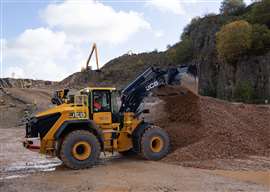 The 480 (shown) and 490 are the largest wheel loaders JCB has built to date. (Photo: Dan Gilkes)
JCB’s wheel loader business is moving up in size with the launch of the 480 and 490 models. Due with customers next year, the new machines were previewed at the Hillhead exhibition this summer. They are intended for use in quarries, waste handling and construction operations.
The loaders are the largest that the company has built to date, with rated payloads of 8 and 9 tonnes respectively. The 480 has a 25-tonne operating weight, while the 490 with heavier counterweight has an operating weight of around 27 tonnes. The two machines share the same driveline and boast a new, patented, hybrid loader arm design.
More power
While the majority of JCB’s smaller wheeled machines use the company’s Dieselmax engines, the 480 and 490 require more power than is currently available. The business has therefore turned to Cummins, with its X12 Stage V diesel engine, to power the loaders.
This is not the first time that JCB has opted for the X12, as the same engine is used in its largest crawler excavator, the recently launched 520X, making it familiar to technicians and parts departments. In the wheel loaders, the X12 delivers 250 kW (335 hp) and 1,695 Nm (1,250 lb.-ft.) of torque, with maximum power at just 1,600 rpm, boosting fuel efficiency and delivering plenty of low-level torque for loading and digging.
The engine is mated with a ZF CVT (constantly variable transmission) gearbox as standard, rather than the usual powershift box, as well as ZF drive axles. The CVT delivers four virtual gears, providing operators more accustomed to a powershift transmission with a familiar feel.
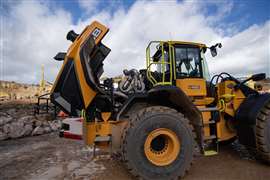 Both new loaders are powered by a 335-hp Cummins X12 Stage V diesel engine. (Photo: Dan Gilkes)
Operators can set the maximum travel speed for each of the virtual gears, and finger buttons in the head of the main attachment control lever provide a means to move up and down the pre-set ratios. This delivers the feel of a kick-down facility when digging into a stockpile or working face, providing maximum tractive effort when required.
The transmission control allows operators to preset rimpull, providing maximum traction when required, regardless of the material and weather conditions, and preventing unnecessary wheel spin. It also delivers what feels like a “single pedal travel” facility, with the foot pedal controlling machine speed and torque, rather than engine rpm.
An intelligent hydraulic boost function allows engine output to automatically meet the constantly changing hydraulic demand from the loader’s front end. This in turn keeps the engine in its most efficient operating zone, boosting productivity and fuel economy.
An integrated transmission brake, along with automatic engine exhaust braking, contributes to reduced axle brake wear. Also featured is a hill-hold setting and an automatic parking brake.
Hybrid lift arms
Both the 480 and the 490 can be ordered with the standard or a long reach loader arm setup, with pin heights of 4,445 to 5,000mm at maximum lift height. Both layouts use a patented bucket linkage design that sits much closer to the loader arms than a conventional Z-bar, without the forward-facing link. According to JCB, the new layout combines the power and breakout forces of a Z-bar with the attachment-friendly design of a parallel tool handling linkage design.
The compact bucket linkage uses a single bucket ram, allowing it to sit closer to the loader arms so the bucket or attachment can be rolled back further for improved material retention. JCB said this slimline linkage makes it easier to install larger, low-density material buckets, with the machine still capable of providing good roll back for material carrying and increased discharge angles, particularly when tipping off steep loading ramps.
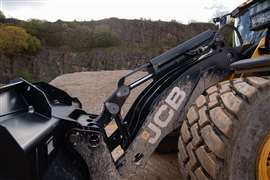 The hybrid loader arm combines the benefits of a Z-bar and a parallel lift linkage. (Photo: Dan Gilkes)
The loader arms also benefit from sealed and lubricated pins and bushes in heavy-duty casings, ensuring maximum durability and long service life.
To maximize the loader arms’ enhanced capabilities, JCB has designed its own range of buckets, with a large opening and a revised profile, capable of delivering an enhanced fill factor in loose materials. The machines can be used with other manufacturers’ buckets, as well, offering a similar material fill and discharge.
Enhanced operator cab
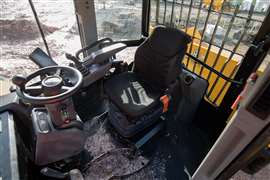
The 480 and 490 use JCB’s familiar Command Plus Cab, with plenty of new features.
Central to the Command Driving Position is a comfortable seat with heating and cooling, adjustable damping and electric lumbar support available, and with the loader controls built into the air suspended frame. JCB’s UX user interface works through a 10-in. full-color touchscreen that provides all the usual controls over machine functions.
The main loader servo lever has been replaced with an electro-hydraulic lever, meaning the operator can set response and lever effort for each function through the control screen. In addition, the joystick has up to 10 programmable buttons for setting return-to-dig or truck loading height.
The operator can also dial in a range of maximum working heights for digging and loading, as required. Kinematic sensors built into the loader arms allow the system to be preset with e-fences, reducing the chance of unwanted impact when lifting and lowering the arms.
Options include an integrated weigh loader as well as lever steer, which allows the operator to steer the machine with a small toggle lever to the left of the seat. This reduces effort for the operator in repetitive loading cycles, with no requirement to continually spin the steering wheel from one side to the other as the loader maneuvers.
A standard reversing camera uses the main screen as a monitor, while the optional 360° camera system comes with a second screen for improved visibility. As with a growing number of JCB’s machines, the roof-top beacons are molded into the corners of the cab roof, maximizing visibility for other operatives on site.
9T Dual Drive Site Dumper
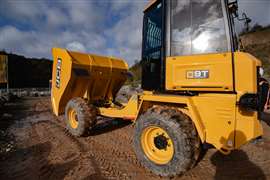 JCB’s 9T Dual Drive site dumper. (Photo: Dan Gilkes)
JCB has taken the Dual Drive technology from its backhoe loader models and incorporated it into its largest site dumper, the 9T. Dual Drive allows the operator to rotate the entire seat platform, including the steering wheel and tipping lever, from facing the front of the machine to facing towards the rear. This makes it easier and safer to maneuver the dumper, particularly with a full skip (bed).
The 9-tonne capacity 9T Dual Drive is powered by the same JCB 430 DieselMax engine as the regular 9T, delivering 55 kW (74 hp) with no requirement for aftertreatment. However, to allow the controls to rotate to the rear, the previous gearbox has been replaced by a Bosch hydrostatic transmission with a two-speed drop box. This in turn drives new Dana Spicer axles, which replace the JCB axles in the conventional site dumper. Maximum travel speed is set at 30 kph (18.6 mph) and the brake master cylinder is now boosted to provide improved retarding.
Where the regular site dumper’s cab is solidly mounted to the chassis, the Dual Drive cab sits on sound-deadening mounts. This additional height allows all the cab’s HVAC systems to run beneath the cab floor rather than through the operator space. Air conditioning and an air suspended seat are standard, and customers can specify LED lights and a road legal driving kit.
 Dual Drive technology allows the operator to rotate the entire seat platform from front to rear facing. (Photo: Dan Gilkes)
The machine’s controls remain the same, no matter which way the seat is facing. This means that steering, transmission and skip tip levers all continue to react to the same operator inputs. The main screen that is part of the driving pod in front of the operator provides a monitor for the skip-facing camera, whichever way the operator is facing. When the seat is facing towards the rear of the machine, a second screen, mounted in the roof of the cab, provides a rear-facing view in addition to the skip-facing monitor. However, the seat must be rotated to face away from the skip to allow entry and egress from the cab.
The 9T Dual Drive can be ordered as a straight tip or a swivel tip design. The front tip model uses a Site Safe design with a very low front lip to improve visibility over the skip from the cab. The site dumper’s cab is also tested to withstand a side impact from a 22-tonne excavator, allowing the operator to remain safely in the cab during loading.
Equipped with a Thatcham-approved keypad immobilizer, follow-me home lighting and a radio as standard, the 9T Dual Drive can also be equipped with an optional radar safety system, auto lubrication and a towing hitch with related electrics.
POWER SOURCING GUIDE

The trusted reference and buyer’s guide for 83 years
The original “desktop search engine,” guiding nearly 10,000 users in more than 90 countries it is the primary reference for specifications and details on all the components that go into engine systems.
Visit Now

CONNECT WITH THE TEAM