Read this article in 中文 Français Deutsch Italiano Português Español
Komatsu debuts completely redesigned production dozer

19 November 2026
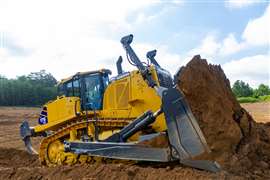 The Komatsu D175AX-10 delivers up to 18% more drawbar pull compared with the D155AX-8. (Photo: Komatsu)
Komatsu North America has introduced the D175AX-10, a production dozer engineered for a range of applications, from aggregates production and mining to large-scale site development. Its comprehensive redesign extends across the engine, transmission, steering system, blade, undercarriage and operator environment.
“This large-class machine builds on the proven foundation of the D155AX-8 with a complete redesign,” said Robert Hussey, product manager, Komatsu North America. “From a new 450-hp engine and four-speed automatic transmission to an all-new steering system and redesigned semi-U blade, nearly every major system has been reengineered to help move more material with greater control.”
New powertrain and steering system
According to Komatsu, the 100,310-lb. (45,500 kg) D175AX-10 delivers up to 25% greater productivity and up to 15% better fuel efficiency in slot dozing compared with the D155AX-8. Its 12.7 L Komatsu DBA127 six-cylinder, turbocharged and aftercooled, Tier 4 Final engine has bore x stroke dimensions of 5.1” x 6.3” and is rated 450 net hp (336 kW) at 1,900 rpm and 1,580 lb.-ft. (2,142 Nm) maximum torque. It was developed with a streamlined EGR-free layout and improved critical components.
The engine is paired with a Torqflow four-speed automatic transmission with a lock-up clutch and 30 speed settings. Automatic Shift Mode can help reduce fuel consumption by up to 5% compared with manual operation.
Double-reduction, spur and planetary final drives increase tractive effort. Average drawball pull is increased up to 18% compared with the D155AX-8, the company noted, supporting performance in heavy load applications.
The new hydrostatic steering system provides up to 17% greater steering force and up to 7% more power while turning. An independent steering pump helps balance power between steering and work equipment, while Pivot, Power and Spin Turn modes provide options for confined work areas and conditions.
Stability and comfort
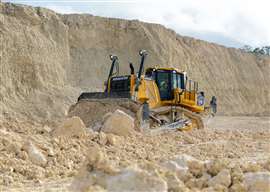 The new hydrostatic steering system provides up to 17% greater steering force and up to 7% more power while turning. (Photo: Komatsu)
The dozer’s 13.9-cu.- yd. semi-u blade is shaped to reduce digging resistance while improving filling and material retention. The redesigned blade linkage and strengthened structures are also intended to support longer component life in demanding applications.
Undercarriage updates include a redesigned eight-track roller system that allows more track on the ground, front oscillating idlers that help maintain constant track-on-ground contact over uneven terrain and an increased minor bogie oscillation angle that helps reduce vibration and operator fatigue.
The cab features a new cab damper mount, a retuned k-bogie suspension, equalizer bar shoulder pad and up to 45% better forward and 30% better rear visibility to enhance stability and operator comfort. The operator environment includes an 8-in. touchscreen monitor, intuitive Palm Command Control System levers and a standard KomVision 360-degree camera system with a 10-in. display. Advanced machine control modes include adaptive powertrain and steering control, neutral auto brake, track shoe slip control mode and multi-stage speed control.
Reduced maintenance
Ground-level service points, a side-by-side cooling package and maintenance improvements help reduce downtime and maintenance costs by up to 28% over the life of the machine, thanks to the EGR-less engine and compatibility with ultra-low ash (ULA) oil.
Hydraulic oil and filter service intervals increase from 2,000 to 6,000 hours, and engine oil and key filter intervals increase from 500 to 1,000 hours. KDPF cleaning is extended to up to 8,000 hours.
POWER SOURCING GUIDE

The trusted reference and buyer’s guide for 83 years
The original “desktop search engine,” guiding nearly 10,000 users in more than 90 countries it is the primary reference for specifications and details on all the components that go into engine systems.
Visit Now

CONNECT WITH THE TEAM