Powering the toughest applications

03 September 2026
Scania Power Solutions’ Sara Hermansson talks about electrification, engines and building teams for the future
Sara Hermansson was named senior vice president and head of Scania Power Solutions in October 2024.
A returning Scania employee, she first joined the truck, bus and powertrain maker through the Scania Student Intro Program for graduate students in 2011. After earning an engineering degree from KTH Royal Institute of Technology in Stockholm, Sweden, she held several roles at Scania’s headquarters in Södertälje, including head of Hybrid and Electric Powertrain Projects.
Hermansson left Scania in 2017 to pursue entrepreneurship and clean technology startups. That led to leadership roles with Northvolt’s off-highway battery business and later with InnoEnergy, an investor in early stage clean energy technology companies.
When Scania acquired Northvolt’s industrial battery business in 2025, Hermansson played a role in assessing the strategic fit and supporting the integration. The business now operates as Scania Industrial Batteries, with Hermansson serving on its board.
In this interview with Power Progress, Hermansson discussed how Scania Power Solutions is defining its role in the energy transition to power demanding applications across land and sea.
We’re midway through 2026. What are you most excited about when it comes to Scania Power Solutions?
What excites me most is the combination of clarity and energy we have right now. We know where we’re going, we have products that perform in the field and we have a team that genuinely cares about making a difference for our customers. Our new 13 L and 11 L engine platform is performing very well, and the customer testimonials we’re receiving show that the technology is delivering real value when installed in demanding machines, vessels and equipment.
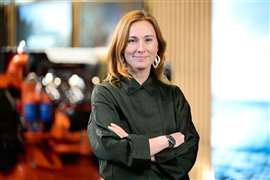 “A product only becomes great when it’s properly installed and integrated into the customer’s machine, equipment or vessel. That is why our work together with customers is so important.” Sara Hermansson, senior vice president and head of Scania Power Solutions. (Photo: Scania)
We have also completed our Strategy 2.0 work, which has helped us articulate where we create the most value. Scania is a company that is driving the shift toward sustainable transport, and within Power Solutions our role is to support customers in applications where reliability, uptime, safety and integration are absolutely critical.
For us, premium means more than the product itself. It means that the customer can trust the full solution. It may be a marine application far from shore, equipment operating in extreme cold or a defense, mining or construction application where failure is not an option. That is where Scania Power Solutions fits best: in applications where premium is not optional, but necessary.
That premium position comes from fuel efficiency, performance and total cost of ownership, but also from how we work with customers. I think customers feel when you really care. We need to understand their world, not just our own product. And when something is difficult, that is when trust is built – by staying until the problem is solved.
You had several years with Scania’s truck and bus business before leaving to join the world of startups, including Swedish battery company Northvolt. What did you learn while working in startups that you can apply to your role at Scania Power Solutions?
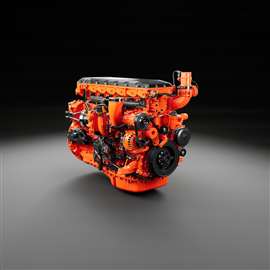 Engines remain a big part of Scania Power Solutions’ business. (Photo: Scania)
A lot. Scania was my first employer, so coming back was special for me. I know the culture, the pride and the engineering depth here, but I also came back with new eyes after several years in startups. I learned to challenge assumptions, to move with speed when needed and to make decisions based on facts rather than on how things have always been done.
One thing I have brought with me is a stronger focus on data-driven business decisions. If someone says, “We tried that before,” my response is usually, “That may be true, but let’s look at the facts today before we close the door.” Markets, customers and technology evolve, and we need to evolve with them.
The other learning is how to live with complexity. The world is not becoming simpler. We face changing regulations, geopolitical shifts, supply chain uncertainty and new customer expectations. Startups are used to adapting quickly because they must. In a large company, we also need that mindset, but we combine it with industrial experience, structure and long-term customer commitment.
Conversely, what, if anything, are you happy to abandon in the past?
When I left Scania, I underestimated what it takes to run a successful industrial company over generations. From the outside, large corporations can look slow. But after working in start-ups, I have a much deeper respect for the discipline, competence and resilience required to stay profitable, relevant and trusted year after year.
What I do not miss is the constant uncertainty around funding and runway. Running investment rounds teaches you a lot about purpose, focus and communication, but it also takes energy away from product development and customers. At Scania Power Solutions, we have a stable business, long customer relationships and the ability to focus on what matters most: developing solutions that create real value in the field.
At the same time, I want to keep the startup sense of purpose. Of course, we need to run a strong and profitable business. But for me, that has never been enough as a purpose. People want to know why their work matters – and our work really does matter. For us, that is about powering a sustainable future for the toughest applications across land and sea.
When Scania acquired Northvolt’s industrial battery business, what made the fit clear? What role did you play in the process?
I was closely involved in the assessment and acquisition process. I had previously been part of building that business at Northvolt, including hiring its early engineers and working with the first customers. That gave me useful background, but I also had to look at the business with fresh eyes and understand how it had evolved.
The strategic logic became clear when we looked at the applications. Northvolt’s industrial battery systems were developed for demanding off-road environments, including underground mining. Scania Power Solutions serves many of the same types of customers and applications: tough conditions, high safety requirements and a need for reliable power.
Scania already had strong electric machine, inverter and powertrain competence for off-road use. What Northvolt’s industrial business added was a battery portfolio designed for these tougher environments. Together, that created a much more complete electrification offering for customers who need robust, integrated solutions.
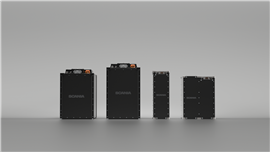 Scania Industrial Batteries was formed after the acquisition of Northvolt’s industrial business. (Photo: Scania)
The acquisition led to the formation of Scania Industrial Batteries. What does that mean for current and future customers?
Scania Industrial Batteries is a sister company that is fully owned by Scania. For customers, the most important message is continuity combined with industrial strength. The team, the product knowledge and the customer relationships could continue, now supported by Scania’s long-term perspective, engineering competence and service mindset.
The transition required a lot of hard work to avoid disruption for customers, suppliers and employees. What impressed me most was the commitment from all sides to keep operations moving. I’m proud of that, because it says a lot about the people in the team and about how important these customer relationships are to the business.
Customers have told us that they value the combination of innovation and industrial maturity. Northvolt brought agility and deep battery know-how. Scania brings stability, application expertise, global reach and a proven ability to support customers over time.
We’re building the offering together. Customers should increasingly experience Scania Power Solutions and Scania Industrial Batteries as one coordinated power solutions partner. We can discuss combustion engines, electric machines, batteries, integration and service from the perspective of the customer’s application.
Service is also an important part of the journey. Scania has a strong service network and a long tradition of supporting customers in operation. Integrating battery service into that environment takes time, but it opens up much greater possibilities for customers compared with what a smaller stand-alone battery business could offer.
What I’ve always liked about Northvolt’s battery business is that it is also positioned as premium. In off-road electrification, premium means reliable products, uncompromised safety, smooth integration and a team that is there to support the customer throughout the transition. That is very aligned with how we think in Scania Power Solutions.
We are still living through a dynamic time for the on- and off-highway powertrain industry. Zero-carbon initiatives are being relaxed, and many OEMs have folded or placed their battery-electric prototypes on the shelf. At the same time, battery-electric vehicles have earned a solid foothold. They are loved for their lack of vibration, noise, reduced maintenance and fuel savings. Where does the mobile equipment industry go from here?
Internal combustion engines will not disappear tomorrow, and in many applications, they’ll continue to play an important role for a long time. At the same time, there are many applications that can already be electrified. I do not believe in one single solution. The transition will require a mix of efficient combustion engines with alternative fuels, electrification and hybrid solutions, depending on the application, infrastructure and customer needs.
Our role is to stay close to customers as their trusted advisor and help them make smart, sustainable choices. For some, battery electric will be the right answer. For others, HVO, biodiesel, natural gas, hydrogen or a hybrid solution may be more relevant. I always come back to the same point: start from the application, not from the technology.
A product only becomes great when it’s properly installed and integrated into the customer’s machine, equipment or vessel. That is why our work together with customers is so important. We need to understand the duty cycle, the environment, the safety requirements and the business case.
That variety is also what makes this business so exciting to me. One week we may be discussing defense applications, the next a marine customer, an excavator or a stone crusher. All of them need power, but the right solution can look very different.
Is there new technology in the pipeline that will help move battery-electric prototypes from the shelf to a dealer’s showroom? When you talk with customers, what are they waiting for to convince them to make the change?
Many customers ask for higher energy density, higher power output and faster charging. Those are all important, but the key is to understand which requirements truly matter for a specific application. You cannot optimize everything at once, so we need to work with customers to prioritize the right performance steps.
This is where Scania’s modular philosophy becomes very relevant. Modularization has been part of Scania’s design thinking for decades, and it is just as important in electrification as it has been for engines. It allows us to build flexible platforms without losing the functionality that matters for a specific application.
Batteries are sometimes described too simply. In reality, a battery system is a technology platform. There are different chemistries, charging strategies, thermal requirements, system architectures and ways to combine batteries with other parts of the drivetrain. Customers often need help understanding how those choices fit their application and business case.
Rather than waiting for a perfect future technology, I believe there is already a lot of untapped potential in designing smart electric drivetrains today. In off-road, marine and defense applications, customers do not necessarily want the very latest unproven technology. They want something that is safe, reliable and tested for their reality.
That is why these markets will always stress test technology in ways that are different from high-volume automotive applications. The corner cases matter, because they are often part of the customer’s normal operation.
How does Scania Power Solutions benefit from its parent company’s truck and bus business? How do your customers benefit?
There is one very big way that we benefit. I say we piggyback on them. They drive volume on the products and also the development. I say we get 60% of the engine already developed for us by the truck and bus business. There’s a lot of work to tailor it for our applications, and we do that in a smart, modular way. If you don’t have a modularization philosophy as a base when you develop products, it’s extremely difficult to get out those synergy effects without compromising on anything.
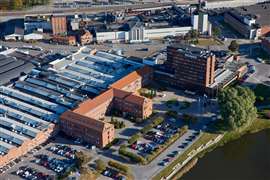 Scania’s corporate headquarters campus near Stockholm, Sweden. (Photo: Scania)
We know that when the engineer is developing something new, they’re developing it in a modularized way, so later we can make changes to have a keel-cooled system on a marine engine, and it’s the same base engine that’s running in a garbage truck.
Our customers also get proven technology. We have built a hundred thousand of those engines for Scania trucks and buses. Our customers also benefit from the global service network that has developed for trucks, buses and engines.
Another big way we and our customers benefit is from specific competencies. I noticed that when I was at a startup, there are so many things you would really like to have – it would have been great to hire an expert on simulations for flow dynamics and an expert on materials technology.
We already have that within Scania, so for me it’s kind of like a new dimension. All those skill sets we longed for at a startup are already in the group. We just need to be smart and know how to use those skills in a smart way.
At Scania, I just have to know where that person’s coffee machine is.
We often hear that it’s difficult to find good help. What techniques have you found that help recruit and retain the best in the business?
Recruitment is very close to my heart. I have seen many times that the right team can achieve much more than any individual, no matter how talented. As a leader, I see team building as one of my most important responsibilities. I spend a lot of time with my managers on recruitment, not to control the process, but to support them in building teams that are strong, diverse and able to work across functions.
Diversity matters, but inclusion is what makes diversity perform. It’s not only about gender, although that was one area where we needed to improve. It’s also about different experiences, backgrounds, perspectives and ways of thinking. When new people join and ask, “Why do we do it this way?” that can be incredibly valuable.
I also believe strongly in recruiting for the team, not only for the individual role. You need people who are excellent in their specialty, but who also understand how their work connects to mechanical, electrical, software, commercial and customer perspectives. That cross-functional mindset is essential in powertrain development.
At Northvolt, I spent a lot of time thinking about how to build a team from scratch. Many of the people who joined then stayed through very challenging times and are now part of Scania Industrial Batteries. That makes me proud, because it shows the strength of a team that has purpose, trust and a clear mission.
People stay when they feel they are contributing to something meaningful, when they can grow and when they enjoy working with the people around them. I really believe in that. Competence is important, but context matters, too. A strong performer can under perform in the wrong environment, and a good team can make people even better.
Recruitment is also a two-way process. The candidate should choose us just as much as we choose the candidate. That means we need to be clear about our purpose, our direction and the type of culture we are building. In this industry, we can be better at telling the story of why our work matters.
It is not enough to say that an excavator is technically impressive or that an engine is efficient. We need to explain what those machines enable in society, why reliability matters and how we help customers transition toward more sustainable solutions. When people understand that purpose, it becomes much easier to attract and retain the right competence.
POWER SOURCING GUIDE
The trusted reference and buyer’s guide for 83 years
The original “desktop search engine,” guiding nearly 10,000 users in more than 90 countries it is the primary reference for specifications and details on all the components that go into engine systems.
Visit Now
STAY CONNECTED


Receive the information you need when you need it through our world-leading magazines, newsletters and daily briefings.
CONNECT WITH THE TEAM