Read this article in 中文 Français Deutsch Italiano Português Español
Reusing simulation data when the requirements change
05 November 2026
How engineers can respond to shifting requirements without restarting the optimization from scratch
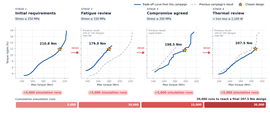 (Chart: Secondmind)
Picture the meeting: A fatigue review has just landed on the desk of the powertrain team. The structural stress cap on a new component came down from where it was when the optimization campaign started: new fatigue data shows a shorter safe life than the original design assumed. Five thousand simulation runs, a healthy trade-off curve, and a design the team was ready to carry forward - but now none of it quite applies.
There’s only one way to understand what is achievable under the new limit - run the whole campaign again.
No one did anything wrong. Changes like that are a normal part of every program: an efficiency target shifts when the program is re-scoped for a new market, a duty cycle gets redefined once a customer segment is better understood, or a component that looked fine in isolation turns out to conflict with something upstream. The optimizer did exactly what was asked of it - but months of simulation work have been spent answering a question that’s no longer relevant.
The conventional approach struggles with a moving target
Optimization tools are not the weak link here - these are well-established algorithms, built into every major CAE vendor’s software. Given a fixed problem - a set of requirements and a budget of simulation runs - they’ll search effectively for the best design that satisfies it. The challenge is that the question being asked rarely stays fixed.
Working out what the requirements should be is part of the engineering job, negotiated and revised as a program progresses. With a conventional optimizer, each run assumes the requirements are settled and when one moves, there’s no way to ask the existing campaign, “what does this change mean?”
The only option is to pose the new question from scratch, at significant cost in time and simulation budget.
There’s another impact, one that is harder to see than the wasted simulation runs. At the design review - where the team is weighing whether the new limit really is fixed, or a compromise is workable - the optimization results are silent on the question being negotiated. They only speak to the requirement as it stood when the campaign was set up. The engineers still make the call but they must make it on experience and precedent alone, because producing the evidence to back that judgment would take another full campaign.
What changes if the model is reusable, not disposable
During the NAFEMS UK 2026 conference, an event for the engineering simulation community hosted by NAFEMS, the International Association for the Engineering Modelling, Analysis and Simulation Community, Secondmind presented a benchmark test that showed how a mid-campaign requirement change could be handled differently: we compared a conventional optimizer against an exploration built so the requirement change became a new question put to the same model, rather than a whole new campaign.
The benchmark took an electric motor design problem - six geometric variables, five performance limits (torque, stress, iron loss, efficiency and torque ripple) - the same kind of interacting-parameter problem that off-highway and commercial vehicle manufacturers are increasingly working through in the move toward hybridized and electrified powertrains.
The program started with an initial stress limit of 250 MPa, then went through three requirement changes: a fatigue review that cut the stress cap to 150 MPa, a negotiated compromise at 200 MPa, and a thermal review that capped iron loss at 2,100 W - a similar sequence to what any real program might encounter as multidisciplinary reviews progress. To keep the comparison repeatable, both approaches ran against the same fast, validated stand-in for the motor’s finite element solver, built from around 18,000 JMAG simulations.
Run the conventional way, each of those four stages meant a fresh optimization campaign - a fixed simulation plan committed to and run in full: 5,000 runs to establish the initial trade-off curve, another 5,000 when the stress cap tightened, more again to renegotiate a compromise, and more still once the thermal limit bit - 20,000 simulation runs in total to land on a final result of 207.5 Nm.
The alternative approach we demonstrated built a surrogate model of the design space. Rather than committing to a fixed simulation plan up front, the way conventional Design of Experiments (DoE) does, it starts from a small seed set - just enough to give the model a rough first picture - and from there, sampling becomes adaptive: after each small batch of simulations, the model uses its own uncertainty to choose the next ones, balancing poorly understood regions of the design space against regions likely to meet the requirements, rather than working through a pre-planned list of points. That targeting is what keeps the total number of simulations down - a fraction of what a conventional campaign would need. Critically, the model also shows where it is uncertain, rather than handing back a confident wrong answer, so gaps in its knowledge stay visible instead of hidden.
The result isn’t a single best point, but a map of what’s achievable and where the feasibility boundaries sit. Once that map exists, it can be queried again at no extra simulation cost. Reduce the stress limit and the feasible region visibly collapses; increase it again and a compromise reappears.
At each requirement change, the engineer can take an immediate answer from the existing model, or spend a small top-up of targeted simulations to sharpen it. Across the same four stages, answering from the model alone reached 196.5 Nm with 448 simulation runs in total. Adding targeted top-ups reached 206.9 Nm - against the conventional method’s 207.5 Nm - with 668 runs in total: roughly thirty times fewer than 20,000, for a result within half a percent. In both cases, the reported designs were confirmed with the simulator.
Where changes are most expensive: early concept
We believe this exploration approach adds value at every stage of a program - but has the biggest impact at the earliest design stages, where requirements are typically least settled. Regulatory targets across markets, program cost targets, platform decisions: all of these and more are still being worked out at the point a concept must be chosen.
Concept-stage decisions are the most expensive to get wrong - they commit roughly three-quarters of a program’s eventual cost - yet they are made with the least amount of simulation data available. A model that can absorb a requirement shifting, rather than forcing a restart, is highly valuable when the stakes of a wrong call are so high.
One OEM faced exactly this at concept stage where its engineers needed to define a body panel’s shape against noise-and-vibration targets. Five interacting design variables made a safe range impossible to pin down from engineering judgment alone, with only a couple of hundred simulation results to work from. Modeling the relationship between geometry and natural frequency directly showed that curvature radius, not panel size, was driving the outcome - a relationship that would let a design review absorb a later requirement change directly, without more simulations to find out. The result was a defensible shape range settled before tooling was committed, removing a source of rework that would otherwise have surfaced only once it was expensive to fix.
The same logic applies to screening candidate configurations against regulatory targets across multiple markets: combinations can be ruled in or out early, and if a target shifts mid-screening, those decisions can be rechecked directly rather than rerun.
Solving for a program that keeps shifting
None of this work changes the physics. The model learns from the same CFD, FEA or system-level runs a conventional campaign would use - what’s different is how many runs are needed, and what happens to the results afterward. A conventional campaign is designed as a one-off event: it produces an answer, and the workflow has no way to revisit it. A changed requirement means starting a new campaign from scratch, not returning to the existing one. A model built to be reusable keeps that same simulation data working even when a requirement moves.
The real gap this benchmark points to is in the workflow itself. Conventional optimization assumes requirements are settled before the work starts and stay that way. Real programs don’t work like that - requirements are negotiated, tested and revised throughout. Engineers already do that negotiation, one design review at a time; a reusable model simply gives them evidence to bring to it. So, when a requirement moves - and on every real program, it will - there’s already an answer waiting, instead of another campaign standing between the engineer and the decision.
About the author: Qi Qi is Machine Learning & Data Science team lead at Secondmind Ltd., based in the UK. Prior to Secondmind, Qi spent nearly a decade at Rolls-Royce working on design, optimization and automation. Secondmind supplies the Design Space Exploration software used in this benchmark. It is already in use by OEMs and Tier 1 suppliers.
POWER SOURCING GUIDE

The trusted reference and buyer’s guide for 83 years
The original “desktop search engine,” guiding nearly 10,000 users in more than 90 countries it is the primary reference for specifications and details on all the components that go into engine systems.
Visit Now

CONNECT WITH THE TEAM