Read this article in 中文 Français Deutsch Italiano Português Español
Secondmind on advanced engine tech validation
12 March 2026
Why powertrain development Is getting more difficult and what engineers can do about It
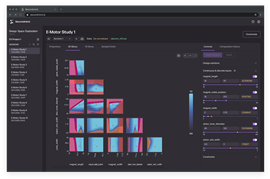 Emerging methods enable engineers to visualise design feasibility and constraints in high dimensionality (Photo: Secondmind)
Powertrain complexity has been the price OEMs have had to pay to reduce emissions from commercial vehicles and off-highway machines. It is not just the diesel particulate filters (DPF), exhaust gas recirculation (EGR), selective catalytic reduction (SCR), and increasingly sophisticated turbocharging systems. The real challenge lies in how these systems interact, which exponentially multiplies design and calibration work.
Although regulatory pressures have temporarily eased, the technical agenda is far from complete. To meet those targets, there is still scope to balance emissions and fuel consumption with power and torque. For example, engine downsizing can still help address these issues, while positively impacting machine cost, packaging and weight, providing power can be reliably delivered across real operating conditions.
 Nick Appleyard, Secondmind
At the same time, OEMs face growing demand for multiple powertrain variants tailored to specific markets, applications and duty cycles. As system complexity increases, designing, validating and supporting these variants becomes more problematic.
Still, the power industry has delivered remarkable progress – regulated pollutants have been reduced by more than 95% while power density has seen some dramatic increases. But this is not without consequence.
Resulting issues, including thermally stressed EGR valves, ammonia deposits in SCR systems, or DPF regeneration failures, point to difficulties managing multiple parameters. These problems are often framed as intrinsic reliability risks, but more commonly they can be traced back to design and calibration decisions made under severe time and resource constraints.
The power and limits of simulation
Simulation-led design is now commonplace across engine manufacturers and their supply chains. Computational fluid dynamics (CFD), finite element analysis (FEA), and system-level models underpin design and validation long before physical hardware exists. This model-based engineering approach enables faster iteration, lower development cost and better-informed decision making than traditional test-first methods ever allowed.
Yet few engineering organisations feel any less constrained. Any gains from faster virtual development are rapidly reinvested into higher performance targets, tighter emissions margins and broader operating envelopes. Simulation capacity does not create slack; it simply raises expectations.
Simulation is also far from cheap. A single run consumes expensive computing resources and specialist engineering time, while software licences can cost tens of thousands of dollars per seat. Individual simulations may take hours and a single design study can require hundreds of runs. In this environment, advantage does not come from running more simulations, but from deciding which ones genuinely matter.
When human intuition reaches its limits
Experienced mechanical and performance engineers can reason about multiple interacting parameters, often juggling five or six variables with confidence and intuition. But the latest low-emissions powertrains operate far beyond that comfort zone, with dozens of tightly coupled variables simultaneously influencing behaviour. Many of these relationships are non-linear, making them particularly difficult to assimilate unaided.
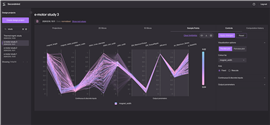 Engineering-grade AI gives engineers insights into feasible parameter combinations (Photo: Secondmind)
Combustion provides a clear example. Geometry choices around valves, piston bowls, injector nozzles, bore and stroke, compression ratio and swirl interact with control parameters such as injection timing, pressure, rate shaping and multi-shot strategies. Each parameter matters, but their combined effects are rarely intuitive.
Optimum solutions are often counterintuitive. A useful analogy comes from professional cycling, where for decades teams assumed that narrower tyres at higher pressures minimised rolling resistance. That seemingly optimised strategy dominated thinking for more than forty years and it was only after careful experimentation that analysts found that wider tyres at lower pressures were often faster in real conditions. The true optimum had been hiding in plain sight.
This is not a question of skill or experience. Engineering training quite reasonably teaches simplification as a survival technique. But when systems become genuinely multidimensional, that habit can narrow the field too early, leaving credible solutions undiscovered simply because they sit outside familiar territory.
Engineering-grade machine learning
Recent attention to artificial intelligence, particularly large language models, has sparked both enthusiasm and anxiety within engineering communities. A common concern is whether AI tools might displace skilled roles. In the context of powertrain development, this concern misses the point.
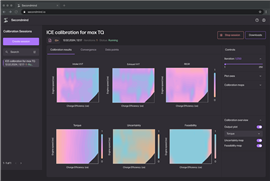 Development of robust calibrations for complex engines in the minimum of test cell time (Photo: Secondmind)
Secondmind is a company which develops machine learning specifically for engineering use cases, rather than adapting general-purpose AI tools. The methods are probabilistic, not generative, and are designed for situations where data is scarce, expensive and slow to produce. This body of work originates from research at the University of Cambridge led by Professor Carl Rasmussen, who is also Secondmind’s chief science officer, with the work focusing on decision-making under uncertainty rather than prediction at scale.
The objective is not to automate engineering judgement. It is to expose more of the problem than time and budgets would otherwise allow. Machine learning prioritises where simulation effort should be spent and where uncertainty remains high. Engineers then decide how to respond. The value sits in that division of labour: computation to surface options, experience to choose between them.
Holding options open for longer
Instead of committing early to a narrow design direction, the tech can allow engineers to hold multiple viable options open for longer. This means trade-offs can be evaluated explicitly, rather than being locked-in by early assumptions that later prove hard to unwind. By building a broader picture of acceptable solutions and the boundaries that define them, teams gain a more honest view of both opportunity and risk.
Crucially, uncertainty is no longer hidden. Areas where knowledge is weak are made visible, enabling targeted investigation rather than blanket coverage. This leads to more robust designs and fewer surprises when hardware is eventually built.
The economics of smarter simulation
For engineering managers under constant budget pressure, solver speed is only part of the equation. Greater impact comes from being selective about where simulation effort is applied. By identifying regions of high uncertainty and targeting those areas, probabilistic machine learning guides each new batch of simulations to deliver maximum information.
This targeted approach has been shown to reduce the number of simulations required by around 80%, while still serving to increase confidence in the outcome. The benefits are not only lower computing costs but a shift in how engineering time is spent; away from repetitive execution and more toward interpretation and decision making. Development cycles shorten, collaboration improves and late-stage rework becomes less likely.
Design and calibration
The same underlying complexity follows the programme from early design work into the test cell. In calibration, engineers must generate control maps that balance injection timing, rail pressure, air/path management and emissions performance across the full operating range. Once again, the issue is scale; far more combinations than any engineer can reasonably evaluate unaided.
Applying the same probabilistic machine learning techniques to calibration allows teams to reduce test-cell time, fuel consumption and iteration cycles, while improving confidence that critical regions of operation have not been overlooked. What looks manageable on a whiteboard quickly becomes overwhelming once real operating ranges are involved.
A shift in engineering culture
The result is not the removal of intuition, but its reinforcement. Decisions move from being defensible to being demonstrable, while simulation shifts from a necessary bottleneck to a source of competitive leverage. Engineers retain ownership of decisions, but with clearer insight into trade-offs, risks and opportunities.
As powertrain systems continue to grow in complexity, this shift matters. Emissions standards, alternative fuels, hybridisation and electrification all raise the bar further. Organisations that can explore broadly, decide confidently and manage complexity effectively will move faster and with fewer missteps than those still relying on narrow exploration and hard-won intuition alone.
This article was written by Nick Appleyard, US Country manager at Secondmind. He also serves as executive director of the NAFEMS ASSESS initiative, which brings together industry, government and academia to expand the impact of simulation in digital engineering and product development.
POWER SOURCING GUIDE

The trusted reference and buyer’s guide for 83 years
The original “desktop search engine,” guiding nearly 10,000 users in more than 90 countries it is the primary reference for specifications and details on all the components that go into engine systems.
Visit Now

CONNECT WITH THE TEAM