Read this article in 中文 Français Deutsch Italiano Português Español
SwRI, SMU to develop AI controller for microgrids
17 July 2026
Southwest Research Institute (SwRI), an independent, nonprofit, applied research and development organization based in San Antonio, Texas, and SMU (Southern Methodist University) are developing an AI-driven controller for hybrid microgrid systems that integrate multiple energy sources and storage systems to function.
The SwRI and SMU project is funded by a $129,842 grant from the Seed Projects Aligning Research, Knowledge and Skills (SPARKS) joint program, which aims to strengthen and cultivate long-term research between SwRI and the Lyle School of Engineering at SMU. It is also funded (fully or in part) by SMU Lyle School of Engineering and SwRI.
The project will develop an AI controller for a microgrid configuration that integrates a battery energy storage system (BESS) with a long-duration hydrogen energy storage system (HESS). The application will integrate fuel cells, advanced solid-state storage technologies, renewable energy generation and the local energy grid for power. The grid will use electrolyzer devices to split water into hydrogen and oxygen through electrolysis for storage.
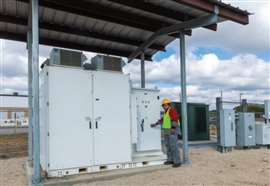 The project leverages real-world testing using SwRI’s on-campus infrastructure – such as its 500-kW-hour grid-connected BESS (shown) – to advance the AI controller. (Photo: Southwest Research Institute)
The controller will be designed to manage and coordinate the available grid’s energy sources in real time to ensure optimal reliability, reduce operational costs, improve renewable energy utilization and enhance system sustainability for critical systems, such as data centers, and other facilities that require continuous power and low-carbon backup sources.
“The rapid expansion of AI computing is creating unprecedented electricity demand, challenging both utilities and data center operators to find reliable and scalable power solutions,” said Dr. Richard Fu, a research engineer in SwRI’s Powertrain Engineering Division and one of the project’s principal investigators. “Hybrid microgrids are one way that industry could tackle this energy challenge. We are working to create a control system that helps them integrate long-duration energy storage and renewable power resources without sacrificing reliability.”
Dr. Jianhui Wang, Mary and Richard Templeton Centennial Chair of Electrical Engineering and a professor in SMU’s Department of Electrical and Computer Engineering, will develop the AI controller. It will be designed to regulate the microgrid’s performance efficiently. The system will use a digital twin, a virtual replica of the system continuously updated with data from its physical counterpart, to emulate realistic operational conditions and workloads, such as those needed to run data centers, and provide algorithms, modeling and data to help the AI controller effectively manage energy allocation.
“By leveraging a digital twin, our AI controller can learn optimal energy dispatch strategies under realistic data center workloads,” said Wang. “This physics-informed AI approach enables intelligent coordination between short- and long-duration storage while respecting equipment constraints. Ultimately, we aim to deliver more resilient and sustainable microgrid operations.”
SwRI’s on-campus infrastructure, including its 250-kW to 500-kW-hour grid-connected BESS and local grid, will provide the AI controller with a safe platform to rigorously test the technology using real hardware.
“SwRI has extensive experience with hardware-in-the-loop (HIL) testing using a real controller in an emulated environment to validate effectiveness,” said Stas Gankov, manager of SwRI’s Advanced Algorithms Section and a member of the project’s development team. “Our HIL platform lets us push the AI controller to its limits. We can emulate fast changes in load, renewable volatility and grid events, all without risking customers or the grid.”
The controller will employ a physics-informed artificial intelligence to coordinate battery and hydrogen storage resources in real time while respecting operational constraints that affect equipment performance and lifetime.
According to SwRI, the project is part of a broader effort to show how it can deliver solutions – such as advanced algorithms, advanced technology and performance validation – for next-generation, energy-intensive facilities.
POWER SOURCING GUIDE

The trusted reference and buyer’s guide for 83 years
The original “desktop search engine,” guiding nearly 10,000 users in more than 90 countries it is the primary reference for specifications and details on all the components that go into engine systems.
Visit Now
STAY CONNECTED



Receive the information you need when you need it through our world-leading magazines, newsletters and daily briefings.



CONNECT WITH THE TEAM