Partner Content produced by KHL Content Studio
14 October 2026
For decades, engine selection across many industrial applications followed a relatively familiar path. Determine the power requirements, weigh the upfront costs, and choose an engine capable of doing the job.
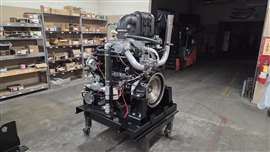 A GL08 engine from Reliable Horsepower, staged in production
Increasingly, that equation is changing.
Fuel costs and availability, duty cycles, emissions requirements, serviceability, maintenance, local support, and long-term operating costs are all playing a larger role in the decision.
At the same time, advances in engine and fuel technologies have expanded the available options, giving equipment owners and OEMs greater flexibility to match power solutions to specific applications rather than relying on a single platform across an entire operation.
The result is a more strategic approach to engine selection – one that begins with what the application actually requires versus a predetermined engine or fuel.
For Jay Canada, VP of Sales & Engineering at IIS/Reliable Horsepower, perhaps the clearest example is how much the industry’s relationship with diesel has changed.
 Jay Canada, VP of Sales & Engineering for IIS
“For years, it was diesel or diesel – those were the choices,” he says. “A lot of OEMs still want to look at diesel for many applications, but it’s a long way from a foregone conclusion like it used to be.”
Blake Thompson, IIS/Reliable Horsepower’s Engine Package Sales Lead, points to rising diesel and operating costs as part of that shift, but says the larger change is the range of choices operators now have. “Diesel is all anyone ever knew, but now there’s some education and comparison happening. I think all those factors combined are making people rethink the engine they’re putting into an application.”
And that doesn’t necessarily mean replacing one preferred engine with another. Depending on the application or fleet, Canada says the answer could involve multiple engine platforms or even the ability to use more than one fuel within the same engine.
“I think it really depends on a customer-by-customer, application-by-application basis. It’s becoming more about what influences the economics of a power solution over its working life. Packaging constraints, operational reliability, local service support, equipment longevity, maintenance costs. What used to be more about dollars-per-horsepower on cost is becoming more about the different parameters and the customer’s bottom line.”
Essential step
The evolution has made engine selection a more strategic process. Thompson says operators are weighing fuel access, operating costs, lead times, and other factors that once received less attention.
Canada points to maintenance and emissions systems as another example. “While current emissions-tier diesel engines employ more complex emissions technology, most spark-ignited engines use a three-way catalyst that can be less expensive to maintain and replace,” he says.
But perhaps the biggest variable is the application itself.
Diesel, for example, can remain well suited to true mobile equipment, where carrying enough fuel onboard and maximizing power output per unit of fuel are important. “Oil and gas operations may have ready access to natural gas or pipeline gas,” Canada adds, “while agricultural applications can draw from several power and fuel options.”
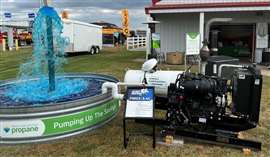 A Reliable Horsepower PM03 engine package in a running display at a recent tradeshow
Duty cycle further complicates the equation, he notes. “Assumptions surrounding spark-ignited engines have changed considerably as the technology has evolved. A decade ago, most OEMs really assumed that propane and other spark-ignited engines weren’t capable of continuous-duty applications, and that’s simply not the case.”
It’s now much more widely understood that propane engines and spark-ignited engines in general are more than capable. Such differences become particularly apparent across industries. Oil and gas equipment may operate 24/7, with planned maintenance representing virtually its only downtime. Agricultural irrigation and water-transfer equipment, by contrast, may operate seasonally or for only a few thousand hours each year. Power-generation applications bring their own load and output requirements.
To that end, says Thompson, “… packaging requirements can vary just as significantly. Some oil and gas applications require engine cooling to be integrated with larger compressor-skid systems, while agricultural equipment may need a single engine to drive the primary application along with auxiliary components.”
Additionally for Thompson, understanding the application becomes the essential first step. “Compliance, reliability, performance, support, and serviceability all enter the equation before an engine is sized and selected. The days of the cookie-cutter engine package that works for everything are mostly over.”
Beyond the engine
As a result, rather than arriving with a predetermined solution, Canada says more OEMs are willing to begin with what he describes as a “blank-sheet-of-paper” approach.
“They want to come to us and talk about their application: ‘Here are the things we need. Here’s what’s important to us. How can we engineer something that’s going to fit those needs?’”
 Blake Thompson, Reliable Horsepower’s Engine Package Sales Lead
As such, the priorities can vary considerably. Upfront cost may drive one decision, while another application places greater emphasis on service support, fuel availability, maintenance costs, or long-term operating efficiency. Power-generation applications, for example, may require additional capacity to handle startup loads, while agricultural customers may begin with something as fundamental as how much water needs to be moved, and how quickly.
“We’re really digging into the application to fully understand what’s going to best fit that need,” Thompson says. “We may not have that solution, but we want to understand that before we provide something that isn’t going to be the right fit.”
In turn, despite the broader acceptance of different technologies, some longstanding assumptions remain. Thompson says operators already familiar with spark-ignited engines generally understand their capabilities, while those with less exposure may still approach diesel as the default choice.
Canada points to the perception that propane engines are primarily suited to irrigation as another holdover from an earlier generation of technology. Today, he says, spark-ignited engines can serve as standalone solutions or become part of broader power strategies incorporating other fuels, technologies, or even battery storage.
Which doesn’t make diesel, propane, and natural gas direct competitors in every application, he clarifies. “Instead, each presents strengths under different operating conditions. Diesel remains well suited to true mobile applications where onboard fuel capacity and power output per unit of fuel matter. Spark-ignited engines can offer advantages in stationary and portable applications, while propane provides an option where natural gas infrastructure is unavailable.”
The decision also increasingly extends beyond the engine itself. “I think, in a lot of cases, the right fit for an engine comes down to the engine package integrator’s ability to correctly design an engine for a specific application,” he adds.
Engineering, design, and collaboration can allow an engine package to accommodate requirements that the base engine alone cannot address. Whether the solution ultimately involves diesel, propane, another spark-ignited fuel, or even an electric drive, Canada says advances in package integration have created considerably more opportunity to tailor the equipment to the job.
“There’s just a lot more opportunity to get things right now, versus in the recent past.”
Challenging assumptions
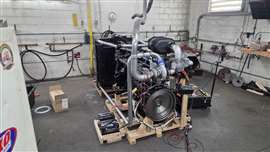 A Reliable Horsepower GX12 engine package, set up for a component test run
Keeping those options open may become increasingly important as operating conditions continue to change. Canada points to two considerations that can easily be overlooked during engine selection: local service support and fuel availability.
“The time to figure that out is not when an engine is down and needs support at the speed of yesterday,” he says.
Fuel introduces a similar risk. Price volatility and potential supply disruptions have made availability another part of long-term planning, strengthening the case for considering different fuels and engine technologies across a fleet rather than defaulting to a single solution.
Canada expects that shift to continue.
“By and large, successful OEMs have abandoned the one-size-fits-all approach,” he says. “Having an engine source or engine partner that helps maximize operational efficiency for each job or application is critical.”
Moreover, the engine platforms themselves are evolving accordingly. Thompson points to greater fuel flexibility, improved diagnostics, efficiency, serviceability, and adaptability as areas that will continue shaping future power systems.
Canada also expects spark-ignited platforms to continue expanding across a wider range of horsepower and kilowatt outputs, opening additional applications while allowing engines to be more precisely calibrated around particular fuels. In some cases, an engine optimized for one methane-based fuel can retain the ability to operate on another, giving equipment owners additional flexibility when local fuel conditions change.
For all the technology entering the equation, however, Thompson says the fundamental starting point remains surprisingly simple.
“I would start with the application, not the engine,” he says. “Put eyes on the application first. Do we have options, or are we limited to one option?”
The objective is no longer to identify a single platform or fuel capable of satisfying every requirement. It’s to understand the job first, evaluate the full range of operational demands, and then determine which combination of engine, fuel, packaging, and support provides the greatest value over time.
For Canada, that requires operators and OEMs to challenge familiar assumptions rather than allowing past practices to predetermine the next engine decision.
“There are other options out there,” he says. “Be willing to expand the horizon of your search. It can really make a difference to your bottom line.”
--------
This article was produced by KHL Content Studio, in collaboration with experts from Reliable Horsepower
--------
All images courtesy of IIS and Reliable Horsepower
--------