Wärtsilä supplying propulsion for high-speed LNG-fueled ferry

02 September 2022
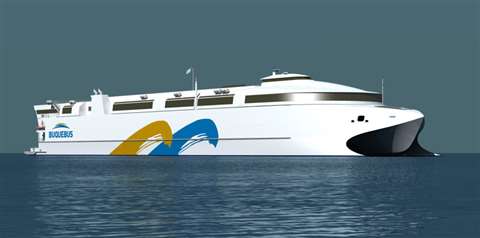 The new high-speed catamaran ferry, powered by Wärtsilä’s 31 dual-fuel engine technology, will be the world’s largest and greenest vessel of its type. (Photo: INCAT)
Technology group Wärtsilä has been commissioned to supply the engines, waterjets and fuel storage and supply system for a new high-speed catamaran ferry being built at the Incat yard in Tasmania, Australia, on behalf of Argentinian ferry operator Buquebus. The vessel, which will operate between Argentina and Uruguay, has an overall length of 130 m, a width of 32 m and the capacity to carry 2100 passengers and 226 cars.
The full scope of the order consists of four Wärtsilä 31DF dual-fuel four-stroke engines, featuring a power output ranging from 4.6 MW to 9.6 MW at 720 and 750 rpm; four Wärtsilä WXJ1500SR modular waterjets with an axial pump design for increased performance and thrust; and two Wärtsilä LNGPac fuel storage, supply and propulsion control systems. The equipment will be delivered to the yard beginning in mid-2023.
The ferry will utilize the dual-fuel engine technology using primarily LNG fuel produced at Buquebus’ own LNG plant. It will also incorporate shaft e-motors powered via the main engine. The resulting minimized emissions will enable the vessel to be Tier III compliant and to operate in emission control areas (ECAs).
“We have selected Wärtsilä waterjets many times in the past, and have always been extremely satisfied with their performance,” said Tim Burnell, Incat’s CEO. “This, though, is the first time we will include Wärtsilä engines and we are excited about the potential they provide. This will be the world’s largest and greenest vessel of its type, and we are very happy to be working with Wärtsilä to make the project a huge success.”
“This is indeed an exciting project,” agreed Mikko Mannerkorpi, general manager, sales, Wärtsilä Marine Power. “Our latest WXJ generation axial flow waterjets reduce the installation footprint on average by approximately 25% compared to non-axial flow jet designs. They also give a higher power-to-weight ratio and come with an advanced Propulsion Control System. Combining this with our highly efficient, fuel-flexible engines means that it is a truly future-proof investment.”
POWER SOURCING GUIDE

The trusted reference and buyer’s guide for 83 years
The original “desktop search engine,” guiding nearly 10,000 users in more than 90 countries it is the primary reference for specifications and details on all the components that go into engine systems.
Visit Now
STAY CONNECTED



Receive the information you need when you need it through our world-leading magazines, newsletters and daily briefings.

CONNECT WITH THE TEAM