ZF rewires commercial vehicles as software-defined platforms

18 June 2026
Flexible system architectures enable step-by-step transformation
 (Photo: ZF)
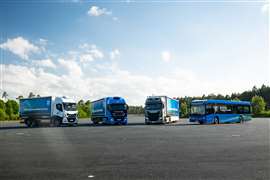
During its annual CV Tech Day 2026, ZF demonstrated its latest safety and motion system innovations for trucks and city buses. Taking place at its test track near Hanover, Germany, the company showed software-defined, AI-driven platforms that it said deliver value today and prepare fleets for future requirements.
Because the transition progresses at different speeds in different markets, ZF emphasized flexibility for its customers with scalable architectures, integrated safety systems and modular electrification. The company said its approach improves safety, efficiency and total cost of ownership while protecting existing investments.
“The direction toward the commercial vehicle of the future is crystalizing, but the path is non-linear and iterative,” said Andreas Moser, Member of the ZF Board of Management and Head of Commercial Vehicle Solutions Division. “At CV Tech Day, we demonstrate how we support our customers with practical solutions that deliver value today and enable a cost-efficient, scalable transition toward zero accidents and zero emissions.”
ZF said it has followed an evolutionary approach, building on scalable platforms, flexible E/E architectures, system intelligence and digital eco-systems. The company said this allows OEMs and fleets to continuously improve efficiency, safety, uptime, and total cost of ownership across the entire vehicle lifecycle while ensuring the utilization of existing investments.
The company highlighted software and system-combined intelligence as the foundation of new commercial vehicle capabilities. Vehicle systems, it said, are evolving from signal-based to service-oriented architectures, enabling scalable vehicle-to-infrastructure connectivity, on-demand functions and automated configuration for specific use cases to support a fully integrated logistic chain. Existing hardware can deliver new functionality through software alone, said the company.
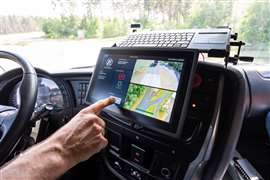
It showcased solutions such as seamless connectivity between truck and trailer data, automated yard zone configuration, emergency stop functions based on Bluetooth Low Energy (BLE) signals triggered by vests worn by yard operators and remote vehicle access, including interaction with vehicle safety systems such as the electro-pneumatic handbrake.
The company said the technology illustrated how commercial vehicles are becoming part of connected operational ecosystems, where software and system intelligence unlock efficiency, uptime and safety gains beyond traditional driving scenarios. Existing technologies, embedded and co-existing with service-oriented architectures, can already be leveraged today to optimize cargo and people transportation.
Software defined vehicle architecture: the next technological step
ZF said there are differences between the requirements for passenger cars and commercial vehicles that have an impact on future architectures and solutions, with commercial vehicles prioritizing productivity, total cost of ownership, lifecycle management, and upgradeability to address increasing complexity while remaining safe, efficient, and economically viable.
 (Photo: ZF)
The company said it has addressed these challenges with purpose-driven, flexible E/E and system architectures that gradually transform vehicles into flexible, upgradeable platforms. This, it said, will enable continuous improvements across the vehicle lifecycle, such as enhanced sensing capability, reduced energy consumption, predictive maintenance and increased uptime.
“Software and connected system intelligence are becoming the key ingredients to unlock next level potentials of commercial vehicles,” said Ivan Brajdic, Head of R&D, Commercial Vehicle Solutions Division, ZF. “Our approach to software- and feature-driven commercial vehicles is evolutionary, not revolutionary. We combine our system expertise across ADAS, braking, electrified drivetrains, steering and suspension with an evolution in E/E and software architectures to enable vehicles to continuously improve, enhancing safety, efficiency and uptime over their entire lifecycle.”
To support real‑world deployment at scale, beside fundamental enablers like system scalability, regulatory readiness or reduced total cost of ownership, ZF’s approach also considered a purpose-driven and smart co-existence of different software architectures so customers can move forward confidently without disrupting existing platforms or operating models.
From isolated functions to scalable 360° safety
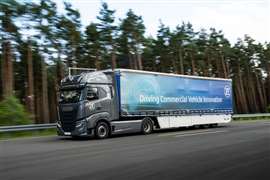
ZF demonstrated how vehicles evolve from individual driver assistance functions to system-level safety. Scalable radar and camera sensor systems around the truck and trailer enable continuous 360° perception without blind spots, it said, with ADAS, braking and steering working together as an integrated safety ecosystem supporting the long‑term vision of zero accidents.
 (Photo: ZF)
The company’s latest ADAS architecture integrates new cameras and radar sensors across the truck and trailer through a truck-trailer link, powered by required network and computing technology (ECUs). This approach enables enhanced scalability and a clear pathway toward higher levels of automation.
This system-level approach extends beyond the truck. Integrated trailer solutions, including trailer camera monitoring systems, expand visibility across the entire vehicle combination and support safer maneuvering and turning. Advanced reversing assistance can detect obstacles behind the trailer and trigger braking, reducing collision risks during yard and loading operations.
For highway and urban driving, ZF’s Driver Monitoring System detects driver distraction or fatigue and enabling real-time warnings to help prevent accidents caused by human error. In low-speed scenarios, warning and active braking assist during nearside turning and moving off enhance the protection of vulnerable road users in urban traffic. Additionally, Rescue Assist detects approaching emergency vehicles early by using acoustic siren recognition.
City buses: Safer, more precise urban operation
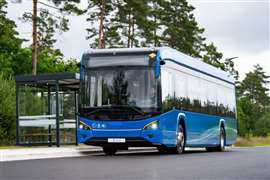
ZF also demonstrated how it can enhance safety in urban environments with dedicated solutions for city buses.
 (Photo: ZF)
City Bus CMS offers a bus‑specific braking profile designed to mitigate collisions and protect standing passengers at the same time. City Bus Assist, a perception sensor-based solution, supports precise bus stop approaches by assisting steering and detecting curb height, reducing infrastructure and tire damage and improving vehicle uptime, said the company. The integrated control of OptiRide ECAS functions enables automated kneeling and facilitates smoother and more accessible boarding.
Additionally, CDC Skyhook uses a software‑based damping algorithm to adapt damper characteristics in real time, enhancing vehicle stability and ride comfort. This automated adjustment based on input from various external sensors and CAN signals directly supports safer, smoother operation in complex urban environments
Smooth pathways to decarbonized transport
ZF said there is no single electrification solution for all commercial vehicle use cases, so the transition to zero-emission transport must be pragmatic, scalable and economically feasible. The company offers a flexible and scalable path to electrification, tailored to different applications: from hybrid solutions such as the hybridized automated transmission (TraXon 2 Hybrid) supporting full-hybrid and plug-in hybrid applications, to modular electric driveline systems including central drives (CeTrax 2, CeTrax 2 dual) and electric axles (AxTrax 2, AxTrax 2 dual, AxTrax 2 LF).
The company said its electric axle solutions also support electrification of trailers and enable energy recuperation to support traction, improve efficiency and reduce emissions.
TraXon 2 Hybrid supports the next decade of electrified transport with electric launch capability, energy recuperation and flexible drive modes, reducing fuel consumption and emissions while maintaining performance and reliability as a practical, cost‑efficient bridge toward further electrification.
With CV Tech Day 2026, ZF provided a preview of what will be on display on its stand at the IAA Transportation show in Hannover, Germany, from September 15 to 20.
POWER SOURCING GUIDE

The trusted reference and buyer’s guide for 83 years
The original “desktop search engine,” guiding nearly 10,000 users in more than 90 countries it is the primary reference for specifications and details on all the components that go into engine systems.
Visit Now
STAY CONNECTED



Receive the information you need when you need it through our world-leading magazines, newsletters and daily briefings.
CONNECT WITH THE TEAM