Read this article in 中文 Français Deutsch Italiano Português Español
Donut Lab launches solid state Donut Battery

05 January 2026
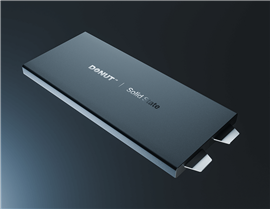 Solid state Donut Battery (Photo: Donut Lab)
Donut Lab has announced the launch of Donut Battery, described by the company as the world’s first solid state battery used in production vehicles. The battery tech is now offered by Verge Motorcycles, although Donut stated that future applications can include all types of light- and heavy-duty on-highway vehicles, together with off-highway machines.
Solid state batteries work much like standard batteries, moving ions between the anode and cathode. But instead of a liquid electrolyte, the batteries use a solid material such as a ceramic or polymer.
This supports a higher energy density and faster recharging. Information states that the Donut Battery can deliver 400 Wh/kg of energy density. Li-ion batteries generally offer up to 200 Wh/kg, while some high-nickel content batteries – including NMC chemistries - have achieved 300 Wh/kg.
The higher storage levels means that smaller batteries can be used to achieve the same vehicle range, or a pack of the same size as a li-ion equivalent can deliver a longer total distance.
Additionally, Donut states a full charge can be achieved in about five or 10 minutes. Li-ion batteries also demand slower recharging from 80 to 100%, to protect battery chemistry and reduce overheating. These issues are eliminated with solid state products.
Costs can be reduced due to the elimination of complex systems to maintain internal operating temperatures. Solid state batteries also offer a reduced fire risk (thermal runaway), making them safer than other power storage systems.
The battery packs perform better in lower temperatures, retaining 99% of the available charge down to -30C.
And on top of that, the format of solid state batteries can support around 100,000 charge/discharge cycles, far more than any li-ion products which have a maximum of between 5,000 and 6,000 cycles.
Speaking about the launch of the new battery tech, Donut Lab CEO Marko Lehtimäki, said: “While the advantages are obvious, the future of solid state batteries has been a moving target constantly delayed when companies working in electrification are asked about when they will become a reality.
“At Donut Lab, our answer on solid state batteries being ready for use in OEM production vehicles is now, today, not later. Donut Lab has engineered a new high performance solid state Donut Battery that can be scaled to major production volumes and seen now in real world use in the Verge Motorcycles bikes out on the road in Q1.”
Solid state batteries have been put forward as the ‘holy grail’ of electrically-powered vehicles and machines, bringing recharging times in line with standard refuelling of an ICE vehicle, while higher energy density helps to reduce range anxiety.
Various OEMs have anticipated introduction of solid state power by around 2030 – and even then, only in limited numbers across premium offerings. In no small part this is down to scaling of solid state battery production, with the tech difficult to replicate at industrial volumes.
Should Donut Lab’s technology deliver related manuacturability and effective power delivery in the real world, the company will have gained a considerable jump on those competitors.
Other projects underway at Donut Lab using the new solid state battery tech include development of the Cova Power Smart semi trailer. Using the Donut Battery and Donut in-wheel motors, the trailer is reported to have reduced diesel consumption by up to 54%, while achieving a 30% reduction in total energy use.
With this and other projects, including a development of a ‘skateboard’ battery pack/chassis for an EV manufacturer, it will be interesting to see if there is a response from other manufacturers working on their own solid state solutions.
POWER SOURCING GUIDE

The trusted reference and buyer’s guide for 83 years
The original “desktop search engine,” guiding nearly 10,000 users in more than 90 countries it is the primary reference for specifications and details on all the components that go into engine systems.
Visit Now



CONNECT WITH THE TEAM