Read this article in 中文 Français Deutsch Italiano Português Español
EAO helps OEMs redefine HMI

19 February 2026
The human machine interface (HMI) determines how people monitor, control and interact with their vehicles and machines. Now, according to John Pannone, managing director for North America at EAO, HMI is being redefined by two major industry trends – electrification and automation.
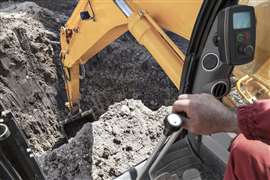 EAO is transitioning its facility in Auerbach, Germany, to support heavy-duty specialty and construction equipment applications. (Photos: EAO)
It should come as no surprise that advances that are already redefining so much of how machines operate would also present their own unique HMI requirements. For example, with electric powertrains, what operators need to see and how controls behave change along with the power source.
“There are new systems that are incorporated when you take a utility truck, for example, and you electrify its implements, the basket, etc.” Pannone said. “Now you have a battery system on board, and battery systems need to be monitored, and they need to drive some feedback [to the operator].”
Depending on the supplier, it can often be difficult to incorporate such controls into the drivetrain’s CAN system, necessitating two parallel CAN systems to be placed on board the same machine – one to control the engine and drivetrain, and a second to control the work functions that go onto that drivetrain.
“We’re working with customers who are interested in that second control system to provide feedback, battery monitoring – all kinds of things that electrification is bringing to the marketplace,” said Pannone.
Aiding the transition
Founded in 1947 in Olten, Switzerland, EAO is a family-owned company that lays claim to developing the first illuminated pushbutton 75 years ago. Today, it is a global producer and supplier of switches, indicators, keypads and other electromechanical and serial communicated components, up to complete HMI control units and HMI solutions.
EAO supplies OEMs in heavy-duty specialty vehicles, buses and trucks, off-road equipment, as well as automotive and railway applications. It has a facility in Auerbach, Germany, that has historically served the automotive market and is now being transitioned into a hub to support the heavy-duty specialty vehicle and construction equipment markets.
“We are a global company. We have 10 EAO-owned subsidiaries. We have a hub in China, in Guangzhou, that services the whole Asian marketplace for us,” Pannone noted. “We have several locations in Europe, across all the European countries, and some of those companies are consolidating some resources in the next year or so into that German hub.”
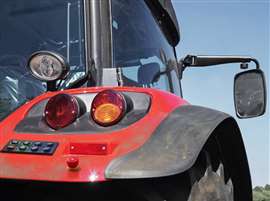 In more challenging environments, EAO has seen a trend away from touchscreens to simpler, rugged and more intuitive controls. (Photos: EAO)
The company’s North American operation is based in Shelton, Conn., USA.
With locations and customers around the world, the company has seen numerous examples of the challenges many OEMs are facing as they move to further automate and/or electrify their product portfolios.
In the case of electrification, many customers are transitioning machines that were previously based on internal combustion engines. “The existing customer that’s transitioning, they usually have a pretty good engineering base. They understand the markets. They usually have very, very deep benches of experience that they have within their facilities,” said Pannone.
Others, however, are true startups entering the product development space for the first time. “They never had a product – they started with some sort of EV-type applications. Those applications are a bit more challenging,” Pannone said. “There, we have to bring a different skill set to them. We have to bring more engineering to that customer.
“Some of these earlier stage companies, we have to bring maybe a bit more ergonomic insight, more user information – maybe help them with a couple scenarios that highlight not only the individual HMI controls but also the overall usability of the interface and the end-to-end customer experience.”
Functional safety
As HMI evolves, functional safety is becoming one of the most critical needs in the market.
“We spend a lot of time talking to customers about functionally safe operation of vehicles, whether that be movement of the vehicle or movement of implements, so that the end product operates in a safe mode,” said Pannone. “We have products that we’re bringing to market that have CANopen Safety embedded in them, mostly in the HMI products.”
CANopen Safety is an extension of the European CANopen Standard protocol that enables reliable, functional safety (up to SIL3) by requiring redundancies for transmitting safety-critical data. EAO’s Series 09 is among the few products currently being built to CANopen Safety requirements.
The Series 09 includes a variety of products designed for challenging environments in heavy-duty specialty vehicles working in on- or off-road applications. The series offers customizable keypads, joysticks and LIN switch panels, universal switches and a LIN/CAN evaluation kit.
“We’re probably the only company at the moment... who has a product that has achieved a CANopen Safety recognition,” Pannone stated. “But we know we’re not alone and we know that this position won’t be forever, because we hear a lot of movement and interest in this area.”
Mixed technology
The right HMI solution – or mix thereof – for an application must also address evolving operator needs to ensure both safety and controllability.
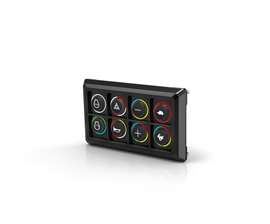 EAO’s Series 09 is among the few products currently being built to CANopen Safety requirements for enhanced functional safety. (Photos: EAO)
“Mixed technology is kind of what we focus on,” said Pannone, “where there’s some use of software, touchscreen, either cursor control or joystick and then discrete functions, discrete buttons that do a certain thing – they turn the light on, that’s it, they don’t do anything else.”
The challenge is how to identify the right combination that can both attract and make it easier to train new operators who grew up with more advanced systems and controllers – without alienating experienced operators who may find adapting to such technology more challenging.
“For the experienced operator, we have to try to find a happy medium... If you shift all the way to one type of new, modern technology, it does render a whole group of your team, not obsolete, but they’re going to require a heck of a lot of training,” Pannone pointed out. “So, you have to try to find that middle space that keeps everybody on the same page, and they’re able to operate equipment safely. We focus on making the operator controls as intuitive as we can.”
Simple, intuitive and adaptable
While most people have experience with some form of touchscreen as the main product interface between the user and the product (i.e., through a smartphone or iPad), such interfaces are not always suited to more complex or ruggedized environments. Consequently, EAO has seen a trend away from this type of HMI in certain applications.
“We see a lot of applications and have a lot of discussions with customers where they’re trying to get away from that type of environment to try to keep it a bit more simplistic for the operator,” said Pannone. “It’s gone from a direction where they tried to put everything on a touchscreen because that was safe and it was simple and it was software, to the point now where it’s come back to the middle where hardware like our push buttons or keypads or cursor controls is valued.
“For example, safety‑critical functions like emergency stops should remain physically implemented, immediately accessible and isolated from other systems to maintain safe operation. In all, their goal is to keep the environment as simple and user friendly as possible.”
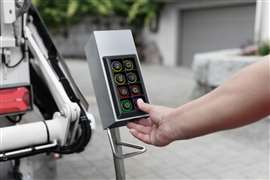 EAO offers solutions, like the Series 09 keypad, that are designed to be simple, intuitive and readily adapted to the application. (Photos: EAO)
EAO said it offers solutions that are designed to be simple, intuitive and readily adapted to the application. Take the Series 09 CAN keypads, which Pannone said have been designed to an “extreme” level of feedback ability.
“We have incorporated [multiple] levels of feedback that the customer can incorporate,” he explained. “You can incorporate three or four colors in quadrants so the segments can be illuminated, or you can add other types of animation like rotational feedback, blinking feedback, brightness of illumination or dimming of illumination or sound.
“We’re working with customers in complex environments to try to bring them a product that is very adaptable. The legends and the inserts, the symbols are all adaptable, so not only can a large customer who has significant volume use this type of product, but a smaller customer can also take advantage of this technology.”
There are no setup fees, Pannone added, and symbol inserts mean a new part number is not required each time a symbol is changed. “This is a very adaptable keypad that can be used in all kinds of different applications.”
That includes in‑cab implementations designed for precise operator control, as well as rugged use cases such as operating the compactor on the back of refuse trucks, where CAN‑based control is commonly used in Europe.
“There’s no need to bring in sensitive screens or things that are not going to last in this environment,” Pannone stated. “You really only need simple feedback for the operator, and the Series 09 CAN keypad can help with this type of application.”
Integrated solutions
In addition to offering stock components, EAO can build customized panels as well as integrate components (buttons, indicators, keypads, displays, etc.) into complete HMI systems.
For North America, this integration is completed at the company’s facility in Connecticut. “Basically, we take our standard products that could be anything from a push button to a CAN-based keypad to a cursor control and we integrate them into subassemblies,” said Pannone. “We’ll bring the design. We’ll also help the customer with ergonomics and user experience ideas.
 EAO can integrate various components into customized subassemblies for plug-and-play application into a vehicle or machine. (Photos: EAO)
“The user experience is a big part of these operator interfaces with any company,” he added. “Is it safe? Is it intuitive? Is it adaptable? All these things come into play.”
Subassemblies are developed based on the serial interface (CAN-based, Ethernet) used by the OEM. “We’ll go through all the steps from prototyping to production to if there’s certification,” said Pannone. “We won’t do the certification in-house, but we’ll work with them to get the product certified. Really, it’s working with the customer on the whole life cycle.”
The aim is to remove any pain points these small pieces of larger systems may present. “We’re trying to take those little pieces, manage them for the customer and then make it so [they don’t] have to worry about that subassembly,” Pannone said. “All they need to do is plug and play and worry about the rest of the system.”
What comes next
According to Pannone, EAO plans to continue to focus on the “mixed technology space,” developing and bringing together a mixture of software, hardware, screen imagery and discrete components. Yet, there are technologies operating “on the fringe” that could influence where industrial HMI, and EAO, head next.
“It could be voice control, gesture control or gesture based, touch operated. It could be a mixture of those technologies,” Pannone mused. Such “multi-modal HMI” is rapidly becoming the norm across industries like automotive and consumer electronics. “But the application of these technologies is not quite to where we want to consider them the safest in all environments. There’s a lot of ambient influences that can affect that.
“When you’re operating a touchscreen, you’re guiding the customer to press here, press there, do this, do that,” he noted. “But a gesture [for] an increase in speed, or an increase in volume or a decrease in volume – what is the universal sign or motion for those gestures?
“There are consumer applications... But in these industrialized, heavy-duty, rugged environments, we’re not sure if it’s there yet. But it could be.”
POWER SOURCING GUIDE

The trusted reference and buyer’s guide for 83 years
The original “desktop search engine,” guiding nearly 10,000 users in more than 90 countries it is the primary reference for specifications and details on all the components that go into engine systems.
Visit Now
STAY CONNECTED



Receive the information you need when you need it through our world-leading magazines, newsletters and daily briefings.
CONNECT WITH THE TEAM