Read this article in 中文 Français Deutsch Italiano Português Español
JCB’s 400+ mph engineering milestone
12 October 2026
A close-up look at what went into developing what’s under the skin of the world record-setting JCB Hydromax.
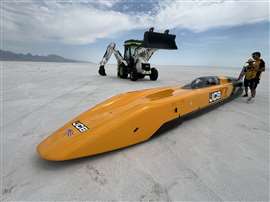 The engines used in the Hydromax are based on the production model engines powering the hydrogen-powered JCB 3CX backhoe loader. (Photo: Becky Schultz)
The JCB Hydromax hit an impressive top speed of 367 mph in a high-speed trial during Speed Week 2026 at Bonneville Salt Flats in northwestern Utah. Then, less than a week later, on August 11th, its twin 800-hp hydrogen combustion engines sent it hurtling down and back across the desert flats to an average speed of 406.320 mph – scorching the previous land speed record of 185.5 mph set by the hydrogen-fueled BMW H2R in 2004.
The Hydromax also comfortably surpassed the world diesel land speed record of 350.092 mph (563 kph) set by its predecessor, the Dieselmax, in August 2006.
The Category A, Group XIV - Class 7 FIA World Flying Record Start Land Speed Record, sanctioned by the Fédération Internationale de l’Automobile (FIA), is the culmination of over a year of planning by a team of 65, consisting of 25 of JCB’s own engineers along with specialists from Prodrive, Ricardo, Xtrac and Ryze Power, the hydrogen provider. This team had been tasked by JCB Chairman Anthony Bamford with bringing his vision to life.
“JCB Dieselmax was always a bit of an unusual idea – but it proved a point. Putting an advanced engine into a land speed car showed the world what it could do in a way a digger never could,” said Bamford, who was on hand to watch the record attempt alongside much of his family. “It’s the same thinking with hydrogen today. If you’re serious about emissions, you have to be serious about hydrogen – and a land speed project is the perfect way to prove it.”
JCB Engineering Director Ryan Ballard, who led the Hydromax project, mapped out a plan indicating the project would take 72 weeks to complete. Instead, the team was given just 50 weeks from start to finish, all while continuing to do their “day jobs” – making what they accomplished even more remarkable.
Bringing the engines up to speed
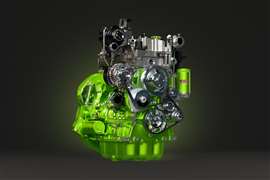 JCB’s 74-hp 4.8 L production hydrogen combustion engine. (Photo: JCB)
Hydromax flew across the line powered by engines based on JCB’s production hydrogen combustion engines. The standard production engines, which received EU type approval for commercial sales in 2025, are manufactured at the company’s factory in Foston, Derbyshire, UK, for use in construction machines such as the hydrogen-powered 3CX backhoe loader.
The 4.8 L, inline four-cylinder, hydrogen combustion engine is the culmination of five years and £100 million (US$135 million) invested in hydrogen engine development. Rated 74 hp (55 kW) at 2,200 rpm and 325 lb.-ft. of torque, the engine is designed to match the performance and torque characteristics of its diesel counterpart while achieving slightly higher thermal efficiency.
The sump, bedplate, block, cylinder head, intake manifold and rocker cover are shared with the base engine design, allowing hydrogen engines to be built on the same production lines as diesel units. Port fuel injection is used on the hydrogen variant to inject hydrogen into the intake manifold at around 145-psi (10 bar) pressure before mixing with air and entering the combustion chamber.
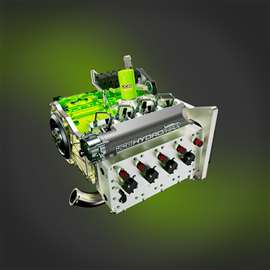 Hydromax’s twin engines were modified to enable mounting on their sides within the 32-ft.-long. vehicle’s narrow bodywork. (Photo: JCB)
Bringing the Hydromax engines quite literally up to speed meant the engine team had to figure out how to produce 10 times the horsepower of the current design. Significant modifications were needed, including raising engine speed from around 2,200 rpm for construction equipment applications to almost 4,000 rpm in the high-performance prototype car. Torque output was also quadrupled compared with the production engine.
To achieve this, the pushrod valvetrain used on the production engine was replaced by a double overhead cam arrangement. Mark Richards, principal engineer at JCB Excavators, said the change provided much greater precision over valve timing at high engine speeds and reduced system flex.
Fuel delivery also changed dramatically. Rather than port injection, the race engines use direct injection with fuel rail pressures increased from around 145 psi to approximately 725 psi (50 bar). Injecting hydrogen directly into the combustion chamber allows significantly more fuel to be delivered in the limited time available at higher engine speeds.
In addition, JCB reduced the engine weight, upgraded the cooling and lubrication systems and adopted a dry sump design to allow the engines to be mounted on their sides within the 32-ft.-long. vehicle’s narrow bodywork.
“Dry sump is common in race cars. It means the oil doesn’t slosh about during fast cornering and is always available for pick-up,” Richards noted. “On the race car, we’ve got an oil pickup pump – the scavenger pump – that is pumping that liter of oil every second around each engine, allowing us to keep the engine lubricated as it runs on its side.”
This arrangement lowers the vehicle’s center of gravity while ensuring a constant oil supply under extreme operating conditions.
While there were substantially changes, some elements remain familiar. Richards said the crankshaft used in the race engine is the same as that found in JCB’s production diesel and hydrogen engines. Computational fluid dynamics work originally carried out during development of the 74-hp engine was also carried across to the race program.
Cool running
Keeping the hardware alive proved a key engineering challenge. The pistons alone require 1 L of cooling oil every second – as much oil flow as the rest of the engine combined – to stop them from overheating.
To overcome this, JCB developed an ice cooling system, with air exiting the turbocharger at around 392° F (200° C) and cooled to less than 50° F (10° C) before entering the intake manifold. The greater density of the cooler air helped to maximize power output, Richards explained.
Instead of cooling inlets on the car, tanks full of ice are used to cool the engine and other underbody components. One tank is located inside the car’s nose structure, while the other is in the hump of the bodywork behind the driver. For each run, roughly 550 lb. (250 kg) of ice was needed – with the tanks being drained and refilled each time.
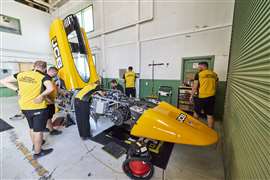 A team of 65, including 25 of JCB engineers, worked in their “off hours” to bring the vehicle to fruition. (Photo: JCB)
Specially developed exhaust valve technology handles the temperatures generated by the 800-hp engine. Each titanium turbo compressor spins at more than 150,000 rpm at close to 572° F (300° C), pumping the equivalent of a standard bathtub of air every half second.
Because of the amount of water involved, both for cooling and as the exhaust byproduct, JCB brought a chemist onto the engine team early in the process to develop a special engine oil that Hydromax Driver Wing Commander Andy Green OBE – who also piloted the original Dieselmax – said “absorbs water like a sponge.”
“Literally from start of warmup of the engine, all that water is being sucked up into an emulsion in the oil – it’s the only oil I’ve ever heard of that can do this – and then it boils off again,” he said. “That’s one tiny example of the specialist bits of science and technology that make this such an impressive end result both for the construction industry and JCB and for the racing industry with a 400-mph hydrogen car.”
20 years of advancement
To deliver power to the wheels, the hydrogen combustion engines drove all four wheels through a twin transmission and clutch system – a drastic step forward from the Dieselmax project. Hydromax also adds a sophisticated induction system with a single-stage motorsport turbocharger to help deal with the high altitude at Bonneville Salt Flats.
“The DNA of the Dieselmax has been carried through to Hydromax,” Green commented. “But with 20 years of extra technology and a much better professional understanding from the team of what they were trying to achieve… it was just more sophisticated.”
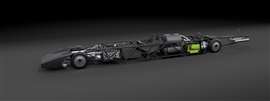 A cutaway of the internal workings of the JCB Hydromax. (Photo: JCB)
In the Hydromax, the twin engines are laid on their side inside the chassis, with the front engine’s cylinder head to the left of the chassis and driving the front wheels via a front-facing gearbox. The rear engine, located behind the driver, has its cylinder head to the right of the chassis and drives the rear wheels via a gearbox behind it.
Crucially, the engines needed to be balanced in terms of their output. To achieve this, they are fed by NACA-style ducts on the bodywork to create a lower drag solution. According to JCB, this updated design resulted in a 4% reduction in aerodynamic drag compared to Dieselmax.
The wheels are driven by custom six-speed sequential transmissions from Xtrac, which have seamless electronically actuated shifting. Spools are used at both the front and the rear axle rather than conventional differentials. The clutches used on both gearboxes are taken from a JCB backhoe loader, as motorsport clutches were not up to the required loads.
As Green pointed out, “An extra 20 years of technology allows a lot more computer and sensor monitoring and control of all the systems, so it was easier to know what was going on, easier to control it. All in all, it was an easier car in a lot of ways to drive, but it also maximized the performance…”
Take-aways from Hydromax
Tom Beamish, JCB’s advanced projects deployment manager, said that the company expects the Hydromax project to enhance development of its hydrogen-powered construction equipment.
JCB has already made the 3CX backhoe loader powered by a 74-hp hydrogen combustion engine commercially available, as well as the G60RS H hydrogen-powered generator that works in tandem with the company’s three-phase powerpack battery.
“We’re always learning whenever we do something like this,” Beamish said. “Take for instance when we did the world’s fastest tractor; we developed really sophisticated turbocharging systems with that. Those same turbocharging systems were then used as learning to develop the hydrogen engines for production.
“So, what we expect is that out of this engineering endeavor that we are doing now, we are going to be able to take so many learning points to then be able to provide into our next generation of hydrogen equipment.”
Ballard said JCB has “great potential” already in its construction products, which are designed to work virtually 24/7 and remain “ultra reliable day after day after day.” But there are opportunities for further enhancement.
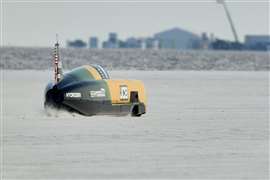 Achieving the world land speed record was intended to prove hydrogen combustion technology works. (Photo: JCB)
“If we can have enhanced telemetry and enhanced onboard monitoring that’s looking at how to optimize our machine all the time and give better uptime, better fuel economy, increased performance – I think it’s things like that that we’ll really take away from this,” he said. “We’re taking cutting edge motorsport technology and now we’re going, ‘Well, how can we apply that to our machines.’”
Speaking to those gathered at Bonneville Salt Flats to celebrate the record-setting speed run, Chairman Bamford said projects such as Hydromax demonstrate what engineering can achieve as well as the potential for hydrogen combustion technology.
“I believe people are far too quick to write the obituary of the internal combustion engine,” he stated. “For some time now, we’ve been told the internal combustion engine has come to the end of its life… Well, I’ve got news for you – it hasn’t. Internal combustion engines powered by hydrogen can be one of the most important solutions of the future, particularly for heavy-duty machinery…
“This isn’t a technology that sits in a laboratory,” he continued. “At its heart, this technology is based on an engine and engineering principles that we understand, that we use every day in construction machinery around the world.”
“It’s a real practical world technology that’s already being marketed,” Green added, gazing out across the stark, blindingly white landscape. “And here we’re in a great place – the world’s most demanding test ground for automobiles, the Bonneville Salt Falts – to showcase just how good that technology is.”
POWER SOURCING GUIDE

The trusted reference and buyer’s guide for 83 years
The original “desktop search engine,” guiding nearly 10,000 users in more than 90 countries it is the primary reference for specifications and details on all the components that go into engine systems.
Visit Now
STAY CONNECTED



Receive the information you need when you need it through our world-leading magazines, newsletters and daily briefings.

CONNECT WITH THE TEAM