Read this article in 中文 Français Deutsch Italiano Português Español
Jeff Eisenberg on Aggreko’s IPO
02 September 2026
As Aggreko returns to the market with a filing for an IPO on the New York Stock Exchange (NYSE), Jeff Eisenberg asks if the stock market has fallen in love with power rental again.
Aggreko filed Form F-1 with the SEC on 24 August, aiming for a New York listing under the ticker AGKO, with Goldman, JP Morgan and Bank of America managing the deal. Depending on how you count, this is the second or fourth act of one of the rental industry’s great stories - a company operating on a truly global scale.
Listed on the London Stock Exchange in 1997 following its spin-off from Christian Salvesen, a stock market darling for much of the next two decades, then taken private in 2021, and now knocking on the market’s door once again. Different exchange, same generators.
I have written versions of this article before, because the rental sector keeps playing out the same script: the stock market falls in love with a rental company, rides its rise, then gets bored and dumps it at a fraction of the price, just as private equity funds step in with their chequebooks.
 The author: Jeff Eisenberg
Aggreko is a perfect case study. It must be said that the business is much stronger now than it was in 2020: its private equity owners, TDR and I Squared, and the management team have done their homework well, aided by the boost from the AI boom.
London Olympics and surging demand
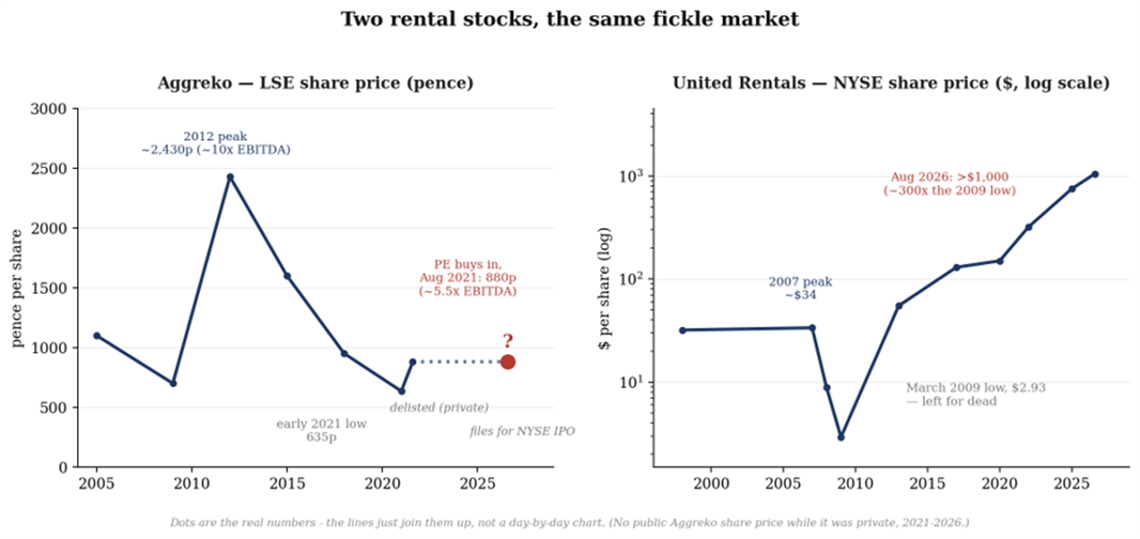
Let’s step back to 2012. The London Olympics and surging energy demand in emerging markets: Aggreko’s stock hit £24 (2,400 pence), a valuation that, by my calculations, corresponded to roughly 10 times EBITDA. A truly excellent growth company, valued as such by the market.
Then oil prices collapsed, the energy transition began to inspire fear rather than enthusiasm, and Covid. By early 2021, the stock had fallen to 635 pence. In August of that year, TDR Capital and I Squared Capital acquired the entire company for £2.3 billion (880 pence per share), at an implied EV/EBITDA multiple of approximately 5.5x.
In essence, that was about half the multiple the market had willingly paid nine years earlier. It was a great deal - provided one could pull it off, and that is exactly what the private equity firms did.
| Timeframe | Share Price | Implied EV/EBITDA |
| 2012 Market Peak (Olympics) | 2,430p | +/-10.0x |
| Acquisition (2021: TDR/I Squared) | 880p | +/-5.5x |
Aggreko, incidentally, is not the only company the market has dumped and forgotten. One need only look at its larger American ‘cousin’, United Rentals. The Connecticut firm listed on the NYSE in 1998 and by 2007 it was trading at around $34 per share. Then the financial crisis hit: the stock plunged to $2.93 in March 2009, a price signalling that the market doubted the company would even survive (remember the Cerberus takeover that did not happen?)
Look at where it stands now, trading at over $1,000 per share. This figure is approximately 300 times higher than the 2009 low and roughly 30 times higher than the previous peak in 2007.
The difference lies in what happened at the low point of each cycle. Aggreko went private, sitting out the subsequent cycle. United Rentals, by contrast, never left the stage: it remained publicly traded throughout the critical period, acquired RSC Holdings in 2012 - followed by a long string of complementary companies - rode the US construction and infrastructure boom, and is now capitalising on the wave of capital expenditure (capex) linked to AI and data centres - the very same narrative Aggreko is now presenting to investors ahead of its IPO.
Same sector, virtually the same playbook, yet two completely different outcomes. Such is the nature of the stock market and rental sector equities: first it loves you, then it doesn’t, and finally - if you have patience, luck, or both - it might fall in love with you again, and even more intensely than before.
 Note logarithmic scale for United Rentals graph on right.
The message in 2021
What was the value proposition when Aggreko went private in 2021? Hybrid energy, less diesel. The message was: ‘We’re going to make temporary power greener.’ It was a perfectly sensible claim for a generator company, but not exactly the sort of thing to drive the public market to re-rate a rental fleet and push its valuation multiples into the teens (13 to 19 times earnings). A solid story, certainly, but not as compelling as the AI narrative.
Which brings us to the present day and why I believe this listing could yield a different result. This time, the theme isn’t decarbonisation, it’s AI. Data centres are being commissioned faster than utility companies can connect them to the grid (with wait times of one to three years in many markets), and Aggreko sits right in that gap, armed with a 17GW fleet.
In 2021, data centres accounted for approximately 2% of Aggreko’s revenue. By the full year 2025, that share had risen to 11% (roughly $391 million), and in the first half of 2026, it reached 19% of sales - $362 million. That’s a CAGR of 66% since 2021.
Group revenue stood at $3.4 billion in 2025 (up 20% year-on-year) and $1.92 billion in the first half of 2026 alone (up 28%), with adjusted EBITDA of approximately $1.3 billion for 2025. This is not the usual promise to ‘go green’. It is a classic case of ‘supplying tools for the AI build-out’, and right now Wall Street cannot get enough of anyone who can credibly make such a claim.
To give an idea of the scale - and to ensure no one mistakes this for the story of a small business that haphazardly tacked AI onto its operations - consider that the company has 14,000 customers across more than 80 countries and a workforce of around 8,000 managing this fleet. It is a massive rental and power business that, quite by chance, found itself in the right place at the right time. Again.
Valuation multiples in context
To put valuation multiples in the rental sector into context once Wall Street buys into the story: United Rentals - a different type of business, with a broad catalogue and growth in specialty rental, rather than specifically energy solutions - has traded in recent years at roughly 11 to 12 times EBITDA. This is the kind of multiple the market assigns to a rental company viewed as being in a phase of structural, rather than cyclical, growth.
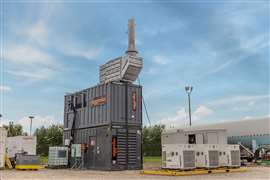 Aggreko’s power offering includes ultra-low emission packages (ULEP). (Image: Aggreko)
Aggreko’s own bankers project a total addressable market for energy solutions of $49 billion today, set to reach $66 billion by 2030, with the Americas growing at 8% annually and Europe at 7%. Significant figures, impactful slides: the sort of thing bankers love.
So: a better story, better numbers, and a theme that captivates investors rather than merely garnering their approval.
Except - and you knew there would be an ‘except’ - one need only look at the wide spread of projected valuations. As early as March, apparently, bankers were talking about a figure around $15 billion. Since the filing of the documentation, I have heard figures ranging from $10–12 billion to $15–20 billion, depending on who you ask.
That is a very wide range for a company that has already made its data public, and it tells us something: no one yet knows for sure whether investors will value Aggreko as an AI infrastructure company or as an excellent power rental firm enjoying a particularly good spell.
These imply vastly different valuation multiples, and Aggreko’s own history suggests a need for some humility on this front: it is a company that has already seen its multiple shift from 10x to 5.5x without having made any significant operational errors.
The market didn’t stop valuing Aggreko because the company changed; it simply shifted its attention elsewhere.
A more compelling story
I will thoroughly analyse the data in the F-1 filing once I have studied it carefully (it’s over 300 pages), but for now, suffice to say that Aggreko’s story is far more compelling today than it was in 2021.
The United Rentals case has already shown that the market can fall back in love with a rental-sector stock it had previously written off - sometimes with even greater enthusiasm than before.
Last time, the romance between Aggreko and the market ended after a decline in revenue from end of the Olympics, US military contracts in Afghanistan and Japan’s grid coming back online after Fukushima. This time Aggreko equipment is powering data centres. The setting has changed, but the technology remains the same.
It took United Rentals nearly twenty years to go from $2.93 to a four-figure share price. In the next few years we will see how Aggreko’s revenue and value growth stacks up.
 Jeff Eisenberg Jeff Eisenberg
|
POWER SOURCING GUIDE
The trusted reference and buyer’s guide for 83 years
The original “desktop search engine,” guiding nearly 10,000 users in more than 90 countries it is the primary reference for specifications and details on all the components that go into engine systems.
Visit Now
STAY CONNECTED



Receive the information you need when you need it through our world-leading magazines, newsletters and daily briefings.


CONNECT WITH THE TEAM