Read this article in 中文 Français Deutsch Italiano Português Español
Is construction ready for flex fuel engines?

11 June 2026
Kawasaki Engines gauges the appetite for its flex fuel concept in construction equipment
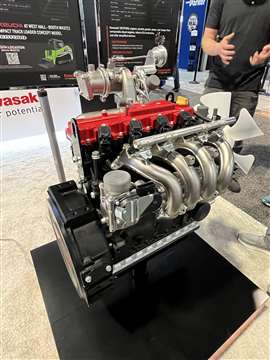 The GeoTorq flex fuel engine platform is compatible with biofuel blends from E0 up to E85. (Photo: Becky Schultz)
If you attend Equip Expo, the North American lawn and landscaping industry’s largest event, you won’t have to go far to find mowers powered by a Kawasaki engine. The company currently holds a dominant position in that sector with its gasoline fueled models from 600 up to 999 cc.
Such a search would prove harder at a major construction industry event like ConExpo-Con/Agg. While Kawasaki engines are used to power lighter duty equipment, as you go up in machine size class and duty cycle, diesel remains the dominant power source, making market gains more challenging for engines rooted in gasoline-based fuel.
In an effort to level the playing field, Kawasaki is taking a novel approach with its GeoTorq flex fuel concept engine platform. The initial model, based on a 2.4 L industrial-grade engine, was exhibited in its ConExpo stand as well as featured in a TL6 compact track loader in the Takeuchi booth to gain feedback and gauge potential market demand.
Simplified aftertreatment
Among the features that make the GeoTorq platform unique is its compatibility with biofuel blends anywhere from E0 up to E85 – a feat that Troy Smith, new product development engineering manager, Engines Division, Kawasaki Engines, said is achieved using an alcohol sensor to measure and adapt to the alcohol content in the fuel.
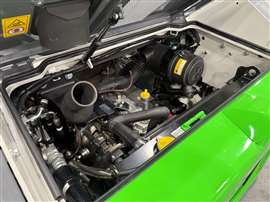 The 2.384 L inline four-cylinder, liquid-cooled, overhead valve engine concept shown in a Takeuchi compact track loader. (Photo: Chad Elmore)
The ability to burn gasoline-based fuels not only reduces carbon, it enables simpler aftertreatment compared to a diesel-fueled equivalent.
“With this engine being gasoline… we can utilize a [common] three-way catalyst in order to be compliant for emissions,” Smith explained. “We can eliminate DPF, potentially SCR, high pressure common rail, and be able to provide equivalent power and torque in a much simpler package.”
For even further simplification, the catalyst used in the GeoTorq is commonly available.
“It’s the same catalyst that goes in your trucks and cars, and it’s proven, it’s known and it’s very durable. [It also] eliminates, from a comparative diesel, that pain point of having to run at higher temperatures to be able to keep the catalyst hot,” Smith stated. “This engine is made so that it can do start-stop… You don’t have to rely on waiting for those regen cycles to be completed. It’s an engine that’s just going to run and run well, [even] in cold weather.”
The engine’s structural cast iron engine block follows most industry standards, he noted, including the use of SAE bell housings. Other features include a heavy rotating assembly and aluminum head for improved cooling and heat rejection.
“This block can be utilized in a chassis and be used as a structural member of that chassis, making it a universal fit and very adaptive for replacing some of the current engines that are in those size categories today,” Smith added. “We want to make it as close to a drop-in replacement as possible to make it easy for an OEM to put it into their system.”
Poised for more
The 2.384 L inline four-cylinder, liquid-cooled, overhead valve engine concept displayed at ConExpo is being developed in both naturally aspirated and turbocharged variants rated 72.4 hp (54 kW) and 95.1 hp (71 kW) at 2,800 rpm and 156.4 and 221.3 ft.-lb. (212 and 300 Nm) torque at 1,600 rpm, respectively. Electronic fuel injection technology is used to control the fuel, air and spark independently, said Smith, enabling the torque to be tuned “for the best power possible” for the specific application.
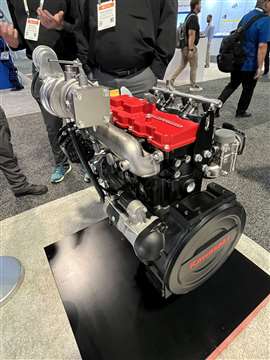 The flex fuel engine platform features simplified aftertreatment consisting of a common three-way catalyst for emissions compliance. (Photo: Becky Schultz)
“Using the base map of the torque profile, we’re able to adjust the torque to have 10% rise, 20% rise, 40% rise, to give our customers the options to have the power that they need and to be able to maintain that power and that torque.”
The engine platform is also positioned to allow entry into other potential engine size classes. “Future engines could be even larger size, potentially a 3.6 L, a 4.2 L,” said Smith. “And then being flex fuel capable with the electronic fuel injection, it allows us to not only [offer] gasoline variations but also sets a platform for the future where the... combustion system [can] be set up for hydrogen.”
The shift to hydrogen, as well as other fuels such as natural gas and propane, would require changes to the injectors and fuel delivery system, Smith said, but the GeoTorq platform has the structure for the spark plugs, injectors and other components that would be required to adapt to the fuel.
“How do we move towards carbon reduction today? This is a step towards that with running the E85 biofuels. That allows us to reduce the carbon below that of, say, a diesel, and it makes it very competitive with even electric,” said Smith.
A launch platform
The initial GeoTorq concept engine is currently undergoing select validation testing, including blind tests with a comparable engine, to gauge feedback on power, noise, vibration, etc. As of yet, no timeline has been set for bringing the platform into series production.
“If there are opportunities for us to be able to take it into a production level, we would be able to do that,” Smith stated, indicating production would come out of the company’s Maryville, Mo., USA, manufacturing plant.
Until then, GeoTorq is serving as a launch platform for the next level of engine capable of delivering cleaner emissions and reduced carbon.
“We have goals for carbon neutrality, and with E85 and biofuels, that will help get us there,” Smith said. “This also sets the [stage] for us to get to hydrogen, where we can use this system to leverage some of our technology on, say, the power sport side and the global Kawasaki network to be able to bring hydrogen when it’s available.”
Takeuchi explores flex-fuel concept
At ConExpo, Takeuchi featured Kawasaki’s GeoTorq flex-fuel engine concept in its TL6 compact track loader, prominently highlighting its capability to burn up to E85 fuel. The aim for both companies was to explore interest in construction, as well as to identify other markets, such as agriculture or power generation, where the engine might be a fit.
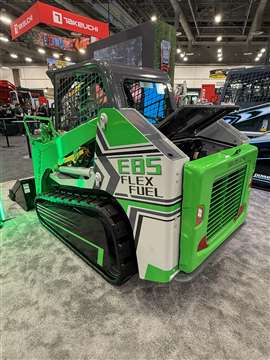 The Takeuchi TL6 compact track loader with Kawasaki’s GeoTorq flex fuel engine. (Photo: Chad Elmore)
Jeffrey Ratliff, director of Sales and Marketing North America, Takeuchi US, said the flex-fuel concept is “an interesting idea that has some potential.” At 72 hp, the power output on the engine is good, he stated, and the torque curve is similar to a comparable diesel engine. “In fact, if we’re running E85 in it, it’s higher than our current diesel.”
Even so, Ratliff said it’s hard to say if the performance benefits of biofuels are enough to sway construction contractors. Rather, he believes even those in commercial construction would recognize the advantages of the simplified aftertreatment of the flex-fuel concept.
“This is a good alternative instead of having to run diesel, where you have all the aftertreatment in this horsepower range. You would have to have a DPF, an EGR valve and a high-pressure common rail fuel system, which is super expensive and super sensitive,” Ratliff commented. “You have to service DPF filters, and if their operators don’t do the regens right, they plug the DPF up.
“When you take all that stuff away, that’s the part that becomes interesting. Lower maintenance cost, for sure, and with a life expectancy that they say should be similar to a diesel.”
If performance is the same or even close, said Ratliff, and “you can take all of that hassle away, I think even those guys start to think ‘I’m willing to listen to the alternatives.’”
POWER SOURCING GUIDE

The trusted reference and buyer’s guide for 83 years
The original “desktop search engine,” guiding nearly 10,000 users in more than 90 countries it is the primary reference for specifications and details on all the components that go into engine systems.
Visit Now

CONNECT WITH THE TEAM