Read this article in 中文 Français Deutsch Italiano Português Español
Rise Robotics takes fluid out of the motion equation

23 December 2025
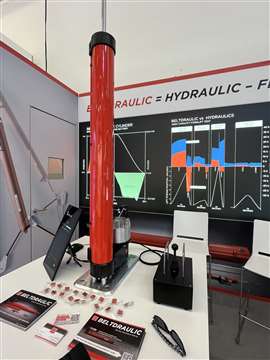 Rise Robotics introduced the Beltdraulic double-acting cylinder at Bauma 2025 in Munich. (Photo: Becky Schultz)
When Rise Robotics was founded in 2011, it began as a project to develop advanced exoskeletons to enhance human motion through powerful, lightweight and precise actuation components. Through its work on “exosuits,” the company discovered its new power transmission method had potential applications in heavy equipment. So, the company pivoted to what it saw as a more viable and scalable market for its technology.
Rise Robotics is now a budding industrial technology startup “endeavoring to disrupt the field of hydraulics.” Its core technology is the Beltdraulic, a fluid-free cylinder that the company said combines the power density and responsiveness of hydraulics with the efficiency and cleanliness of electromechanical systems – all with the aim to facilitate full machine electrification.
Belt-based solution
According to the company, Beltdraulic technology is capable of delivering hydraulic-level power and responsiveness in a compact, lightweight and fluid-free design.
The technology uses a unique setup of belts arranged like a block and tackle system inside a cylinder. The block and tackle system is positioned around a central power unit that turns rotary motion into linear belt motion.
“We’re tensioning steel cables and that material, which is the power transmission medium, is at a higher utilization than compressing a fluid,” explained Arron Acosta, co-founder and vice president of Business Development, Rise Robotics. “The root principle is like putting the working material in tension instead of compression.
“Big picture, a shaft is spinning, whether it’s an electric motor, a manual crank or even a hydraulic motor. That comes into our system, and then out of that comes a rod that pushes and pulls. So, it’s actually very similar to hydraulic – it’s just tensioning a belt instead.”
The single-acting cylinder configuration uses one block and tackle set and is suited for applications where maximum extension or retraction is key. The double-acting cylinder, introduced at Bauma 2025, uses two sets for added versatility, with force that acts in both directions (extension and retraction).
The system is currently available in 2-metric ton and 22-metric ton load classes.
“Most screw-type actuators stop in the 3,000- to 4,000-lb. class and we start at 4,500 lb.,” said
Hiten Sonpal, CEO, Rise Robotics. “And then we go all the way up to 50,000 lb., but the technology itself goes up to 100,000 lb. no problem.”
Advantages over hydraulics
Hydraulic cylinders provide efficient motion in a wide range of applications, Acosta acknowledged. But he noted, “The one thing they can’t do is they can’t get both precision and efficiency. They have to throttle the system in order to get the efficiency or the control they’re looking for. They have to do a trade-off there.”
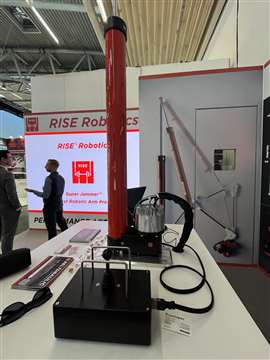 Beltdraulic technology uses belts housed inside the cylinder, with a central power unit turning rotary motion into linear belt motion. (Photo: Becky Schultz)
The Beltdraulic system, on the other hand, is designed to combine precise movement and positioning with smooth acceleration and deceleration. The lighter weight system also provides higher speed capabilities, as well as enhanced control over displacement, speed and various motion characteristics.
“We run three times as fast as the hydraulic system typically. That means that our customers can generate three times as much revenue over a given time period,” Sonpal asserted.
“We’re 75% efficient,” he continued. “Typically, any system that’s over 50% efficient is back drivable. So, if we were to be in a forklift, for example, we would, on average, decrease the battery needed by half, or double the runtime of the machine. And we do that because... [the Beltdraulic is] three times more efficient as hydraulics, but we also regenerate energy every time we lower, just like an electric car slowing down.”
“We can increase the runtime of the battery, which is valuable,” Acosta said. “You can also decrease the battery size to save on CAPEX. Then on OPEX, you’re going to be saving on energy costs. You’re going to be saving on maintenance costs. There’s no fluids to leak, there’s no hoses that burst, there’s no filters to change. Basically, every 100,000 cycles, you change the belt.”
With these combined benefits, the company said its Beltdraulic system can reduce power and fuel consumption by 65% to 90% compared to modern hydraulic systems, regardless of the energy source (e.g., diesel, CNG, hydrogen or electric).
Potential applications
Sonpal said Rise Robotics has seen a lot of interest in the Beltdraulic technology from various sectors, including construction, mining, agriculture, maritime, food processing and even military applications.
“A lot of those [industries] have some specific pain points around hydraulics that they don’t want,” Sonpal said, such as the need to avoid hydraulic oil spills. “Those are easy markets for us to enter.”
Take the transportation and logistics sector, where speed of delivery is of the essence. Rise Robotics has developed and is testing the Railgate, a heavy-duty liftgate produced in collaboration with Anthony Liftgates to aid in loading and unloading tractor-trailers. According to Acosta, its increased operating speed compared to hydraulically powered lifts can potentially enable delivery drivers to make an additional stop per day.
“That extra stop is extra revenue, which means it pays for itself in a month or so. So that’s something that we’re proving out with liftgate operators,” he said. “We expect to see the same thing with forklifts... If you have a higher productivity container handler, the same number of [machines] could do more picks. You can make more revenue.”
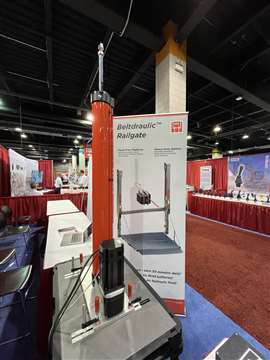 Beltdraulic actuators are used in the Railgate, a heavy-duty liftgate for the transport and logistics sector designed to speed delivery times. (Photo: Becky Schultz)
While the Beltdraulic platform is “highly configurable,” the initial target is largely the material handling market, such as industrial forklifts and construction lifts. “We’ve really been focused on lifting,” said Acosta. “We think our beachhead niche is places where people want to create more value with the technology.”
A careful approach
Though the technology is being applied in a number of use cases, Rise Robotics has been careful in its approach to bringing the Beltdraulic to market. Sonpal said the system is currently in the low-rate initial production (LRIP) phase in its current load classes.
“We’re doing an investigation of contract manufacturers to get to the next stage for full production,” he said. In the meantime, product development and testing remain ongoing.
Rise Robotics has taken a similarly cautious approach to its early partnerships. Rather than share its technology directly with OEMs, it has invested in making a developer kit available.
“When we sell the developer kit, it definitely comes with terms and conditions where it’s not your property that you can just go and figure out how to reverse engineer. It’s the beginning of a relationship where you’re a licensee,” Acosta explained.
Edging closer to commercial production, the company recently received its first commercial customer order for the Beltdraulic in an application in the oil and gas industry. Such early customers will have the opportunity to collaborate directly with the Rise Robotics engineering team, as well as secure priority allocation of production units.
Acosta predicted: “Once people know that it works, then they’re really going to want a lot of them.”
Operating on autopilot
Proving that the possibilities for its technology cross industries and applications, Rise Robotics recently announced a partnership with iNav4U, creator of the Zora intelligent operating system for yachts. The partnership will combine Zora’s adaptive control software with Rise’s actuator technology to enhance autopilot performance.
Yacht autopilot systems have traditionally relied on hydraulic drives that require regular maintenance and draw significant power. They often struggle with calibration drift, network integration issues and inconsistent performance in demanding sea conditions, the announcement noted.
The collaboration between iNav4U and Rise Robotics is meant to directly tackle these challenges by replacing hydraulic cylinders with the Beltdraulic actuator, providing a clean, fluid-free mechanism that operates quietly, efficiently and with minimal maintenance. The result, said the companies, is an autopilot solution that is easier to maintain, faster to respond and more reliable over long passages.
“Partnering with iNav4U allows us to show what Beltdraulic technology can do when combined with advanced vessel controls,” said Rise Robotics’ Hiten Sonpal. “Together, we’re delivering precise, efficient steering without the complexity or environmental risk of hydraulics.”
POWER SOURCING GUIDE

The trusted reference and buyer’s guide for 83 years
The original “desktop search engine,” guiding nearly 10,000 users in more than 90 countries it is the primary reference for specifications and details on all the components that go into engine systems.
Visit Now

CONNECT WITH THE TEAM