Read this article in 中文 Français Deutsch Italiano Português Español
Street Smarts: Tesla makes business case for battery-electric
19 August 2026
It’s hard to muster a lot of sympathy for either the California Air Resources Board (CARB) or the U.S. Environmental Protection Agency (EPA).
The two agencies’ ultimate goal for their diesel emissions regulations campaign heading into 2027 and beyond was to transition the trucking industry completely off petroleum-based fuels by 2036. You’d think such a massive undertaking would mandate cooperation and buy-in from the trucking industry.
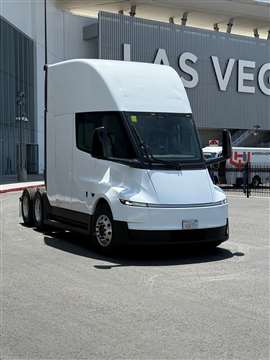 Tesla has begun production of its battery-electric Semi at its new manufacturing facility in Nevada. (Photo: Chad Elmore)
Instead, CARB and EPA routinely ignored outreach from the industry. To many, it seemed like the agencies were dictating unrealistic policies from an ivory tower while turning a deaf ear to legitimate technology, cost and operating concerns.
Equally maddening, the agencies appeared to be picking and choosing clean propulsion technologies based on a culture of “internal combustion engine bias” instead of allowing the free market and fleets decide for themselves which solutions would work best for their applications.
That culture of arrogance has now left CARB and EPA’s aggressive clean trucking agenda in tatters. The second Trump administration has systematically gutted CARB and EPA diesel exhaust emissions – moves that have been largely applauded by the trucking industry.
And yet...
As recent events in the Middle East have demonstrated, maybe running fuels and powertrains that aren’t heavily dependent on diesel fuel or gasoline wasn’t such a bad idea, after all.
EPA’s upcoming heavy-duty emissions standards and recent geopolitical events have underscored a broader reality: placing all of your energy needs in a single basket carries significant risks for fleets today.
Beyond a concept
Even before events in the Middle East rattled global oil markets, Tesla was making a similar business case to heavy trucking fleets at ACT Expo 2026 in Las Vegas.
During an executive dialogue with ACT Expo founder Eric Neandross, Tesla Director of Semi Truck Engineering Dan Priestley made perhaps the company’s strongest argument yet that the Tesla Semi has moved beyond the concept stage. His central message was simple: total cost of ownership (TCO) – not government incentives – is becoming the primary reason fleets should consider battery-electric trucks.
“TCO’s here,” Priestley told attendees. “Every day your business is not running electric is a day you’re leaving money on the table.”
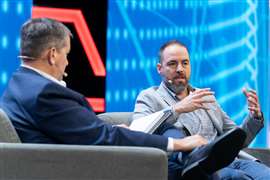 Dan Priestley, director of Semi Truck Engineering, Tesla, speaking at ACT Expo. (Photo: ACT Expo)
Priestley pointed to several developments supporting Tesla’s position. The company has begun production at its new Nevada manufacturing facility and remains committed to ramping toward annual production of 50,000 trucks.
The company also introduced a new Standard Range Semi capable of approximately 325 miles between charges. The lighter, less expensive model is aimed squarely at local, drayage and regional haul operations where daily mileage often fits comfortably within that operating envelope.
Tesla continues expanding its charging ecosystem, as well. New 1.2-MW mega chargers promise faster turnaround times, while a lower-cost depot charger gives smaller fleets a more affordable entry point into overnight charging.
Public charging infrastructure is also beginning to emerge through partnerships with truck stop operators, addressing one of the industry’s largest concerns about battery-electric trucks.
Just as important, Priestley highlighted operational improvements beyond the truck itself. Tesla reports fleet uptime approaching 97% and says more than 90% of service events are resolved within 24 hours. For fleet managers, uptime contributes to TCO every bit as much as fuel savings.
Change in the conversation
None of this guarantees that every fleet should rush out and order battery-electric trucks.
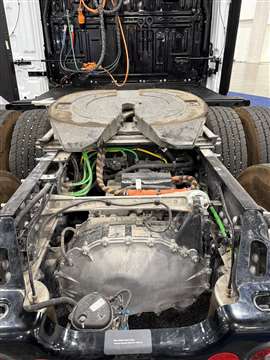 Tesla’s Dan Priestley said the question has changed from does the technology work to where battery-electric trucks can make economic sense. (Photo: Chad Elmore)
As Priestley himself acknowledged, TCO depends on numerous variables. Electricity prices vary dramatically by region. Duty cycles differ from fleet to fleet. Payload requirements, charging availability, financing costs, maintenance practices and annual utilization all influence the economics.
A truck making predictable regional deliveries and returning to the same terminal every night presents a very different business case than one hauling irregular long-distance freight across multiple states.
That’s why perhaps the most significant takeaway from Priestley’s presentation wasn’t the company’s specific TCO calculations. It was the recognition that the industry’s conversation has matured.
Five or six years ago, discussions surrounding heavy-duty battery-electric trucks centered largely on whether they could perform real commercial work. Questions about range, durability, charging time and payload dominated nearly every conversation.
Today, those questions haven’t disappeared, but they’ve become more nuanced. Increasingly, fleets are asking where battery-electric trucks make economic sense, not whether the technology works at all.
Tesla deserves credit for helping move that discussion forward, even if its timelines have often proven overly optimistic.
At the same time, every major truck manufacturer now offers or is developing battery-electric Class 8 platforms. Charging providers are investing heavily in commercial infrastructure. Utilities are becoming active partners. Fleet experience continues to accumulate. The market itself is becoming more sophisticated.
No longer experimental
 Jack Roberts is a Tuscaloosa, Ala.-based independent journalist and licensed commercial driver with more than 20 years’ experience covering the North American and global trucking industries.
But as recent events have demonstrated, energy diversity for fleets isn’t simply about emissions anymore. It’s about resilience, operating flexibility and managing business risk in an increasingly unpredictable world.
Tesla may ultimately prove to be too optimistic about exactly how quickly fleets embrace its semi. Yet Priestley’s larger point is difficult to dismiss. For many operations, battery-electric trucks are no longer an experiment. They’re becoming a legitimate business proposition that deserves careful evaluation.
Whether fleets decide the numbers work for them is another question entirely. But given the growing unrest in the world today, ignoring the question altogether may no longer be the smartest business decision a fleet manager can make.
POWER SOURCING GUIDE

The trusted reference and buyer’s guide for 83 years
The original “desktop search engine,” guiding nearly 10,000 users in more than 90 countries it is the primary reference for specifications and details on all the components that go into engine systems.
Visit Now
STAY CONNECTED



Receive the information you need when you need it through our world-leading magazines, newsletters and daily briefings.

CONNECT WITH THE TEAM