Read this article in 中文 Français Deutsch Italiano Português Español
Cummins’ X15N engine builds on HELM strategy

12 October 2026
The new natural gas engine offers impressive power density and reduced emissions, which is driving interest around the world
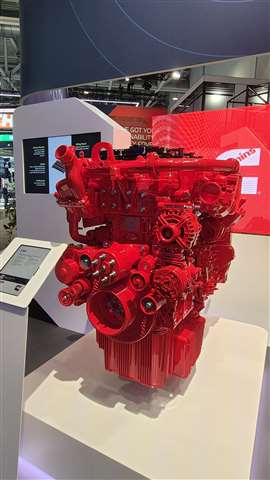 X15N engine at IAA Transportation 2026 (Photo: Power Progress)
Cummins presented its latest X15 six-cylinder turbodiesel engine at the 2024 edition of the American Trucking Association’s Technology and Maintenance Council’s Annual Meeting and Transportation Technology Exhibition (more conveniently referred to as TMC) in Nashville, Tennessee.
Intended for heavy-duty on-highway applications, this latest model offers a series of improvements over its predecessors, with the new 14.5-liter engine producing up to 605 hp (445 kW) and 2,050 ft lb of torque, all while delivering a 4% improvement on fuel economy.
To help reduce emissions, the engine can use biodiesel in blends up to 20%, while also supporting renewable diesel/HVO up to 100%.
At the launch, Jose Samperio, vice president of the North American On-Highway Engine Business, said: “With more than 25 years of experience, we designed our 2027 X15 with better fuel efficiency while maintaining the horsepower and torque ratings our customers have come to rely on. The X15 gives them the stability they need today and well into the future.”
HELM engines
The new X15 is one of the new HELM series of engines developed by Cummins. Further including the X10 and B7.2 model ranges, these engines have been designed from the ground up to share respective engine blocks from the diesel variant with a head designed to support a fuel-specific injection/combustion system.
At IAA Transportation 2026 in Hanover, Germany, Cummins held the European premiere of the new X15N; this first addition to the X15 range is designed to use CNG/LNG or biogas. To get more details on the new entry, Power Progress spoke with Maged Tadros, executive director for Global On-Highway Engines and also Bill Lamb, director of Platform Strategy.
“The new X15N was developed in China, where natural gas has proved to be a popular alternative to diesel,” said Lamb. “Our spark ignited-engine team is based in China, so with support from teams in other regions, we agreed it was the best development location.
“The first natural gas engine in this series was a 14.5 liter model with a single overhead camshaft. The new X15N has a 16-liter block with a double overhead cams, but despite the displacement increase it’s still only fractionally larger than a typical 13-liter model. Output has been increased to [a maximum of] 650 hp (478 kW) and 3,000 Nm of torque, so it’s very power dense for a natural gas engine.”
These changes, says Lamb, are all intended to address the downsides of using natural gas in an internal combustion engine, such as reduced transient power response when compared to diesel. Take a moment, if you will, to compare with the opening numbers and you’ll see that the X15N actually has greater maximum power and torque output than its diesel counterpart.
Technical differences
Lamb says that the X15 diesel uses a series of typical features, including ‘swirl’ combustion chambers and flat cylinder heads. On the other hand, the X15N uses a double overhead camshaft setup and a ‘pent roof’ combustion chamber, all of which Lamb says is more similar to a gasoline engine.
 William Lamb, Cummins
“The pent-roof combustion chamber has valves positioned at an angle and that design promotes a tumble-type of motion in the fuel/air mix. This is ideal for any spark-ignited engine, whether it’s using natural gas, gasoline or hydrogen,” explained Lamb.
The dual camshafts support the pent-roof design, while also allowing specific open/close timings for inlet and exhaust valves. But in addition, Lamb says it has helped with the design and packaging of the engine.
“You can use a larger valve diameter when using the dual cam setup supported by the pent-roof design,” he said. “When using a gaseous fuel, it helps to have more air/fuel mix coming into the combustion chamber when necessary.”
X15N draws global interest
For clarification, Tadros pointed out that while the Cummins team in China had the lead in development of the X15N, the engine benefitted from work delivered by teams in all global regions, based on their respective areas of expertise.
Asked what was behind the decision to base development in China, Tadros had this to say: “It’s a case of the market driving product planning. With the power density and efficiency levels, [the X15N] will be very competitive in the China market.”
It was reported by the ICIS that in 2025, 198,700 heavy-duty natural gas trucks were sold in China. This was around a 12% year-on-year increase over 2024 numbers but national market share for natural gas models actually fell slightly to 24.8% due to growing sales of HD battery-electric trucks (2025: 231,000 units, 29% share).
“What we try to do is make any change [in fuel type] easier to make, with similar touch points, similar connections, between the engine models. Switching from diesel to natural gas should not be difficult.” Maged Tadros, Cummins
Tadros said that while China will still likely take the sales lead, there is notable interest in the X15N across both North and South America. “Colombia, Chile, Peru, Ecuador and also Brazil, we have seen a lot of interest from these countries. So while our products are customer-driven, with development tracks based on specific needs, this engine fits a regional dynamic.”
“There’s also interest in Europe due to the focus on reducing CO2,” added Lamb. “Currently the regulations don’t include biogas, they only look at emissions and not where the fuel comes from. Biogas is already used by truck operators across Europe but there’s no credit to OEMs for using it. So there’s a real opportunity to match the regulations to the market.”
 Maged Tadros, Cummins
Production and strategy
Owing to the similarity between the blocks, the engines could be produced on any line which supports that configuration.
“The new X15N uses essentially the same block as the diesel model,” says Lamb. “The cylinders were bored out to achieve the necessary displacement, but the exterior dimensions remain largely the same.” Bore and stroke of the X15N is 136 x 184 mm, compared to 135 x 169 mm of the X15 diesel.
Asked about production numbers, Tadros says that Cummins has already sold more than 200,000 natural gas engines around the world. Based on tightening CO2 emissions targets, he believes that the X15N will add significant volumes to that figure.
“Our product strategy is to offer choices to our customers,” says Tadros. “Dependent on the region where our customers are operating, they need those choices. What we try to do is make any change [in fuel type] easier to make, with similar touch points, similar connections, between the engine models. Switching from diesel to natural gas should not be difficult.”
POWER SOURCING GUIDE

The trusted reference and buyer’s guide for 83 years
The original “desktop search engine,” guiding nearly 10,000 users in more than 90 countries it is the primary reference for specifications and details on all the components that go into engine systems.
Visit Now
STAY CONNECTED



Receive the information you need when you need it through our world-leading magazines, newsletters and daily briefings.



CONNECT WITH THE TEAM