Read this article in 中文 Français Deutsch Italiano Português Español
WinGD offers built-in marine engine emissions compliance

30 September 2026
Marine engine specialist WinGD offers retrofit-ready engines as a way to futureproof vessels against changing emissions targets
 Retrofitting to use a new fuel type can be completed in as little as 12 days (Photo: WinGD)
WinGD is a Swiss company which manufactures low-speed, two-stroke engines used in large commercial vessels (fuel tankers, container ships, etc.). In addition to diesel models, which can also use HVO and biodiesel, the company offers a portfolio of engines using alternative fuels, including LNG, methanol, ethanol and ammonia (dual-fuel models generally combine diesel as a pilot fuel with another alternative fuel.)
The driving motivation behind these different fuel solutions is to offer ship owners a choice of routes to achieving compliance with the International Marine Organization’s (IMO) Greenhouse Gas Reduction Strategy. This has a goal of reaching net-zero emissions across global shipping on or around 2050.
Seems pretty straightforward – and it was, at least for a few years. According to WinGD, in 2024, about 45% of all new gross tonnage around the world was set to use an engine using an alternative fuel. But when adoption of the IMO’s Net Zero Framework was delayed in October 2025, the percentage of planned vessels using an alternative-fuel power solution quickly dropped off. This, despite the prospect of a global carbon pricing scheme for ships not meeting emissions standards.
Renewable Fuel Economics
A recent whitepaper published by WinGD, ‘Renewable Fuel Economics’, highlighted that following the Net Zero Framework announcement, 60% of current ship orders are expected to use ‘conventional’ (read: diesel) fuels.
There are various reasons to support staying with diesel. In one possible scenario, a global framework for net-zero will never be introduced. Following on from that, a drop off in ship orders using alternative-fuel engines would stifle growth of related fuel production, making it more difficult and more expensive to source that fuel.
Further, existing low-carbon drop-in alternatives for diesel engines, such as HVO and biodiesel, could already support emissions standards compliance. Produced using biomass which has absorbed CO2 while growing, HVO is effectively carbon neutral at point of use.
Retrofit ready
 René Baart, WinGD
Another option is to fit the vessel with a ‘retrofit ready’ engine, such as the X and X-DF (dual fuel) models produced by WinGD. While questions about emissions targets remain, these engines allow a ship owner or operator to be flexible in terms of future emissions targets and choice of fuel type (based on availability and cost).
“The retrofit process would cover a full change of the fuel injection system, together with a suitable fuel supply system,” explained René Baart, head of BU Retrofit Solutions at WinGD, who spoke with Power Progress at the SMM 2026 trade fair in Hamburg, Germany.
“We would also need to change some engine components so those are fit for working with the new fuel, ammonia, methanol, ethanol or LPG. For example, you cannot inject ammonia in the same way as diesel fuel.”
I think that now we need governments to incentivize [alternative fuel] adoption. Carmelo Cartalemi, WinGD
Looking at ammonia (NH3), it has both negatives and positives as a maritime fuel. It has comparatively poor combustion characteristics. Used in compression ignition engines, it usually needs a pilot fuel to initiate combustion. This is usually a low (~5%) quantity of diesel. Fuel toxicity also means ammonia needs double-wall piping and related leak detection systems.
On the plus side, ammonia contains no carbon, so produces no CO2. But emissions can include NH3 slip, NOx and nitrous oxide (N2O), particularly at low engine speeds. Counterintuitively, WinGD has reported NH3 slip at less than 10 ppm and N2O at below 3 ppm when testing with the X-DF-A engine.
Calculating ROI
While designs for these future-proofed engine models have been around for a while, Baart says that the first examples only entered the market in 2022. “We’re now carrying out first retrofits on those engines. The 6X52-S short-stroke engines, they’re being updated from diesel to methanol.”
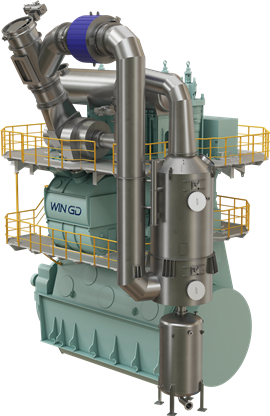 WinGD’s iCER EGR system can reduce emissions in X-DF dual-fuel engines (Photo: WinGD)
In addition to emissions reductions through fuel type, additional cuts can be achieved using the variable cylinder technology (see box). This adjusts compression based on engine load to optimize fuel efficiency and EGR function.
Feasibility of the retrofit is largely based on return on investment. This balances cost of the refit with reduced operating costs which covers both reduced fuel consumption and other costs, such as reduced operating taxes. Baart adds that a retrofit on a vessel setup to support the changeover can be done in as little as 12 days.
Operators need stability
While legislation will ultimately force a switch, it’s cost savings that are going to drive early adoption of environmentally-friendly fuels. As most of these are less energy-dense than diesel, it would appear critically important to increase engine efficiency to get closer to the per-kilo energy benchmark of diesel.
“We have improved the efficiency of our engines when using alternative fuels by about 3%,” says Carmelo Cartalemi, head of Strategic Marketing at WinGD. “We’re approaching 55% overall efficiency, which is about the maximum for internal combustion. I think that now we need governments to incentivize adoption.”
Continuing, he says that choice of fuel type is largely dictated by vessel segment. “The operators understand the charter requirement, the mission profile. Then it’s a question of which fuel type will deliver the best level of decarbonization.
“On the other hand, regulations are changing, fuel prices are changing. What’s needed is some stability. Ship owners want to decarbonize, but they don’t want to pay a premium.”
Baart estimates that there are currently around 4,500 ships now in operation around the world using a WinGD engine. Of that number, he estimates that about 2,300 of those are retrofit-ready, but to varying degrees. For example, some vessels using legacy engines will be refitted for safety rather than efficiency, but even that will ultimately reduce the vessel’s carbon footprint.
“The world cannot be saved with only new engines,” he concluded. “We need new engines and retrofits to improve emissions performance across global shipping.”
POWER SOURCING GUIDE

The trusted reference and buyer’s guide for 83 years
The original “desktop search engine,” guiding nearly 10,000 users in more than 90 countries it is the primary reference for specifications and details on all the components that go into engine systems.
Visit Now
STAY CONNECTED



Receive the information you need when you need it through our world-leading magazines, newsletters and daily briefings.


CONNECT WITH THE TEAM