

Autonomous robot for subsea inspection under development

05 September 2023
University of Houston researchers hope technology will reduce cost, risk of inspections
Researchers at the University of Houston are developing an autonomous robot to identify potential pipeline leaks and structural failures during subsea inspections.
The SmartTouch technology now in development at UH consists of Remote Operated Vehicles (ROVs) equipped with multiple stress wave-based smart touch sensors, video cameras and scanning sonars that can swim along a subsea pipeline to inspect flange bolts – bolted connections have accelerated the rate of pipeline accidents that result in leakage, according to the Bureau of Safety and Environmental Enforcement (BSEE).
The BSEE is funding the project with a $960,493 grant to UH researchers Zheng Chen, Bill D. Cook Assistant Professor of Mechanical Engineering and Gangbing Song, John and Rebecca Moores Professor of Mechanical Engineering, who are working in collaboration with Oceaneering International and Chevron.
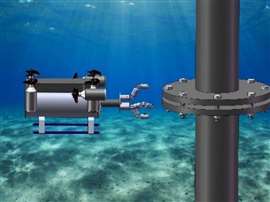 Rendering of the SmartTouch technology now in development.
“By automating the inspection process with this state-of-the art robotic technology, we can dramatically reduce the cost and risk of these important subsea inspections which will lead to safer operations of offshore oil and gas pipelines as less intervention from human divers will be needed,” said Chen, noting that a prototype of the ROV has been tested in his lab and in Galveston Bay. The experiments demonstrated the feasibility of the proposed approach for inspecting the looseness of subsea bolted connections.
Oil and gas pipelines fail for a variety of reasons including equipment malfunctions, corrosion, weather and other natural causes, or vessel-related accidents which account for most large leaks. Toxic and corrosive fluids leaked from a damaged pipe can lead to devastating environmental pollution.
“Corrosion is responsible for most small leaks, but the impacts can still be devastating to the environment. Therefore, our technology will be highly accurate in monitoring corrosion and will also help mitigate the chances of pipeline failure from other factors,” said co-principal investigator Gangbing Song, who has conducted significant research in piezoelectric-based structural health monitoring. His prior research efforts include numerous damage detection applications, such as crack detection, hydration monitoring, debonding and other structural anomalies.
POWER SOURCING GUIDE

The trusted reference and buyer’s guide for 83 years
The original “desktop search engine,” guiding nearly 10,000 users in more than 90 countries it is the primary reference for specifications and details on all the components that go into engine systems.
Visit Now
STAY CONNECTED




Receive the information you need when you need it through our world-leading magazines, newsletters and daily briefings.


CONNECT WITH THE TEAM