Read this article in 中文 Français Deutsch Italiano Português Español
Briggs & Stratton delivers low-noise power solutions
15 May 2026
Mark Kerr explores how battery-electric machine drives are unlocking enclosed operating environments
While the power industry continues to debate the pros and cons of battery-electric systems, the more practical advantages are often ignored. In many applications, it is not cost or emissions that limit where equipment can be used, but how much noise is generated – the same byproduct which can limit the use of conventional IC-powered machines.
As construction and infrastructure work increasingly takes place in dense urban areas, noise has become an operational constraint. In many projects, acoustic limits dictate equipment selection, working hours and even the feasibility of some operations.
Battery-electric powertrains offer a fundamentally different approach which is beginning to change how and where equipment can be deployed.
Noise as the limiting factor
Noise regulations are tightening across cities, particularly in residential or mixed-use areas. For example, urban frameworks such as the EU Environmental Noise Directive and local authority restrictions in some major cities increasingly limit acceptable sound levels and hence the working hours for construction projects.
 Mark Kerr, Briggs & Stratton
This means that even when IC equipment meets emissions standards, engine noise can still exceed acceptable thresholds.
These restrictions can have a direct impact on productivity. Contractors may be forced to limit work to narrow daytime windows or deploy smaller, less capable machines simply to comply with related requirements.
Battery-electric systems offer a different path. By dramatically reducing the acoustic footprint, electrified machines can operate closer to people and in environments where traditional IC machines would be disruptive.
The result is not just quieter equipment, but greater operational flexibility. These machines can work inside buildings, near sensitive infrastructure and over a wider range of working hours without causing a disturbance. In practice, this means deployment at otherwise restricted times, such as early mornings, later evenings - or in continuously occupied buildings. Longer working windows allow tasks to be completed in less time, increasing the productive use of both equipment and labour, while potentially improving project margins.
For machine OEMs, these regulations are driving a shift in how machines are designed and deployed.
Precision work in noise-sensitive environments
The advantages of battery-electric machines are apparent across interior construction projects and particularly glazing installations, where lifting equipment frequently operates indoors or in close proximity to workers.
Czech manufacturer Kovo-Vůjtek, which specialises in production of mini cranes for facade glazing and building interiors, had to address these challenges when developing its latest generation of pick-and-carry cranes.
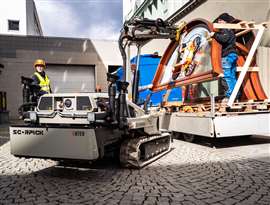 Scorpick Enter installing windows in the commercial area of Ostrava, Czech Republic (Photo: Kovo-Vůjtek)
Traditional diesel engines presented several limitations for the intended applications. Indoor operation required careful management of exhaust emissions, while engine noise made communication between crane operators and installation crews more difficult during delicate lifting tasks.
To circumvent these constraints, the company collaborated with engineering partner Technotrade to develop the Scorpick Enter, a fully-electric crawler crane powered by a 48 V lithium-ion battery system from Briggs & Stratton’s Vanguard portfolio.
Switching to a battery-electric drivetrain significantly reduced the machine’s operating noise from around 100 dB (diesel) to approximately 70 dB for the electric variant. This 30 dB reduction equates to about an eightfold decrease in perceived noise. For tasks such as installing large glass sections, where operators must closely coordinate with workers to guide the fragile or expensive loads into place, the nose reduction simply makes the job safer and easier.
Just as importantly, eliminating engine emissions allows the crane to operate in any space, with the freedom to move between indoor and outdoor sites without any operational compromises.
Low vibration helps product and people
Beyond access to restricted sites, the reduced vibration developed by a battery-electric machine has a direct impact on the working environment. Any vibration reduction when dealing with glass products can minimise the potential for damage, while lower vibration allows the machine operator to work more accurately and for longer periods.
In applications such as glazing installation, where accuracy, coordination and control are critical, the combination of low noise and improved working conditions becomes a meaningful operational advantage.
Expanding Machine Capability
Examples like this reflect a broader shift in how electrification is viewed across the off-highway machine industry. For OEMs designing equipment for specialised applications, these capabilities can expand where and how machines are used. For machine buyers, battery-electric machines can potentially open up access to otherwise unavailable revenue streams.
In that sense, the most compelling advantage of electrification may not be emissions or purchase cost. It is the ability to deploy equipment in places and situations where conventional machines simply cannot operate.
As urban development intensifies and construction increasingly moves into noise-sensitive environments, quiet operation is no longer simply a comfort feature. In many applications it is becoming a prerequisite for access to the worksite itself.
Mark Kerr is OEM Sales manager, UK & IE, at Briggs & Stratton.
POWER SOURCING GUIDE
The trusted reference and buyer’s guide for 83 years
The original “desktop search engine,” guiding nearly 10,000 users in more than 90 countries it is the primary reference for specifications and details on all the components that go into engine systems.
Visit Now
STAY CONNECTED



Receive the information you need when you need it through our world-leading magazines, newsletters and daily briefings.

CONNECT WITH THE TEAM