Read this article in 中文 Français Deutsch Italiano Português Español
High Speed ISObus and future of ag communication
15 October 2026
The Agricultural Industry Electronics Foundation is working on the next generation of ISObus
Long before off-highway machines could see, think and operate together, ag equipment was already exchanging operating information. Those communications, however, were often limited, and tied to a specific manufacturer.
The ag industry went on to develop ISObus through an international standards effort, giving tractors, implements and components a common language so they could share information and operate compatibly through machine-to-machine (M2M) communication.
This communications standard cultivated decades ago under the ag industry’s vision for greater machine interoperability is evolving into a new high-speed digital backbone, ushering in a future of connected machinery across multiple industries.
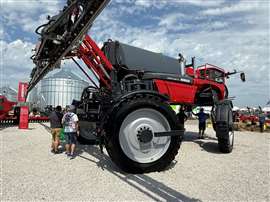 AEF member company Horsch Maschinen GmbH displayed its Leeb 8.460 VL sprayer at the 2026 Farm Progress Show in Boone, Iowa. Horsch LLC, the company’s U.S. office, is located in North Dakota. (Photo: Chad Elmore)
Crossing industry lines
In the world of agriculture, a network called ISObus has been the standard for 25 years, from the first public reveal at the Agritechnica trade show in Hanover, Germany, in 2001.
The ISO 11783 standard “nervous system” of ag equipment has seamlessly connected tractors to implements and aftermarket options such as displays and joysticks.
“With ISObus, machines work together as a system better than each component can work on its own, with the current ISObus delivering enough performance for today’s applications,” said David Smart, Agricultural Industry Electronics Foundation (AEF) High Speed ISObus project lead and John Deere Fellow.
The AEF, founded in 2008, is a global non-profit focused on improving cross-manufacturer compatibility and interoperability. In 2014, it began developing the next generation of ISObus. By 2021, it had organized a cross-industry collaboration of the world’s leading heavy equipment manufacturers to build ISO 23870, the new High Speed ISObus (HSI) standard.
Cross-industry meetings have allowed engineers to collaborate on the initial drafts of the new standard where agriculture, earthmoving, mining, forestry and on-road truck and trailer all meet to solve a similar need for the future. That future will come together as a new set of ISO standards, in the Joint Working Group (JWG) 16, under co-leadership of ISO TC 127 / SC 3 and ISO TC 23 SC19.
Opening the floodgates
The current ISObus is robust, delivering enough performance for today’s applications, but ISObus has both physical and data limits.
“The current ISObus is trying to push data through a tiny little soda straw,” said Smart. “High Speed ISObus is a firehose.”
Conservatively speaking, HSI is roughly 4,000 times faster than the original technology. It will open new opportunities for innovation, serving the industry far into the future as even more performance and automation is demanded.
But HSI is not just a faster replacement for ISObus; it is a standardized digital backbone that will let machines, attachments, sensors, cameras and future autonomous systems exchange greater amounts of information across manufacturers and potentially even across industries.
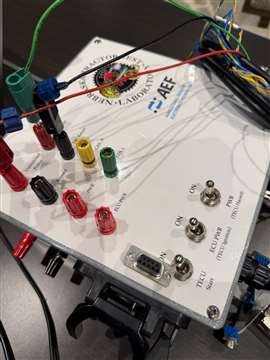 The AEF hosts Plugfests around the world where agricultural equipment OEMs and suppliers meet to ensure new technology and software is compatible. (Photo: Chad Elmore)
Faster data, finer control
With HSI’s greater capability, global software developers across multiple industries can significantly increase communication performance or speed.
“That translates to the precision of control, the amount of data that can be controlled and the amount of data that can be logged,” said Smart.
For example, HSI will give a large sprayer and a large planter greater command and control with precision down to the row and nozzle level, not possible with ISObus previously, while simultaneously logging information from the implement back into the tractor. Cameras can be added to the system to monitor the process in, around, under and behind the machine, and multiple cameras in multiple locations can stream to the monitor(s) of the cabin.
“On today’s ISObus, a very large, complex planter could take four, five, eight seconds to completely update every piece of information on the screen they’re looking at,” said Smart. “With high speed ISObus, we can do that in a fraction of a second.
“That’s just the starting point. Work from other AEF teams on Wireless Infield Communications (WIC) as well as the group’s Autonomy (AUT) team will be focused on further improving the performance and automation of the systems, as well.”
Common backbone, broader market
With HSI, the basic infrastructure is built for that next future layer of applications to be developed and put into place.
“This new standard is not only for agriculture. HSI is being developed as a common standard shared by construction, earthmoving, mining, forestry and on-road truck and trailer industries. It should serve everybody’s needs,” said Smart. “Certainly, that’s the intent.”
While the ag industry upgrades its existing standardized connection between tractor and implement, other sectors may be starting from much further back.
Construction attachments often rely on manufacturer-specific systems, while truck-trailer communication remains limited. HSI would introduce a common architecture built around network switches linking controllers, displays, cameras and other devices across each machine and attachment.
For those industries, HSI could represent not only a faster network, but the first broadly standardized digital connection across the entire machine-attachment interface.
For OEMs and suppliers, that common connection may reshape the price of innovation. Instead of developing a different interface for every machine brand or attachment, companies could potentially design cameras, sensors, controllers and software around a shared architecture, lessening integration costs, shortening development cycles and potentially giving startups and component suppliers access to larger markets.
Shaping the road ahead
HSI was demonstrated for the first time by the AEF at its North American Plugfest during the 2022 Commodity Classic trade show in New Orleans.
“The optimistic side of me says HSI will be officially introduced in 2028-2029,” said Smart. “We are doing our best to keep moving forward, and keep the initial release focused on two use cases: moving existing ISObus control and functions on to this hyper-fast network, and making digital cameras integrate across machines and attachments.”
With HSI’s initial priorities just around the corner, companies that participate now will have the clearest understanding of, and an opportunity to help shape, the future standard.
“This is a good time for companies to get their engineers involved in the HSI project,” said Smart.
“Whether their discipline is wire cable connectors, or the electronics of network switches, or the electronics of cameras, monitors and ECUs, by getting them involved in the project, they can learn about it and they’ll help bring their expertise to the table, as well.”
Smart suggested engineers and companies contact the AEF and join the AEF’s HSI project team.
Engineering the next step
“Will we have produced international standard documents for all the pieces of HSI by 2028? Probably not,” Smart said, “but we hope to have them mature enough that companies could deliver initial products. That comes back to the involved companies, their expertise, and understanding what we have and where we’re going.
“Even if the standard isn’t yet published as an international standard, those that are involved in the process in the development, they can understand it,” he added. “Is there a risk to working ahead producing product? I believe some things will be internationally standardized by 2028.”
Time will tell if HSI is ready in the next few years to launch the off-road industries entirely into warp speed. Meanwhile, the members of JWG-16 are committed to sharing their technical knowledge and expertise to put the world’s heavy equipment and automotives on the path to the next level: full automation.
About the author: Melinda Zimmerman-Boehler is president of Lighthouse Communications, a Wisconsin-based firm focused on construction, infrastructure and ag-tech industries.
POWER SOURCING GUIDE

The trusted reference and buyer’s guide for 83 years
The original “desktop search engine,” guiding nearly 10,000 users in more than 90 countries it is the primary reference for specifications and details on all the components that go into engine systems.
Visit Now
STAY CONNECTED



Receive the information you need when you need it through our world-leading magazines, newsletters and daily briefings.
CONNECT WITH THE TEAM