Read this article in 中文 Français Deutsch Italiano Português Español
Solving ‘dirty power’ challenges speeds the route to autonomy
26 January 2026
Autonomous vehicles (AVs) continue their journey from experimental prototypes to production-ready systems. During this transition, the computers driving them are starting to look more like rolling data centers than traditional automotive electronics. Packed with high-speed processors and advanced sensors, these sophisticated computers depend on clean, stable power to make split-second decisions safely.
But vehicle power isn’t clean. Inside every truck, dozer or military vehicle, voltage can fluctuate wildly. Alternators surge, electric drives generate feedback noise and ignition systems spark. That chaos is known as “dirty power,” and it can be catastrophic for a sophisticated computer.
Computers were designed to consume the stable electricity found in homes, offices or data centers. This contrasts with inherently noisy and unpredictable vehicle power systems. Without the right design, vehicle power systems can disrupt — or even destroy — high-performance electronics.
Server-grade computing in harsh environments
Automotive control modules are designed to tolerate harsh electrical environments. But on today’s bleeding-edge AV platforms, traditional automotive electronics have trouble keeping pace with the computing demands of complex AV decision making.
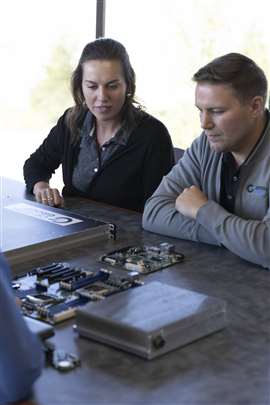 Crystal Group’s employee-owners work closely to engineer rugged solutions that perform in the harshest environments. (Photo: Crystal Group)
This leads many developers to turn to server-grade CPUs and GPUs to process the torrent of data from cameras, radar and LiDAR sensors in real time. These devices operate at clock speeds and complexity orders of magnitude beyond typical automotive electronics, which can make them very sensitive to the power fluctuations often present in harsh vehicle environments. Even slight inconsistencies in voltage can create significant issues. A millisecond disruption might not affect a radio or electronic control unit (ECU), but it can interrupt a high-speed central processing unit (CPU) or a graphical processing unit (GPU) performing trillions of operations per second.
That electrical input sensitivity has forced AV developers to rethink how they convert, clean up and deliver vehicle power.
Many early autonomous prototypes relied on external power conditioning units. Acting passively as a filter, or actively as a voltage pre-regulator, these devices smooth out voltage surges and spikes, which results in clean, regulated power for computers. While effective, they add size, increase cost, impact power delivery system efficiency and reduce overall reliability of the system by introducing more potential points of failure. Drawbacks like these can be dealbreakers in specific applications, such as evolving electrical vehicle applications where every watt counts.
One logical way to address the drawbacks of external power conditioning is to eliminate it and integrate the power conditioning capability directly into the computing hardware. Instead of filtering the power externally, the computer itself is designed to accept dirty input and manage it internally.
The payoff includes fewer components, higher efficiency and lower interconnect complexity. This integration also allows engineers to package more computing power into a smaller footprint. This is a critical consideration for space-constrained applications such as automobiles.
Built for the real world
To handle the unpredictable conditions of real-world operation, Crystal Group systems are designed to meet demanding standards such as MIL-STD-1275 for military vehicles and SAE J1455/ISO 16750 for commercial platforms. These standards help ensure performance whether the computer is on a city bus, a combine harvester or a military vehicle.
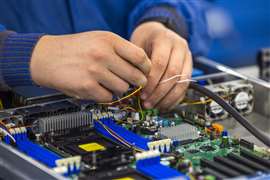 Crystal Group’s hands-on approach ensures rugged systems are carefully crafted and tested for performance to ensure they can be trusted in the field. (Photo: Crystal Group)
These industry standards define operating parameters such how much voltage can spike or dip, and how fast. The solution is then built to survive those operating parameters. Transient suppression, filtering and wide voltage tolerance add resilience to the system so that it doesn’t reset when something unexpected happens.
This approach is critical for vehicles operating in industrial or remote environments. Construction vehicles might be subjected to generator surges on site, while military transports face highly unpredictable electrical loads. Without engineered power resilience, any system failure could halt operations or compromise safety.
The noise problem
Power fluctuation isn’t the only issue. The high-frequency switching that modern power supplies use can create electromagnetic interference (EMI), which can scramble sensors or radios — or, conversely, be disrupted by them.
AM radio is particularly susceptible to power supply noise because it operates in the same frequency range as many power supply circuits, which can easily overwhelm a radio receiver if noise is not properly controlled. On the other hand, sensors may need to be mounted far from the computer for optimal situational awareness, but the long cables can act as antennas, funneling stray vehicle noise into sensitive circuits.
Crystal Group combats this with careful filtering and shielding. Computers are enclosed in rugged metal housings that act as Faraday cages to contain electrical emissions. Informed selection of connectors, proper treatment of cable shields and conditioning of low-level signals can combat inbound noise. Grounding and cable routing also deserve close attention. Vehicle chassis grounds dump noise everywhere. The solution requires close collaboration with the OEMs to make sure everything plays nicely together.
These efforts are particularly important as vehicles become more electrically complex. Electric drivetrains, traction motors, inverters and even auxiliary systems like cabin heating and air conditioning can inject noise into the system. Managing that interference is as critical as managing the voltage itself.
Cooling the brains of autonomy
 Every Crystal Group system is assembled and inspected by skilled employee-owners who take pride in delivering optimal reliability. (Photo: Crystal Group)
With multiple CPUs and GPUs running nonstop, AV computers generate enormous amounts of heat, especially when mounted in enclosed spaces like trunks or under seats.
Traditional air cooling finds itself at odds with the rapidly growing need for higher performance hardware. Air isn’t a very efficient way to move heat, which is fueling a strong shift toward liquid cooling. This mirrors what is happening in high-performance data centers.
By circulating glycol-based coolant through the system, engineers can double the computing density while keeping noise and temperature under control, even in extreme environments. The move to liquid cooling also keeps vehicles quieter since air cooling requires high-performance fans, which are often very loud. That matters in passenger-focused AVs like urban robotaxis, where comfort counts. It’s not just managing power. It’s about managing the overall passenger experience.
Thinking outside the box
Every OEM faces different packaging challenges. Some have space to spare while every inch matters in other applications.
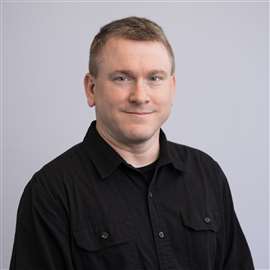 Micah Snodgrass
Customers have asked Crystal Group for many obscure requirements – non-rectangular shapes, unique interface types or locations or even the ability to survive total immersion in water for mounting outside the vehicle. That’s not something that can be found off the shelf.
Fully sealed units with air or liquid cooling plenums offer protection in wet environments. Materials like carbon fiber can save weight for aerial or weight-sensitive platforms, while billet aluminum designs may be more appropriate for ultra-rugged applications like mining, construction or defense vehicles.
Internally, forward-thinking cooling and a modular power architecture allow systems to scale up as computing demands grow. When a customer realizes they need another GPU, it can be accommodated without reengineering the whole platform. It’s designed to evolve. Flexibility in materials and technologies is critical when supporting a market as fast-moving and cutting-edge as AVs.
Powering the future of autonomy
 Michael Steffen
Dirty power will always be part of the equation in mobile environments – but it doesn’t have to be a limiting factor. In the world of autonomy, clean data starts with clean power. The right engineering can make that a reality on any road, field or battlefield.
Through ruggedized engineering, integrated power conditioning, EMI management, thermal design and modular scalability, companies like Crystal Group prove that even the most delicate data-center technology can thrive in the harshest conditions. Every customer has unique requirements – different vehicles, different missions, different power systems. There is no one-size-fits-all design.
About the Authors: Micah Snodgrass is a principal systems architect and Michael Steffen manages design engineering at Crystal Group, a manufacturer of custom-tailored rugged tech solutions based in Hiawatha, Iowa.
POWER SOURCING GUIDE

The trusted reference and buyer’s guide for 83 years
The original “desktop search engine,” guiding nearly 10,000 users in more than 90 countries it is the primary reference for specifications and details on all the components that go into engine systems.
Visit Now
STAY CONNECTED



Receive the information you need when you need it through our world-leading magazines, newsletters and daily briefings.

CONNECT WITH THE TEAM