Read this article in 中文 Français Deutsch Italiano Português Español
John Deere explores what’s possible with ethanol

09 July 2026
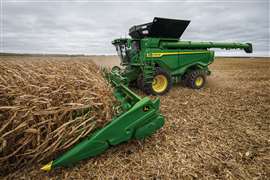
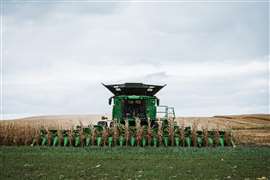 The U.S. is capable of producing more biofuels but automotive efficiency gains and the shift to electrification could impact market demand. (Photo: John Deere)
Ethanol has long been a staple in the automotive industry, used primarily in a low percentage blend with gasoline as an octane enhancer for spark-ignited engines. Over 16 billion gallons of ethanol are produced annually in the U.S., with the vast majority going toward passenger car use.
This has historically left little room for other applications, but the potential capacity is now there to generate ethanol in even larger quantities.
 Dr. Danan Dou, chief technologist (Power Systems), John Deere Power Systems (Photo: John Deere Power Systems)
“With growing crop yields, efficiency gains associated with feedstock processing, as well as fuel conversions, the U.S. is able and capable of producing more biofuels, more economically, in the future,” said Dr. Danan Dou, chief technologist (Power Systems), John Deere Power Systems, in a joint presentation at Emissions Analytics’ Off-Highway & Power Generation USA 2026.
While on the surface, this is welcome news for growers, as Dou noted when Power Progress caught up with him later at the event: “With efficiency gains in automotive, with electrification, the risk is whether the demand for gasoline or ethanol will decrease.”
That risk, along with fluctuating commodity prices, has prompted John Deere Power Systems to investigate alternative solutions for heavy-duty engines that could help support agricultural customers by providing new market opportunities for their crops.
Ethanol-fueled diesels
Converting diesel-powered equipment to spark ignition is perhaps the most clear-cut prospect.
“In the last several years, our renewable fuels conversation really elevated a different perspective on spark-ignited engines, because the majority of the renewable fuels are actually more conducive as a spark-ignited solution,” Dou commented. “Ethanol is a liquid fuel, it’s renewable and it is produced from crops like corn grown by our customers. That propelled us to say, ‘What can we do to convert some machines [to be] capable of running ethanol in support of our customers?’”
To that end, John Deere participated in a U.S. Department of Energy funded industry collaboration with Marquette University in Milwaukee, Wis., to study a flex fuel solution that would convert a diesel engine to spark ignition. The solution involves an actively fueled pre-chamber – equipped with its own fuel injector and spark plug – that can be mounted to the cylinder head of the engine to allow it to burn ethanol and high percentage gasoline-ethanol blends by mixing controlled combustion.
“That opened up a new direction around the fuel blending strategy. It’s another way to leverage this widely available biofuel important for the U.S. and important for our customers,” said Dou.
Currently, John Deere is gaining development experience for the spark-ignited solution.
“We still have some more work to do in terms of product validation, market acceptance, scale, investment,” Dou said. “We are developing prototypes that run ethanol to showcase the possibility. We’re also testing the market to see if customers will accept that. So, we need to further prove that [solution].”
Bio2Fuel project
Another angle John Deere is exploring is the direct use of ethanol in diesel engines. Dou has a long history working with Dr. Greg Shaver, Reilly Professor of mechanical engineering at Purdue University, on previous projects, so it was a natural fit to work together, along with other industry partners, to develop a flex-fuel project exploring how an unmodified diesel engine reacts to varying blends of ethanol and biodiesel with and without petroleum diesel.
The project – which included using ethanol to produce biodiesel as fatty ethyl ester (FAEE) – eventually became known as Bio2Fuel. It was the subject of Dou and Shaver’s joint presentation at the Off-Highway & Power Generation conference.
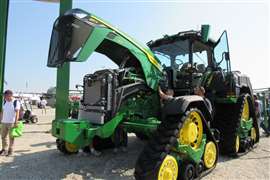 John Deere Power Systems is researching alternative solutions for heavy-duty diesel engines, including the potential for ethanol blends. (Photo: Becky Schultz)
“Biodiesel has a higher viscosity, higher [cetane] number, higher lubricity, so it’s complementary to the properties of ethanol,” Dou noted. “After adding some ethanol with biodiesel with or without petroleum diesel, you can get to a fuel that meets some of the properties and behaves like a diesel. In fact, some of the properties can meet the specification of the diesel standard today.”
As Shaver explained during the presentation, the project consisted of lab testing of a 13.6 L John Deere diesel engine utilizing diesel, premium diesel, biodiesel and ethanol in multiple combinations and percentage blends.
“The idea in a nutshell is to be able to leverage the tremendous amount of ethanol and to some extent biodiesel that we produce in the United States and North America today. The key question is can we operate them in a compression ignition engine that is not modified to the extent that it will… still work well with diesel fuel,” Shaver stated. “So, we take an unmodified diesel engine that meets all the government’s regulatory requirements and customer expectations operating on diesel, and then we try to understand what can we do to bring ethanol into this engine.”
Proof of concept
Preliminary work on the project demonstrated the ability to burn up to 50% ethanol in a modern diesel engine. “We accomplished this by injecting more fuel in the engine, block heating and bypassing the compressed air cooler at low loads,” Shaver stated. A 60% blend was also trialed, requiring the further step of motoring the engine for additional pre-heating during engine start.
Key takeaways thus far show similar or better engine out emissions for the blends with ethanol, except for CO and hydrocarbons for the 60% blend at low loads; and an increase in fuel consumption as the fuel’s energy density decreases.
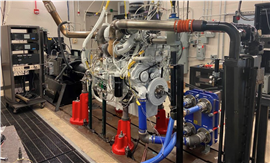 Shown is the 13.6 L John Deere diesel engine in a test cell at Purdue University. (Photo: John Deere Power Systems)
“Ethanol and biodiesel, as well as blends that include both of them, have a lower energy density than conventional diesel fuel, in large part because they’re oxygenated. You need to inject more fuel into the cylinder to get the same amount of torque or the same amount of power at the same engine speed,” Shaver pointed out.
“So, one key takeaway here is … you can run a high-torque operating condition, you can run high-power operating conditions like with diesel, and you would sacrifice that at least a little bit with an ethanol and biodiesel-based blend. That’s just Mother Nature.”
While there is only so much fuel you can pragmatically put into the combustion chamber, design changes to the combustion chamber could perhaps surmount this, said Shaver. “But one way or the other, you’re likely going to run into a limit around peak torque and peak power.”
Ultimately, the project accomplished what it set out to do – to show that a diesel engine can, in fact, burn ethanol in some form. But there’s more work to be done.
“I said, ‘It looks promising, but we should not end here,’” said Dou. “We did not prove everything – durability, additional emissions compliance, other aspects for the engine. We have to look at it more in totality. So, we want to form a consortium to follow this up. We don’t want to go alone.”
It takes a village
The consortium has been officially registered within the Purdue University system and John Deere has invited a number of different entities to join a three-year project investigating how to develop a fuel conducive for use in diesel engines.
“We tried to [build a] team leveraging expertise from OEMs, fuel providers and some great researchers that can look into all the combustion details coming together – keep this open book, explore,” Dou emphasized. “We will discover things that were not a clear success, but so far it’s warranted additional research at this point. We see opportunity here.”
The more organizations that join forces, he added, the bigger the chance of developing a successful and economical solution.
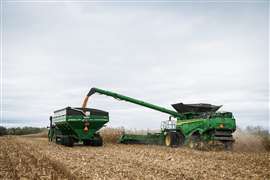 John Deere has formed a consortium to investigate how to develop and support an “engine-agnostic” fuel derived from crops grown by its customers. (Photo: John Deere)
The consortium will address engine combustion optimization, failure identification, durability profile and other aspects of biofuel use in existing engines.
“We are trying to make an engine-agnostic fuel,” Dou stated. “If you can leverage existing engines, you can make a bigger impact for demand... So, we’re looking for what’s the minimum product to use in an existing engine. We also say, “What is the potential maximum possibility?’ We have tried to answer both spectrums with this research.”
The intent is to generate sufficient data to convince the industry as well as fuel providers that an ethanol blend could represent a winning concept with room to grow – and to give them a potential roadmap for progressive growth.
“The heavy-duty industry is very conservative. They may say, ‘I see enough risk, I’m not comfortable, so I will watch.’ We say we’ll take some baby steps,” Dou said. “Most of the fuel strategies started with a lower concentration to prove [the concept]. We’re looking for a similar roadmap.”
Energy and infrastructure
Potential future work will also assess long-term fuel storage, stability and tank options, as well as fuel quality and safety concerns.
“We not only need to prove the engine will do well with the fuel, but somebody has to produce the fuel, someone has to distribute it, make it available, so that takes an equal amount of effort,” said Dou.
“We need to have a powertrain that works for the customer, but the energy has to be there for the customer, too, and that energy has to be cost effective. Availability, price, convenience, storage – all these things matter to make the customer more successful.
“The coalition is meant to refine the engine solution, optimize it, but also make sure the infrastructure piece, manufacturing piece and anything we have not learned [can] be discovered,” Dou added. “We want to do it early enough, so we can tell the story – this is the whole picture – and hopefully it will turn out to be a more attractive solution than others.”
More diversity ahead
Overall, John Deere foresees a more diverse future for powertrains, and it’s not alone.
“The other OEMs are following a similar strategy, in that sense – more diversified powertrain offerings to fit the specific applications the customer segments are looking for, and there may not be a single solution for everything,” Dou said.
Diesel engines will continue to be a part of the solutions available. “Diesel is still very core to us. We’re not going to abandon diesel. We still see diesel has constant performance characteristics. That’s why diesel is the king,” Dou stated.
Diesel is likely to maintain its dominance, he said, but the options will increase – perhaps including spark ignited systems or different ways to use alternative fuels within a compression ignition system. “All these are possibilities, and we have to test the market to see which one will be the best solution.”
John Deere supports “all flavors,” Dou said, but the solutions developed have to work in customers’ hands. “They have to be productive, profitable. In the end, the customer has to decide which is the right solution,” he said.
“Whatever is important to our customer, we’re behind it. Powertrains will have more options coming up, broader portfolios are likely and broader fuel options will be some form of reality,” he predicted. “There are different ways to do it, and we’ll let the best solution win.”
Versatile solution for ag customers
Ethanol is a versatile fuel, said John Deere’s Dr. Danan Dou. For example, there are early pilot trials taking place into how ethanol can be used to produce hydrogen.
 Ethanol produced from crops is upgradeable to produce a spectrum of fuel products. (Photo: John Deere)
“The process is well developed. The reason for that is it’s the same as steam methane reforming. The steps are the same, you’re just changing the feedstock,” he explained. “That’s relevant if you use the hydrogen to produce ammonia and use ammonia for fertilizer and feed it back to the agriculture [industry].”
Ethanol is also upgradeable to produce a spectrum of fuel products, including higher alcohols or hydrocarbon fuels. Likewise, vegetable oil can be upgraded into renewable propane, renewable diesel, renewable jet fuel and renewable naphtha, enabling it to support various industries.
As a liquid fuel, ethanol is easy to handle in terms of fuel tanks, transportation, etc. According to Dou, gaseous fuels such as hydrogen, natural gas, propane and biomethane can be more difficult to manage and have lower energy densities by comparison. That said, unlike diesel, which has a higher flash point, ethanol is flammable and needs to be treated as such.
“So, from those angles, we look at [ethanol] as a compromise relative to diesel, but it’s a much better step for our customers relative to hydrogen, relative to natural gas,” Dou said. “It’s less of a trade-off to manage from a customer acceptance point of view.
“If they can support their own agriculture crop-based demand,” he added, “it’s a win for them.”
POWER SOURCING GUIDE

The trusted reference and buyer’s guide for 83 years
The original “desktop search engine,” guiding nearly 10,000 users in more than 90 countries it is the primary reference for specifications and details on all the components that go into engine systems.
Visit Now
STAY CONNECTED



Receive the information you need when you need it through our world-leading magazines, newsletters and daily briefings.



CONNECT WITH THE TEAM