Read this article in 中文 Français Deutsch Italiano Português Español
Mobile charging tackles electric equipment barrier


13 July 2026
One of the biggest barriers to the adoption of electric compact equipment remains stubbornly practical – how do you charge machines on fast-moving urban sites with little or no grid connection? One solution is to treat electricity like diesel – and deliver it when and where it is needed.
 Charge Fairy can see where a machine is working, how much battery it has, how quickly it is discharging and when it is likely to need charging. Image: Charge Fairy
The construction industry has spent years asking whether electric compact equipment can perform like diesel. Increasingly, the answer is yes. The harder question is what happens when the battery runs low.
For Ed Lea, founder of Charge Fairy, that question first came into focus not on a construction site, but in the consumer EV market.
The company began life in 2020 as a mobile charging service for electric car owners in London, UK, who had no home charger. Its model combined portable power with telematics, allowing Charge Fairy to see where cars were parked, how much charge they had and when they would need energy.
The idea worked technically, but the economics were difficult. Customers were spread across London, meaning too much time was spent driving between individual cars. Then came the moment that shifted the business towards construction.
At an e-mobility event in London, Lea met Volvo Construction Equipment’s Mats Bredborg, who was exhibiting an early ECR25 electric compact excavator. The feedback on the machine itself was positive. Operators liked it. It dug like a diesel machine. Yet when they met again a year later, sales had not taken off.
“The machine can work as well as the diesel until it needs charging,” says Lea. “The kind of places in London where 1.5 or 2.5 tonne machines are used, there’s no power. They’re used on the streets, outside, to fix roadworks and utilities.”
Range anxiety to site reality
That, Lea realised, was where Charge Fairy’s original model could be better applied. Instead of chasing electric cars across residential London, the company could support compact plant working in concentrated urban environments, where charging infrastructure is often absent.
The system is built around real-time machine monitoring. Charge Fairy can see where a machine is working, how much battery it has, how quickly it is discharging and when it is likely to need charging. That allows the company to plan a visit before the machine runs out of energy.
In practice, a compact excavator might start work at 8am breaking into heavy concrete. If the battery’s energy levels is falling quickly and likely to be low by midday, Charge Fairy can arrive during the lunchbreak, plug in and deliver enough energy for the machine to continue through the afternoon shift. In other cases, most of the charging happens overnight, when the machine has been left safely on site and the roads are quieter.
“The key thing is it’s never about the operator calling us to say, ‘Please come and charge’,” says Lea. “They don’t know. They might think they’re working all day, then a concrete delivery doesn’t come and everything changes.”
The technology is also more complex than simply putting a large battery in a van. Compact electric machines typically use 48V or 96V battery systems. This is unlike cars and larger electric machines, which commonly operate at much higher voltages and use established charging standards. For smaller machines, DC charging protocols vary by manufacturer. Charge Fairy currently supports JCB and Volvo machines, with further OEMs in development.
Lessons applied to construction
The company’s most important validation has come from London, where it has worked with FM Conway, an infrastructure services provider. A trial began in early 2025 with one Charge Fairy-supported electric machine operating on a project, with a diesel unit parked nearby as a back-up. According to Lea, the diesel machine was never used.
After the trial period, the diesel excavator was removed, the electric machine continued for the full 12-week project, and a further two more electric machines added. Charge Fairy has now delivered more than 750 charging sessions across 30 London sites for FM Conway.
The experience confirmed that the model is particularly well suited to compact equipment. The average charge session is under 10kWh, meaning Charge Fairy can use relatively small 3.5 tonne vans with comparatively modest onboard batteries. That would be harder to replicate for a 20 tonne and above electric excavator, where the energy requirement is much greater.
“The study has allowed us to scale the use of zero emission equipment in tight London spaces and freed up our operatives to focus on delivering works rather than worrying about charging,” said Matt Tallon, sustainability director at FM Conway.
There were behavioural lessons too. Operators who previously stopped using electric machines at around 20% battery, because they needed enough energy to reach a depot or charger, are now willing to run them much lower. The reason is simple – the machine can stay where it is. By morning, it will be fully charged.
Where the model fits
Lea is clear that Charge Fairy is an urban solution first. It is best suited to roadworks, utility maintenance and short-duration city projects, where compact machines operate behind barriers, often without meaningful site infrastructure.
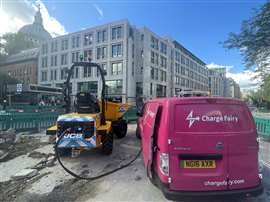 London remains Charge Fairy’s live operating base, but Copenhagen in Denmark is the next target. Image: Charge Fairy
It is less immediately applicable to major infrastructure projects with larger equipment and established (and hard to enter) site compounds. For now, the strongest opportunity is in cities, where air quality, noise and local emissions are increasingly under scrutiny.
That is important because the pressure to electrify is beginning to move from aspiration to procurement. Lea points to Westminster Council’s requirements in London, and Copenhagen’s move towards electric machines below 8 tonnes on city projects. In these cases, mobile charging becomes an enabler rather than an optional extra.
Commercially, Lea acknowledges that the service is currently slightly more expensive than diesel when the cost of people and logistics is included. But he argues that the wider benefits – reduced noise, fewer vibrations, better air quality and lower local pollution – are increasingly valuable to clients and cities.
Charging as a service layer
The next stage is scale. London remains Charge Fairy’s live operating base, but Copenhagen in Denmark is the next target. Lea expects expansion to come through local partners using its technology, potentially rental companies or dealers, rather than Charge Fairy employing people in every city.
That could make the model faster to replicate. Dealers, in particular, may need new revenue streams as electric machines reduce conventional service requirements. Mobile charging could become a practical service layer around electric fleets.
For construction, the significance is simple. Electric machines may be ready, but adoption depends on making them easy to use. Charge Fairy’s proposition is that operators should not have to think about charging at all. They should finish the job, leave the machine in place and return to find it ready to go again.
In that sense, the future electric site may not feel radically different from today’s diesel site. Energy will still arrive by vehicle. Deliveries will still be coordinated. The difference is that the fuel will be cleaner, quieter and driven by data.
POWER SOURCING GUIDE

The trusted reference and buyer’s guide for 83 years
The original “desktop search engine,” guiding nearly 10,000 users in more than 90 countries it is the primary reference for specifications and details on all the components that go into engine systems.
Visit Now
STAY CONNECTED



Receive the information you need when you need it through our world-leading magazines, newsletters and daily briefings.


CONNECT WITH THE TEAM