Read this article in 中文 Français Deutsch Italiano Português Español
Origin provides engines for a purpose

22 April 2026
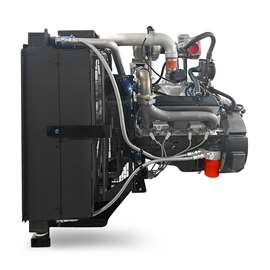 Origin Engines’ latest release for power generation applications is a 6.2 L OHV model in a 150-kWe standby version. (Photo: Origin Engines)
It’s fairly common for manufacturers to claim their products are “designed with purpose” but it’s less common to say they are “designed for purpose.” Such is the case with Kearney, Nebraska-based Origin Engines, which supplies gaseous-fueled engines that it says “are designed, engineered and manufactured to meet your specifications and your unique application.”
Origin Engines has an over four decade-long history of designing and producing industrial engines. “We launched this division of our company about 15 years ago. The overall parent company is 43 years old,” said Pete Stout, business development manager.
“What we offer is 100% engineering, design control of our platform engines. We’re only focused on spark-ignited engines – natural gas, gasoline, propane,” he continued. “And we really focus on what we call secondary use OEM markets. We work with OEMs across power generation, mobile industrial, oil and gas, marine as well as other market segments.”
Customized solutions
While the company specializes in higher horsepower configurations, Origin’s engines range in displacement from 3.6 L to 23.9 L and come in a broad power band. In the power gen space, coverage extends from 20 to 200 kWe.
“In this horsepower range, OEMs have largely used adapted automotive engines, and as automotive engine technology has changed, that really hasn’t come as a benefit to these secondary use markets,” Stout pointed out. “That’s where our organization came in – by being able to design engines that were really focused on what we could do for stationary power generation… and really optimize that.”
At PowerGen 2026 earlier this year, Origin Engines displayed three of its platforms: a 6.2 L V8, 10.3 L V8 and 3.6 L four-cylinder configuration, each of which are turbocharged, air cooled and have what Stout described as “industry leading power density in each size.” The latest release is the 6.2 L overhead valve model in a 150-kWe standby version.
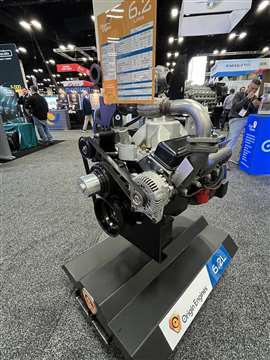 The 150-kWe 6.2 L that debuted at PowerGen 2026 is based on a platform engine with increased power density. (Photo: Becky Schultz)
“Outside of our platform engines in the power generation market, you’d be looking at a gasified diesel-based platform which comes with significant size and cost difference than what we’re able to do in a smaller engine,” Stout noted. “That 6.2 L at 150 kWe – previously larger displacement and big blocks have occupied that market.
“We engineer increased power density. The benefit to the OEMs is a smaller packaging size and a typically lower cost per kilowatt.”
Origin’s engineering team is positioned on site at the manufacturing facility. By maintaining full engineering and design control, the company can work with OEMs to develop engine solutions that fit the specific duty requirements of their applications. Since the engines aren’t adapted from other industry segments, Stout said OEMs aren’t required to repower on a recurring basis due to ongoing engine design modifications.
“When we collaborate with OEMs to integrate [an engine] into their package, we can fundamentally produce it indefinitely because we’re not tied to other needs,” he stated.
Engines are produced under the Origin brand, plus the company private labels for a number of generator suppliers.
“While brand recognition is still building, our products are already deployed across a number of highly reputable OEM platforms in a variety of industrial markets,’” Stout said.
Designed for density
Achieving higher power density in a compact package is all in the details, according to Stout.
“When we design the blocks, we look at the critical surfaces; we look at how the block is designed; the metallurgical content of the block; the critical load fastening; and we just really focus it [to that intended] application,” he explained. “We’re not trying to be everything for everybody. For standby power generation, for example, it has to produce power when demands come, but it also doesn’t have a life expectancy of 5,000 operation hours.
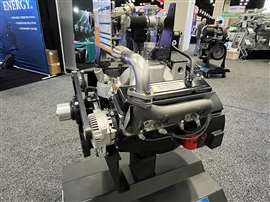 The company develops purpose-built gaseous engines in displacements from 3.6 L to 23.9 L. (Photo: Becky Schultz)
“So, we sit down with OEMs and ask what is the goal, what does the product need to be able to do and then we collectively work on that. But it’s material selection, it’s tolerances, it’s working with turbocharger sizing and then heat mitigation – we’re removing as much heat as we can from the engine through the cooling systems.” This includes using piston oiling in all engine models to remove heat from the pistons.
In the case of the latest 150-kWe version of the 6.2 L engine platform, increased power density is based on roughly a decade of experience in the standby power generation space.
“It’s taking a platform engine that we have high production volumes on, and we just continued to look at increasing power density and what it would take to do that,” said Stout. The changes required to achieve that power node were backed up with thorough validation testing, he added.
When smaller is better
Such adaptability sets Origin Engines apart from other suppliers, Stout noted.
“When you take a look at the engine OEM space, there are very, very large organizations that have been doing it forever. We are kind of the new kids on the block,” he commented. “The differentiating factor is we can have better attention to detail. We can typically maneuver a lot faster. And the service and after-sales support that we offer is typically a lot better. There’s a lot better accessibility to our organization.
“Our organization size isn’t a limitation,” he continued. “It’s our competitive advantage that directly benefits our OEM partners.”
POWER SOURCING GUIDE

The trusted reference and buyer’s guide for 83 years
The original “desktop search engine,” guiding nearly 10,000 users in more than 90 countries it is the primary reference for specifications and details on all the components that go into engine systems.
Visit Now
STAY CONNECTED



Receive the information you need when you need it through our world-leading magazines, newsletters and daily briefings.

CONNECT WITH THE TEAM