Read this article in 中文 Français Deutsch Italiano Português Español
The hard truth about electric construction machines
09 March 2026
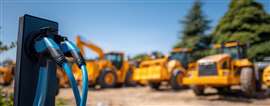 Image generated using AI (Image: Hanna via AdobeStock)
The technology is ready, but the market is not. abcg consultant Robert Droogleever examines the barriers preventing electric construction machines from reaching scale – and what it will take to move from promise to progress.
The construction industry has never lacked ambition, but when it comes to electrification, ambition is still outpacing reality. Battery-electric machines have now been on the market for over a decade, yet adoption remains marginal.
The technology works, the prototypes are proven and the environmental case well-rehearsed – and yet the tipping point still refuses to arrive. The question is no longer if construction will go electric, but why it hasn’t.
Current situation:
| % Battery Electric Machines 2025 | Europe | USA | China |
| Excavators | <1% | <1% | 1% |
| Wheeled Loaders | 5% | <1% | 42% |
Source: Off-Highway Research
The fact is that we are not waiting for breakthrough technology. In the last 10 years larger electric components and batteries suited for construction machinery have become available. The next step is higher density batteries that reduce machine weight or increase runtime.
Battery‑ powered machines today can already operate for a full shift (or at least until the lunch break, depending on the application). Therefore, the obstacles preventing this industry from transitioning to electrification are found in other areas.
Purchase cost remains a major obstacle
 Image generated using AI (Image: Huzaifa via AdobeStock)
The purchase price of battery powered construction machines is still significantly more expensive than their diesel counterparts. Few companies today are willing to pay double the purchase price versus the diesel alternative.
In the total cost of ownership (TCO) calculation, this purchase cost will be offset by lower repair and maintenance costs and lower energy cost. The energy cost can be very different depending on the region, but energy efficiency favors battery machines.
In most regions and for most construction contractors, this total cost of ownership is still too high for battery machines.
The arrival of lower-cost Chinese electric equipment may help narrow the gap between EV and diesel, but large-scale adoption requires a clear economic advantage. Of course, a higher purchase price can be partially offset by strong residual values. This, however, introduces a new set of uncertainties that warrant closer examination.
Uncertain residuals
Battery life, degradation and rapid technological evolution create uncertainty about future resale values.
Indeed, the more mature electric passenger car market has very low resale values, re-enforcing this concern.
Customers hesitate to invest in equipment when they cannot predict its long-term worth or resale value. At abcg, we believe that creating reassurance about resale values would go a long way to making battery machines more advantageous. OEMs could help by offering rental options or strong buy‑back programs, but they also face the challenge of absorbing older, potentially obsolete machines.
Some OEMs are looking to expand sales of battery equipment primarily through rental companies – thereby shifting the liability to their balance sheets.
| Cost of ownership | Diesel version | Electric version |
|
Purchase Price Resale value and depreciation |
Baseline Established process |
More than double High capex and uncertainty on battery life drive cost |
|
Energy cost
|
Diesel cost has remained stable
|
Electricity cost varies a lot between continents: Lowest in North America, followed by China and highest in Europe
|
| Energy Efficiency | 20-40% | 80-90% |
| Maintenance and repair cost | Baseline (M&R costs are driven by engine, driveline and hydraulic cost) | 25-50% less (based on experiences in on-highway trucking) |
| Operator | Same | Same |
| Tyres | Baseline | Architecture with individual wheel motors allows for reduced slippage and scrubbing extending tire life. |
Charging infrastructure
Electric machines need reliable and easy access to charging points, which is often not the case on remote or temporary jobsites. Renting or purchasing containerized power solutions remains costly. Overnight charging is feasible and does not require excessive peak power, but it still restricts continuous operation, except for applications at semi-permanent sites, such as quarries and mines. In contrast, diesel engines benefit from a mature, convenient and globally established refueling infrastructure.
Lack of regulatory pressure
Unlike the automotive sector, where regulations have helped accelerate electrification, the construction industry has not yet seen decisive action to make diesel unattractive. Governments appear cautious about imposing stricter rules, slowing the pace of change. Even for the automotive sector, the EU and UK have softened their electric adoption targets and even reduced EV subsidies.
The world we live in
These are some of the reasons that OEMs haven’t aggressively promoted their electric machines. R&D investments in the development of zero emission machines is high, and a lack of demand could make the return on this investment negative.
Volvo was the one exception making a splash with its battery electric line-up at Bauma in 2025. Others, like Caterpillar and Komatsu, have been more cautious with fully battery electric machine launches, offering only a few models.
The city of Oslo did one of the best documented experiments of a fully electrified construction site. The results were positive, from emissions and noise pollution reduction point of view. Power costs were also lower. That said, upfront cost, charging logistics and cold weather performance counted against it.
And the tipping point is when?
Who knows. At abcg, we believe the decisive factor will be the total cost of ownership. When electric machines become cheaper to own and operate than diesel machines, a more decisive shift will begin.
China is probably closest to a tipping point. Low energy cost and an extensive battery-electric ecosystem is driving this. The Chinese government also subsidises battery-driven construction equipment. In 2025 around 20% of the mid-sized wheeled loaders sold were battery electric vehicles (BEV), according to Off-Highway Research data.
 Image generated using AI (Image: Gojek via AdobeStock - stock.adobe.com)
Interestingly, the sales of battery powered excavators in China is still low, due to charging complications and higher power demands. That said, it is clear that Chinese OEMs have the most experience of operating large fleets of electric machines.
Europe and USA are still further away from switching to batteries on construction equipment. The cost benefit is not as clear. In the US, government policies are not driving the change, while in Europe the energy pricing is not favourable.
According to the International Energy Agency (IEA), the average EU price of electricity in 2026 is expected to be roughly twice that of the United States – and about 50% higher than in China.
The construction industry is by nature conservative and slow to change. Many contractors have tested electric machines but have not adopted them at scale. And who can blame them? The benefits at present are not compelling, except in cases where zero emission‑emission operation is mandated by local authorities or environmental regulations.
Sectors such as mining and waste handling may transition more quickly. These users see more advantages because the higher usage, or hours they run the machine. Lower cost of energy and maintenance for battery driven machines offsets the higher purchase price of the machine.
So, more hours worked per year reduces the cost of ownership for battery machines. This is why it is expected that the EV adoption will start with larger machines, contrary to what one might think given the rush to launch electric compact machines by many OEMs.
Conclusion
Electrified vehicles will see widespread adoption only when total cost of ownership (TCO) becomes favorable. This tipping point will come first with larger equipment which run more hours. The focus of the OEMs today is too much on the smaller equipment, but the Chinese market demonstrated the success on the mid-size wheeled loaders.
OEMs can start estimating when this will occur by product type. While energy prices cannot be influenced, battery pack costs are more predictable. Battery pack costs dropped 39% from 2019 to 2024 (according to the Volta Foundation). Switching machine design from electrified-diesel to fully electric further reduces TCO. With these elements engineering teams will be able to estimate when specific electric machines in specific regions will outpace diesel in customer TCO.
Electrification goes beyond impacting machine architecture, system design and machine capabilities. It transforms supply chains, demands new services and redefines business models for OEMs and dealers.
The impact will be significant – and those who plan early will be best positioned to lead.
Robert Droogleever is a consultant at off-highway consultancy abcg.
POWER SOURCING GUIDE

The trusted reference and buyer’s guide for 83 years
The original “desktop search engine,” guiding nearly 10,000 users in more than 90 countries it is the primary reference for specifications and details on all the components that go into engine systems.
Visit Now
STAY CONNECTED



Receive the information you need when you need it through our world-leading magazines, newsletters and daily briefings.

CONNECT WITH THE TEAM