Read this article in 中文 Français Deutsch Italiano Português Español
Trendlines: Construction equipment shifts from wheels to tracks

03 February 2026
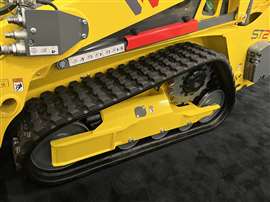 Photo: KHL Staff
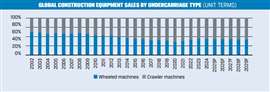
At the start of the 2000s, the global construction equipment market was split roughly 60:40 wheeled to crawler machines. By the end of this decade, those proportions will be flipped, with tracked machines accounting for 60% of global sales.
The biggest changes over the last 25 years have been in North America and China. In North America, there has been the dual trend of replacing skid-steer loaders with compact track loaders, along with compact excavators taking over from backhoe loaders. Meanwhile, in China there has been a pronounced shift from wheeled loaders being the dominant machine type to mini and crawler excavators taking over as the highest volume machines.
Similar, if perhaps less pronounced trends have been seen elsewhere. For example, as in North America, Western Europe has gently jettisoned the backhoe loader in favor of specialized excavators and wheel loaders. There is some movement in this direction in India, too; but while crawler excavators are gaining some share, backhoe loaders still sell in staggering numbers.
 Source: Off-Highway Research
Reasons behind the switch
There are various reasons for these changes, yet they are all rooted in a combination of picking the most productive and profitable tool for the job, and to some extent picking a new machine that can do something the old one can’t.
In the case of compact track loaders, despite the higher purchase and maintenance costs compared to skid steers, the tracked undercarriage means better traction, the ability to work in softer conditions and reduced risk of damaging the ground.
With backhoe loaders, users have generally found that for any given task it is more productive to use a dedicated loader or excavator than the oversized and less maneuverable Swiss Army Knife machine (to quote the old cliche about backhoe loaders).
 Chris Sleight is the managing director of Off-Highway Research, a market research and forecasting business specializing in analysis of the global construction and agricultural equipment markets. Formed in 1981 as part of The Economist Intelligence Unit (EIU), it is now the largest consultancy of its kind in the world, with offices in Chile, China, Germany, Japan, India, the U.K. and the U.S. OHR is part of the KHL Group. www.offhighwayresearch.com
In China, the switch from wheeled loaders happened for slightly different reasons. Historically, the main machine type available in China from the country’s state-owned OEMs was the wheeled loader. Excavators were available, but the relative complexity of these machines and the lack of good components in China meant they under-performed and were unreliable. The result was that wheel loaders were used for everything, including many applications which just weren’t right.
That started to change in the 1990s, as the country opened up to international trade and overseas OEMs set up subsidiaries and joint ventures to build crawler excavators in China. However, the real shift started in the late 2000s, when China’s domestic OEMs started to make credible excavators.
Where tracks win
Wheeled machines will always have their place in the world, particularly when a lot of machine movement or a high travel speed is needed. But in an industry like construction, which often takes place off road, it’s hard to beat a crawler machine in many applications.
POWER SOURCING GUIDE

The trusted reference and buyer’s guide for 83 years
The original “desktop search engine,” guiding nearly 10,000 users in more than 90 countries it is the primary reference for specifications and details on all the components that go into engine systems.
Visit Now
STAY CONNECTED



Receive the information you need when you need it through our world-leading magazines, newsletters and daily briefings.

CONNECT WITH THE TEAM