Read this article in 中文 Français Deutsch Italiano Português Español
Trendlines: Global construction equipment market review 2026

22 December 2025
Global construction equipment sales should start to come back next year, but there is uncertainty around the forecast.
Editor’s Note: The following article appeared in the November/December 2025 issue of Power Progress.
The most recent peak in global construction equipment sales was in 2021, when the market hit a record high of 1.36 million units sold, according to specialist market researcher and forecaster Off-Highway Research. This was a result of low interest rates and government stimulus around the world in reaction to the Covid pandemic.
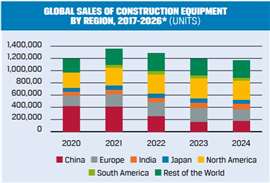 Source: Off-Highway Research
That growth continued unabated throughout 2022 in all major markets except China, where sales started to plummet due to the end of the stimulus spending program and the emergence of enormous bad debts in the real estate market. Overall global construction equipment sales fell 5% in 2022, but the drop was entirely due to China. Global sales, excluding China, were up 7% in 2022.
Markets outside China started to cool in 2023 and have been adjusting down ever since back to more sustainable levels. The most specific brake has been rising interest rates around the world – a necessary tactic to curb runaway inflation – which has slowed residential building. Despite that, inflation has had a direct impact on the market, with project costs rising, while the cost of the equipment itself has risen sharply.
After a steep global fall in 2023, last year saw the decline in global equipment sales decelerate, with only a 2% drop. In a reversal of the previous year, the developed markets of Europe, Japan and North America all fell (Europe landing particularly hard), while emerging equipment markets all generally improved.
Most markets will be flat to down-ish this year, but the overall effect is forecast to only be a further 2% decline in global sales.
China
On the positive side, China will see some more growth in 2025, but that is not to say the market is healthy. Far from it. The real estate segment is still very distressed and local governments are deep in debt. What’s more, there is no obvious way for the provinces to repair their finances and start funding projects again, because the previous strategy was always to sell land to real estate developers.
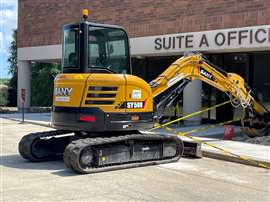 Globally, construction has become increasingly mechanized. (Photo: KHL Staff)
The 12% sales growth expected in China this year will come mostly from sales of electric equipment, as did the majority of the growth last year.
China is the only market in the world where electric construction equipment has genuinely taken hold, particularly in wheeled loaders where sales of electric machines are poised to overtake diesels in the next year or two. Scrappage schemes to take older, more polluting diesel machines out of the active fleet and subsidies around electrification have been helpful, as has the ferocious competition between China’s leading OEMs, which has driven down prices.
The Chinese market should continue to grow for the rest of the decade, but without a major change in the driving factors, it will be a long road back to a healthy market. At the moment, back to “normal” looks at least five years away.
Europe
High interest rates and high construction costs have depressed homebuilding across the region for the last two to three years, and the relative buoyancy in the infrastructure segment was not enough to offset the sharp correction this caused in the construction equipment market in 2024.
The situation in Europe was made worse towards the end of the year by unprecedented political instability in the region, with the collapse of governments in Austria, France and Germany in the space of three months. Unsurprisingly, the uncertainty these events caused led to these three countries seeing the steepest percentage declines in the region for their construction equipment markets. The continuing political turmoil in France means it will be the worst performing market in Europe this year, too.
“Less worse” last year were markets in Southern and Eastern Europe, which suffered more limited declines. However, the downturn was widespread, with only Ireland seeing an increase in equipment sales last year.
 Despite improvements in key countries, equipment sales in Europe are expected to slide a further 2% in 2025. (Photo: KHL Staff)
Despite improvements in a number of key countries this year, including Germany and the UK, equipment sales in Europe are expected to slide a further 2% in 2025. France will be the biggest negative factor, but demand in Benelux and the Nordic regions is also weak. The recent collapse of the Dutch government may worsen that outlook.
On the positive side, Southern Europe remains generally strong and on a growth trajectory.
North America
The 5% decline in North American equipment sales last year was more limited than it might have been. Homebuilding remained strong, and even rose slightly, despite high interest rates, and this was particularly helpful in sustaining compact equipment sales. Meanwhile, the infrastructure segment remained strong, and the nonresidential building segment has been helped by several large microchip factory and data center projects.
The cyclical decline is expected to continue this year and will be made much worse by the Trump Administration’s inflationary and anti-trade tariffs policy. If enacted, August’s Section 232 tariffs on steel-derived products will be crippling. The high steel content of construction equipment means that imported machines (about 20% of the market) will be almost the full 50% more expensive.
Meanwhile, machines from U.S.-based manufacturers largely using components sourced in the U.S. could see cost increases of about 20% due to the components they import from abroad and the foreign content in the parts they source within their borders.
The lack of clarity on tariffs and the ongoing shifts in policy and emphasis breeds uncertainty in the market and an erosion of confidence. This will lead to investments being delayed, and Off-Highway Research believes the North American market will fall 11% this year as a result. This would be the biggest decline for any major market in 2025.
Next year could be better. The fundamental drivers, such as the need for housing and the data center boom (accompanied by enormous power requirements) should all be good for the industry. Continued inflation from tariffs (which might force interest rate increases), a presence in the region of a large fleet of young machines from the boom of the early 2020s, ongoing uncertainty and chaotic policymaking could derail this.
India
Construction equipment sales grew 10% to a new record high last year. The general election did not prove as disruptive to the industry as it usually is and new emissions regulations for road-mobile construction equipment that came into force at the start of 2025 meant there was a significant sales surge in the final months of the year. This so called “pre-buying” is common when legislative changes will add to the cost of equipment.
That seems to have effectively moved sales form 2025 into 2024, and a 9% decline is expected this year as a result. In addition, there are concerns that the pace of roadbuilding activity could slow due to a reduction in the number of tenders being put out by the government.
But these are small disruptions in the bigger picture of the Indian equipment market, which continues to exhibit strong long-term growth, and which is now comfortably the third largest territory in the world in volume terms after the U.S. and China.
 In 2024, the decline in global equipment sales decelerated, falling just 2%. (Photo: KHL Staff)
Japan
After an unusually sharp increase (for Japan) of 7% in 2023, the market suffered an equally steep fall in 2024, with a decline in sales of 9%. At just under 63,000 units last year, the market is a little below what would be considered its natural level of around 65,000 machines per year.
Although volumes were low in 2024, the expectation is that the market will remain at this somewhat depressed level for the next one to three years. This is partly because the high sales volumes of the pandemic years means there is a relatively large fleet of young machines available in the Japanese fleet, and partly because there is a sense of uncertainty among equipment buyers due to the unpredictable policymaking of President Trump, and what this might mean for the global economy.
South America
The inflationary environment of 2023 saw the South American construction equipment market turn down steeply after the unprecedented peak of 2022. There was a modest 1% rebound in volume terms last year, which was driven by mining, oil and gas extraction.
The market is expected to now enter a shallow cyclical decline for most of the rest of the decade, with fleets having been refreshed by the sharp spike in sales in the early 2020s.
However, equipment associated with mining should still perform well thanks to a reasonably buoyant outlook for various commodities. Ther nature of mining is that it tends to focus on lower volume/higher cost types of equipment, so while the forecast is for a decline in volume terms, the overall value and general health of the South American equipment segment should remain reasonable.
Rest of the World
Like South America, the other equipment markets around the world are predominantly emerging economies with some sort of extraction industry at the heart of their wealth creation. High commodity prices meant this disparate group of countries achieved a 5% increase in sales last year. This followed on from the dip that was seen in 2023 when high interest rates and high inflation derailed growth.
 Chris Sleight is the managing director of Off-Highway Research, a market research and forecasting business specializing in analysis of the global construction and agricultural equipment markets. Formed in 1981 as part of The Economist Intelligence Unit (EIU), it is now the largest consultancy of its kind in the world, with offices in Chile, China, Germany, Japan, India, the U.K. and the U.S. OHR is part of the KHL Group.
The global outlook for commodity prices for the next few years is that they will remain at reasonably high levels, and Off-Highway Research believes these will be strong enough to drive modest growth in equipment sales.
Summary
Off-Highway Research’s forecast is for steady growth in construction equipment sales both globally and in the individual regions from 2026 onwards. This should lead the markets to a cyclical peak in the early 2030s, which in volume terms should eclipse the stimulus-driven high of 2021.
This is a point worth remembering at times like these. Construction equipment sales always grow over time. The world’s population is growing, which demands infrastructure and housing, and the construction industry that has to deliver this is becoming increasingly mechanized. Evening out the ups and downs of the cycle, this equates to a compound annual growth rate (CAGR) of around 2%.
POWER SOURCING GUIDE

The trusted reference and buyer’s guide for 83 years
The original “desktop search engine,” guiding nearly 10,000 users in more than 90 countries it is the primary reference for specifications and details on all the components that go into engine systems.
Visit Now


CONNECT WITH THE TEAM