Read this article in 中文 Français Deutsch Italiano Português Español
Dig Robotics seeks to take human variability out of excavation
28 July 2026
Smart excavation tool aims to make operator performance sharper, faster and more consistent
Throughout his extensive career in the construction equipment industry – including a 33-year stint with Caterpillar where he eventually came to head up the global excavator business – Kenneth Gray has witnessed firsthand the role human variability can play in equipment performance. In one instance, he recorded a 20% difference in excavator productivity between a customer’s two best operators using the same machine on the same jobsite and under the same operating conditions.
This has implications when it comes to gauging potential machine ROI. “Most excavator OEMs that introduce a new or updated machine, how much performance improvement are they claiming – 5%, 7% normally?” Gray noted. “It’s very difficult for customers to perceive that difference because there’s so much human variability in performance.”
Gray now serves as chief performance officer of Dig Robotics, a company seeking to level the operator playing field and thus maximize machine productivity.
 Kenneth Gray, chief performance officer and co-founder, Dig Robotics. (Photo: Becky Schultz)
“Ideally, our mission is to make every operator as good as the best operator,” he said, “and help the best operators find insights that will improve their performance.”
Real-time operating intelligence
Dig Robotics was founded in October 2023, when Gray and his co-founders Noam Rotem, chief excavation officer, and Oded Media, chief scientist, set their sights on developing a smart excavation tool that provides operators and site managers with real-time intelligence on operator performance. The aim is to “super-power” excavators by enabling operators to do their jobs sharper, faster and more consistently.
The tool they developed uses artificial intelligence (AI), 3D scanning and advanced kinematics or motion planning to map the entire jobsite in 3D, see the bucket geometry and precise movements, and calculate exactly how much earth is being moved per cycle.
“We do motion planning for how a bucket moves precisely through the cut of material that [the operator is] trying to load out,” Gray explained. “Then we bring in computer vision – we’re using LiDAR to compare that ideal to what’s actually happening.”
The LiDAR sensor captures live data as the machine works, while algorithms calculate the ideal digging path at any moment, based on the site topography, machine geometry, bucket size and material characteristics. The system then compares the operator’s actual movements to the optimal path.
“We’re keeping data points on the depth of the cut, the angle of rotation of the bucket and the timing of the extraction of the bucket and we’re measuring the volume extracted and the time required to do that with every bucket load,” said Gray.
Operators are then provided with immediate visual feedback in the cab displayed using simple color-coded indicators. This allows both novice and experienced operators to see exactly where adjustments are needed.
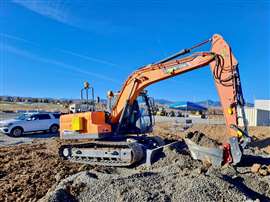 A Doosan DX140LC fitted with Dig Robotics’ system (Image courtesy of Dig Robotics)
“If you’re a good operator, you’re probably a good operator because you worked at it. It’s not an accident, right? But if I were able to give an operator insight that you’re in the cut too long, what are they going to do? They’re going to try getting out of the cut sooner and they’re going to investigate what happens,” Gray commented. “That’s what we want to do. We don’t want to take control. We want to provide insight that says… maybe you want to try a shallower cut or maybe you’re rotating the bucket too soon or too late.
“We’re seeing some really significant performance improvements just by telling operators what their trends are,” Gray stated. “And we’re seeing an equal reduction in fuel in many cases.”
In one early example, the system was installed on a 20-year-old Liebherr R 984 C run by a veteran operator who had used the machine since it was new. After installation, the operator saw performance improve 10% and fuel consumption decrease roughly 20.
Aiming for fully loaded trucks
Both the operator and site managers are provided with data-driven insights on truck fill level, the number of trucks filled, cycles required to fill each truck and more.
“What we found with the operator interface is a couple of things. Number one, [operators] respond a lot better to learning about their habits,” said Gray, “and they’ll respond to their habits if there’s a recommendation. Then they want to know that the truck is full, too. Because usually what happens [when] we five-pass load a truck – was it full when we five-pass loaded or not? How do you know? Well, we’re measuring that load exactly.
“The opportunity to move a full truck only comes once,” he continued. “That’s what we’re trying to do. We’re trying to make sure that downstream not only is that excavator really productive, but we’re getting the most we can out of each out of each truckload.”
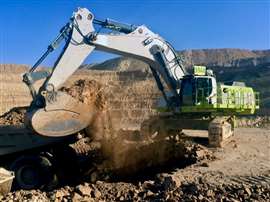 A Liebherr 9150 in action (Image courtesy of Dig Robotics)
To enhance efficiency even further, the system can learn and adapt as it works. According to Dig Robotics, the machine learning component allows it to automatically assess material conditions, such as cohesiveness, granularity, the presence of boulders, etc., without any manual input. Each bucket informs the next, while machines working on the same site share information to build a collective understanding of the material being excavated.
Technology integration
Dig Robotics’ operator guidance tool is currently designed as an “OEM-agnostic” aftermarket solution that can be retrofitted to most any excavator, regardless of brand or age, often within a single working day.
“We want to support customers’ strategic needs for mixed fleets, because there aren’t that many 100% Liebherr fleets or 100% Cat fleets, even if you look at a certain machine category,” Gray said. “We want to be able to be included on everybody’s unit. That’s the first design principle.”
Equipment dealers have helped the startup to evaluate the system’s technical performance, commercial viability, installation process and long-term support requirements.
Now, the focus for the initial pilots is on production bucket machines in sectors where incremental productivity gains can deliver substantial financial returns, such as large civil infrastructure projects, quarries and mines. For example, in August 2026, Turner Mining Group will be evaluating the technology in a live production environment using both a Hitachi EX1200 and a Caterpillar 374 Next Gen excavator.
The next step, said Gray, will be integration with technology such as grade control. “The technology stack is similar. They don’t have [computer] vision, which we do… We think they’re complementary technologies and so do the Tier 1 companies. They view it the same way,” he asserted.
Dig Robotics is already making progress in this area with the recent announcement that it will be building its earthmoving performance applications into the Trimble ecosystem, and is a finalist in its 2026 0-60 Challenge. At the Trimble Dimensions User Conference this fall, the company will demonstrate the Dig Dashboard site manager tool in the indoor expo, as well as run the operator guidance tool live on an excavator in the off-site demo area. Gray will also host a classroom session for anyone who wants to dig deeper into the technology.
What lies beyond
In future, Gray envisions moving into high-production applications beyond excavators and eventually working directly with OEMs.
“The motion planning that we’re capable of doing, the level of expertise our team has, the depth of understanding, our demonstrated ability in the past to fully automate machines… we have some expertise that is rare,” Gray commented. “I think OEMs will be interested, but trust isn’t given... You have to earn it.”
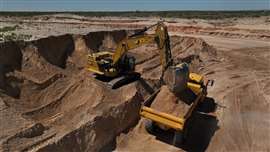 Turner Mining Group will be evaluating the Dig Robotics technology on a Hitachi EX1200 and a Caterpillar 374 Next Gen excavator (shown). (Photo: AMI Attachments)
This is where customer feedback is crucial. “We are at the pilot stage. We are testing the production intent design, which means that it’s the production component, the production assembly and production source,” Gray said. “We’re at the point now where we want to test what we’re going to sell...
“We’re looking for the right kind of ‘lunatic’ that wants to benefit from the technology,” he added, “and recognizes that there’s some development between now and when it’s commercially available, which will probably be early next year.”
What Dig Robotics plans to sell isn’t autonomy, though it comes close. “We can get 80% of the benefit for 20% of the cost of full automation, and maybe less than 20%,” Gray stated.
This is achieved all while keeping the operator a vital part of the equation. “If the problem that you’re trying to solve is that there is a person in the seat, then full automation is what you need. If that’s not the problem you’re trying to solve – if it’s productivity or cost or efficiency – you might not benefit from eliminating the person in the seat because the processing power in that computer you’ve got between your ears is pretty incredible.”
That power is especially valuable in the loading area, which Gray likens to “chaos theory.”
“There’s always something going on that you don’t expect,” he noted. For example, the operator may need to adjust to the movement of the material being dumped or remove a rock that’s fallen in the path before the next truck backs in.
“If we could load the truck perfectly, we would, but the random nature of material doesn’t let us do that,” Gray pointed out. “But your mind can respond to those changes – what we would call edge cases – instantly… It’s the human’s ability to process those unexpected changes that are really hard to replace.”
Consequently, he believes there is substantial money to be made by customers, dealers and Dig Robotics between what the company seeks to offer and full autonomy.
“There are a lot of steps,” he concluded, “and we’re just taking some of the first ones.”
POWER SOURCING GUIDE

The trusted reference and buyer’s guide for 83 years
The original “desktop search engine,” guiding nearly 10,000 users in more than 90 countries it is the primary reference for specifications and details on all the components that go into engine systems.
Visit Now
STAY CONNECTED



Receive the information you need when you need it through our world-leading magazines, newsletters and daily briefings.

CONNECT WITH THE TEAM