Read this article in 中文 Français Deutsch Italiano Português Español
Honda NCM facility makes changes for electric ZTRs

22 June 2026
The roughly 660,000-sq.-ft. Honda North Carolina Manufacturing (NCM) facility, as well as the adjacent Power Products R&D Center, is situated on a 107-acre site that also includes 12 acres of test grounds (featuring six grass varieties), an autonomous demo park, endurance track, undulation track and a slope testing area. The facility has produced more than 50 million products since production first commenced in 1984.
 Honda’s North Carolina Manufacturing (NCM) facility in Swepsonville, N.C. (Photo: Becky Schultz)
“At one point, back in pre-COVID years, we were making more than 2.5 million units a year in the plant, between engines that we would sell to other OEMs, snow blowers, push mowers, tillers, generators, etc.,” said Mark Salsbury, production manager, Honda NCM. “Then, with the market and the business decisions and changes, a lot of that changed over to ATVs. We kept the snow blowers and now also the ZTR line currently.”
Today, NCM is the exclusive production source for all Honda all-terrain vehicle (ATV) models in North America. It also continues to produce commercial and residential outdoor power equipment such as snow blowers.
“During the last three years, there has been a major change in the facility in what we’re building here,” said Salsbury. “The ZTR is our newest… and we’re very proud of what we’ve been able to do with that.”
Module-style approach
Production of the new ProZision models began at NCM in January 2026. The mowers are assembled using domestic and globally made parts, and in future will include parts made in the new plastics department – part of a $9.7 million investment in the plant announced last fall.
Currently, the facility’s three main production lines have capacity to produce roughly 74,000 ATVs, 25,000 snow blowers and 1,200 ZTRs per year, with the ability to grow as demand dictates. Even so, Salsbury acknowledged such numbers seem a far cry from NCM’s pre-COVID peak.
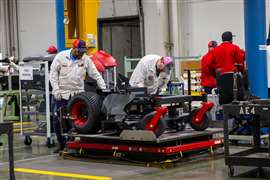 The ZTRs are assembled using a module-style approach, rather than a traditional assembly line. (Photo: Honda)
“[In unit volume], it looks like we’re building hardly anything today as compared to where we were, but they’re just much more complex products,” he explained. “When you take a ZTR compared to a push mower, it’s a completely different animal in what it takes to build one.”
ZTRs are assembled using a module-style approach, rather than a traditional assembly line; subassembly tables are used for major components such as electronics, handles, frames and mower decks. In all, Salsbury said it takes about an hour and 45 minutes to assemble a traditional ProZision model, and slightly longer for the autonomous version due to the additional electronics.
Put to the test
Once assembly is completed, each model is dyno tested, with additional lidar and radar testing for the autonomous model, before the machine heads out to the test grounds for further evaluation.
Additional testing of major systems and components – both during product development and post-production – is conducted within the Power Products R&D Center, which provides EL bench testing, a sound chamber, weatherability testing, full prototype capability, environmental test chambers, NVH testing, blade impact and thrown object testing and more for the mowers as well as a wide range of other Honda products.
POWER SOURCING GUIDE

The trusted reference and buyer’s guide for 83 years
The original “desktop search engine,” guiding nearly 10,000 users in more than 90 countries it is the primary reference for specifications and details on all the components that go into engine systems.
Visit Now

CONNECT WITH THE TEAM